China Energy Label

The China Energy Label (CEL) is a mandatory labeling scheme that promotes energy efficiency for designated products sold in China. Since its introduction in 2005, it has become a critical part of China’s commitment to energy conservation and consumer protection.

The CEL must be displayed clearly on both the product and packaging, providing end users with essential information on the product’s energy performance.

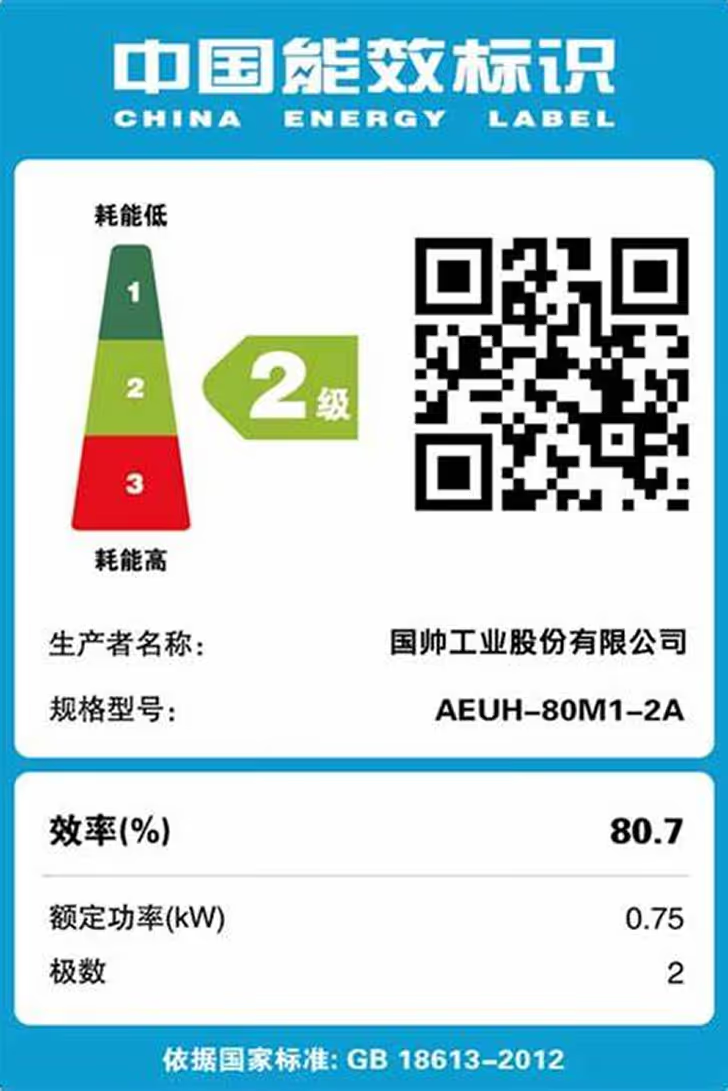
China Energy Label CEL
Product's energy efficiency class

Consumer Behaviour & the China Energy Label

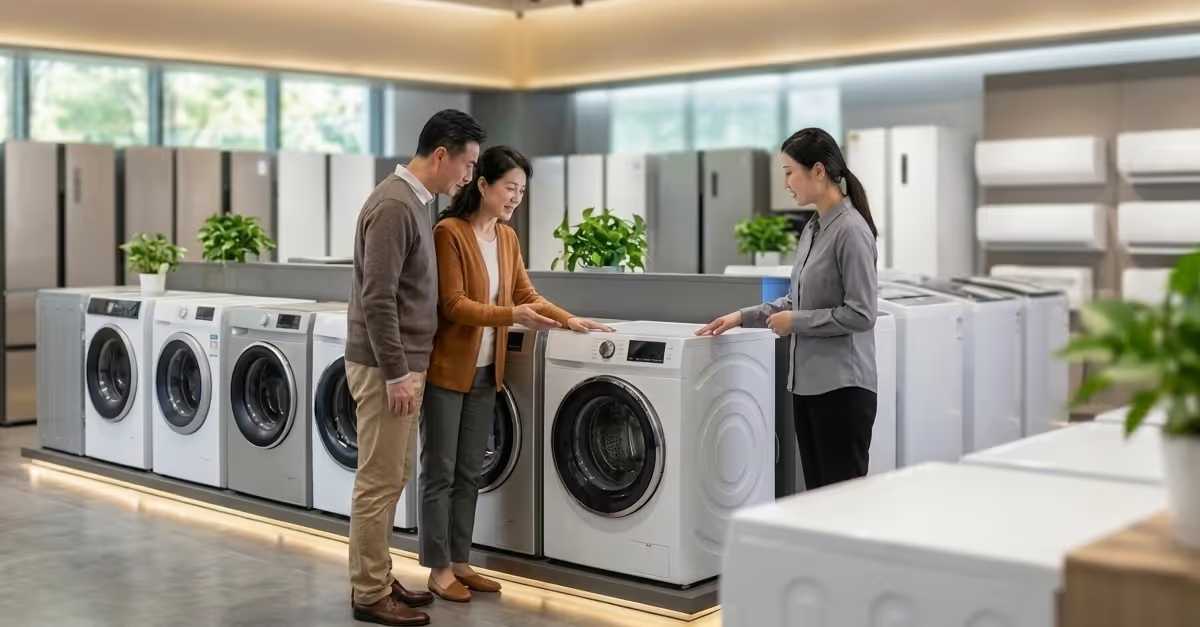
The China Energy Label (CEL) serves as a key resource in the Chinese market, informing China based consumers about the energy efficiency of various products. Its primary purpose is to encourage the purchase of energy-saving products and support the sales of energy-efficient electronic devices. As the largest energy user globally, China has a vested interest in promoting energy efficiency, and the CEL plays a pivotal role in this effort.

The impact of the CEL on consumer behavior is significant. A study revealed that over half of consumers use the CEL when making purchasing decisions, highlighting its importance in fostering eco-friendly buying habits. The label provides crucial information about both the efficiency class and energy consumption of products, making it easier for consumers to make informed decisions.

Recent advancements have further strengthened the effectiveness of the CEL. For instance, the China National Institute of Standardization (CNIS) partnered with Alibaba to mandate the validation of energy labels for products sold on Tmall, thereby reducing the number of unlabeled products available. Additionally, the inclusion of annual energy consumption information on labels has improved consumer understanding of energy usage over time.

Understanding the China Energy Label (CEL)

The CEL system requires manufacturers to test products according to specific national standards and register them in a central database. Labels must be affixed to products before sale or import into China. The label grades the product's energy efficiency and enables consumers to make informed purchasing decisions while encouraging manufacturers to develop energy-efficient technologies.

The system includes regular surveillance, spot checks, and sanctions for non-compliance, making it a vital part of market entry strategies for electrical and electronic products in China.

Key Authorities Involved

The CEL is managed by several Chinese government agencies:

SAMR (State Administration for Market Regulation): Oversees enforcement and overall implementation.
NDRC (National Development and Reform Commission): Leads policy development for energy-saving initiatives.
China National Institute of Standardization (CNIS): Develops technical standards and testing protocols.
China Energy Label Center (CELC): is responsible for CEL classification and all issues concerning CEL certification.

CEL Database (www.energylabel.cn): Official registration platform for label filing and public access to product energy efficiency data.

Product Categories Requiring CEL

Since its establishment in 2005, the China Energy Label (CEL) has become mandatory for a wide range of household and commercial items, ensuring that energy efficiency is a priority across various sectors. The CEL applies to over 40 categories of products, including:

Air conditioners
Refrigerators
Washing machines
TVs
Lighting products (e.g., LEDs)
Electric motors
Gas cookers
Computers
Water heaters
Electric fans
Rice cookers
Photocopiers.

The product scope is defined in the “Catalogue of Products Subject to China Energy Labeling”, and new categories are periodically added or updated. Each listed product must be tested and registered before being imported or sold in China.

CCC marking requirements for electronic products

The CEL Registration Process

The registration process for the China Energy Label (CEL) begins with product testing in an accredited laboratory in China or accepted foreign labs (if mutually recognized). This step is crucial to ensure that the product meets the required energy efficiency standards. Once testing is completed and passed, companies must create energy efficiency labels following strict design guidelines to ensure uniformity.

Companies must submit various forms of documents online, including their business registration, product photos, test report, and technical documentation as part of the registration process. After submission, the Energy Efficiency Label Management Center provides feedback or requests corrections typically within two weeks.

Once the review has been completed and approved, the label becomes mandatory for all units sold in China. The product is also publicly registered in the national CEL database.

Registration must be completed before customs clearance or first sale.

Non-compliance with CEL requirements, such as missing labels, false efficiency grades, or unregistered products, can lead to:

Customs clearance delays or rejections
Market recalls
Fines
Listing in national enforcement bulletins.

Regular post-market spot checks are conducted by SAMR and local regulators to verify label accuracy and validity.

Energy Efficiency Classes & Standards

China’s energy efficiency label categorizes products into five distinct levels of energy efficiency rating with level 1 indicating the highest efficiency and least energy consumption. These levels are designed to help consumers make informed decisions by allowing easy comparison of energy-saving capabilities across different products.

The CEL is linked to specific GB-Standards for each product category, ensuring uniform product energy efficiency class assessment and providing an energy consumption label for clarity. For instance, household refrigerators must comply with the GB 12021.2-2015 energy efficiency standards. Products rated below level 5 are prohibited from being produced or sold in China, emphasizing the importance of meeting these standards to remain compliant in the market.

In addition to the energy efficiency rating, the CEL must contain necessary information:

measured energy consumption values
standardized QR code linking to the product's official record in the CEL database
product model number
name of manufacturer.

The label must be affixed in a clearly visible position on the product, conforming to the specified layout, dimensions, and color schemes defined in implementation rules.

The energy efficiency levels and standards serve as a benchmark for manufacturers, pushing them to innovate and create more energy-efficient products to improve energy efficiency and national development. This not only benefits consumers through reduced energy bills but also supports broader environmental goals by lowering overall energy consumption.

Discover Our CEL Services

Access personal support from our experienced consultants, including application preparation and advice on regulatory changes for your products' China Energy Label

1

Applicability Assessment

Non-binding checks: Initial, free assessments to determine if a product may be subject to CEL.
Binding assessment: In-depth regulatory analysis of whether CEL applies, including technical specification reviews and communication with Chinese authorities.

2

Clearance Certificates

Cisema-issued negative certificates: Bilingual (Chinese-English) confirmation that CEL is not applicable, used to support customs clearance.
Local authority clearance: Application to Chinese local authorities for official clearance certificates, especially useful for one-time sale authorizations or urgent imports.

3

New CEL Label Applications

Full project management for first-time CEL applicants:

Submission of application to Chinese competent authority.
Coordination of type testing at accredited laboratories.
Label issuance and database entry.
CEL label usage compliance.

4

CEL Label Changes

Management of modifications to existing labels, such as:

Design updates.
Component modifications.
Material or supplier changes.
Manufacturing site relocation.
Compliance with updated technical standards.

5

CEL Label Maintenance

Annual factory inspections to keep your CCC certificate valid.
Random product testing oversight, if required by authorities.

6

Certificate Cancellation

Filing of formal cancellation applications for single certificates or entire approvals to prevent potential import sanctions or negative records with authorities.

7

Regulatory Translations

Professional translation of regulations and standards from Chinese.

Request a Proposal to Get the CEL Label for Your Products
Request Proposal

How We’ve Helped Clients with Our Expert Guidance

Read about how we work with clients to find solutions, bringing together deep industry knowledge with leading talent.

View More
April 18, 2026

China Manufacture License Renewal for Level A2 Pressure Vessels

Cisema supported Inox Torres Group in successfully renewing its China SELO license for Level A2 pressure vessels through expert audit preparation and regulatory guidance.

Learn More
China Manufacture License Renewal for Level A2 Pressure Vessels
Previous
Previous

Latest Insights

View More

China CEL Update: 2025 Energy Efficiency Label Catalogue & Implementation Rules

Learn about the 2025 China Energy Label (CEL) update, covering 38 product categories and new implementation rules.

March 18, 2026
China CEL Update: 2025 Energy Efficiency Label Catalogue & Implementation Rules

Webinar: China customs clearance - Certification and trade logistics

China customs clearance requirements, with a focus on CCC and trade logistics, will be covered in the upcoming webinar on June 25, 2024

March 18, 2026
Webinar: China customs clearance - Certification and trade logistics

China Energy Label Catalogue Update – 16th batch has been released

China’s Energy Label Catalogue has been updated. The 16th batch has been released by SAMR and includes 3 new product types requiring CEL.

March 18, 2026
China Energy Label Catalogue Update – 16th batch has been released

NMPA Project Plan and SAMR Legislative Plan for 2020

The NMPA (National Medical Products Administration) announced the 2020 project plan and selection process for 86 medical device industry standards.

March 18, 2026
NMPA Project Plan and SAMR Legislative Plan for 2020

Introducing QR code for the China Energy Label (CEL)

Introducing QR code for the China Energy Label (CEL).Back in spring the Chinese authorities AQSIQ (General Administration of Quality Supervision, Inspection and Quarantine of P.R. China) and NDRC (National Development and Reform Commission) drafted a change of the energy efficiency labeling. The intention is to make it easier for Chinese consumers to check on the energy efficiency of a product using online media.See below example:[caption id="attachment_1345" align="alignnone" width="182"] credit: 24.08.2016: https://www.cnca.gov.cn/xxgk/ggxx/2016/201608/W020160803588217825962.pdf[/caption]With immediate effect the labels have to be adjusted and get approval from the China Energy Label Center (CELC). Starting October 1st 2016 the import of products to China carrying the old efficiency label will be problematic.What has also changed is that web shops have to include the QR-code in their product description. Distributors have to do incoming goods inspections, to check on the CELC-registration and ensure that only conformal goods are traded.For more information please contact:Cisema China Certification GmbHTel.: +49 89 4161 7389 - 00Fax: +49 89 7484 9956info@cisema.dewww.cisema.com

March 18, 2026
Introducing QR code for the China Energy Label (CEL)

Energy efficiency labeling requirements for electric motors

Energy efficiency labeling requirements for electric motors in the People's Republic ChinaThe two recent successive announcements with numbers 136 and 137 of the ELAC (Energy Label Administration of China) re-regulate the energy efficiency labeling of electric motors in the People's Republic China. In addition, the update of GB standard 18613-2006 with number GB 18613-2012 was implemented without transition. Currently, the old label is accepted still, but for the next annual report to the ELAC, the current standard must be specified. For this reason, the type of tests must be carried out according to GB 18613-2012 as soon as possible.Currently, the energy efficiency labeling is valid for electric drives for 3-phase asynchronous motors. In the future, synchronous motors with permanent magnets and 3-phase induction motors will be affected also.More information on energy efficiency labeling in the VR China can be obtained from us. Please let us know if you need anything.

March 18, 2026
Energy efficiency labeling requirements for electric motors
Previous
Previous

Get in Touch with Our China Energy Label Team

Access personal support from our experienced consultants, including application preparation and advice on regulatory changes for your products' China Energy Label

Request Proposal