
Published on
Last updated on
China Compulsory & Voluntary Certification Whitepaper
Request Whitepaper
China Compulsory & Voluntary Certification Whitepaper
Products entering the Chinese market must comply with national product safety certification requirements. For many product categories, certification under the China Compulsory Certification (CCC) system is mandatory before products can be imported, sold, or used in mainland China.
This whitepaper explains the structure of China’s certification system, including mandatory CCC certification and voluntary product safety certification. It outlines the regulatory framework, certification procedures, testing requirements, and compliance considerations companies must address when preparing products for the Chinese market.
Why This Topic Matters
China has significantly strengthened product safety and quality regulation over the past two decades. One of the central elements of this system is China Compulsory Certification (CCC), introduced in 2002 and now widely recognized as the primary safety certification mark for numerous product categories in mainland China.
The catalogue of products subject to CCC certification has expanded and evolved over time and currently includes 20 product groups, covering a wide range of industrial and consumer products such as electrical equipment, automotive components, and household appliances.
Companies that fail to comply with certification requirements may face significant operational risks, including:
- Customs seizures of imported goods
- Delays in product launches
- Financial penalties and legal liabilities
- Potential exclusion from the Chinese market in serious cases.
Understanding when certification is required and how the certification process works is therefore essential for manufacturers exporting products to China.
What You Will Learn in This Whitepaper
This whitepaper provides a structured overview of product certification requirements in China.
Key topics include:
- The regulatory framework governing CCC and voluntary certification
- Product groups subject to CCC certification
- The role of certification authorities and testing laboratories
- The certification procedures used to obtain CCC approval
- Product testing and factory inspection requirements
- Compliance considerations for labeling and certification marking
- Certification exemptions and clearance certificates.
China’s Product Certification Framework
China’s product certification system is administered through several government authorities and accreditation bodies.
Key organizations include:
- State Administration for Market Regulation (SAMR) – responsible for establishing regulatory frameworks and supervision of product safety systems
- Certification and Accreditation Administration of China (CNCA) – defines certification rules and oversees certification organizations
- China National Accreditation Service for Conformity Assessment (CNAS) – accredits testing laboratories used for certification activities.
Certification bodies authorized by CNCA evaluate applications and conduct certification activities for specific product categories. Examples include the China Quality Certification Centre (CQC) and other specialized certification organizations.
Products Subject to China Compulsory Certification (CCC)
CCC certification applies to a wide range of industrial and consumer products. The official catalogue currently contains 20 product groups that require certification before products can enter the Chinese market.
Examples include:
- Electrical wires and cables
- Electrical switches and protection devices
- Low-voltage electrical equipment
- Motors and electrical tools
- Welding machines
- Household appliances
- Audio and video equipment
- Automotive components
- Telecommunications equipment
- Toys and products for children.
Each product category has detailed implementation rules and technical requirements defined in Chinese national standards known as GB standards (GuoBiao).
CCC Certification Procedures
China provides two primary certification pathways depending on the product category.
Procedure 1 – Conventional CCC Certification
The conventional certification procedure typically includes three main components:
- Application submission to an authorized certification body
- Product testing in accredited laboratories
- Factory inspection conducted by Chinese inspectors.
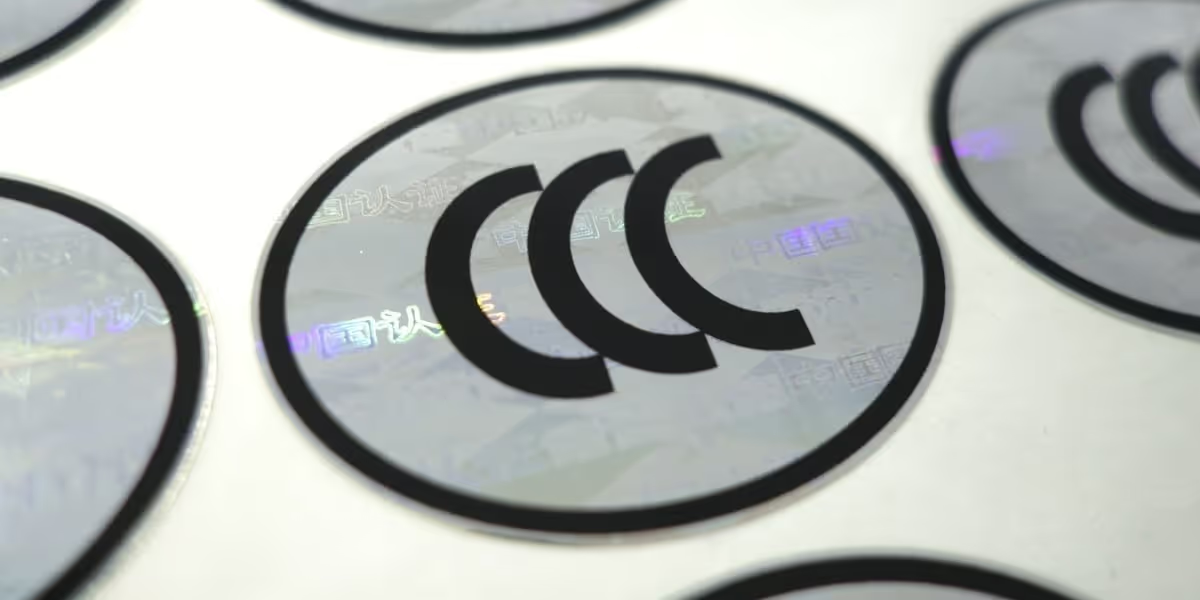
Once these steps are successfully completed, the CCC certificate is issued and products must be marked with the CCC certification logo before they can be imported into China.
While official processing times for certification organizations may be limited to 90 working days, the overall certification process often takes several months depending on testing, inspections, and documentation preparation.
Procedure 2 – Manufacturer’s Declaration
In certain product categories, an alternative certification pathway is available based on a manufacturer’s declaration system introduced in 2018.
This procedure differs from conventional certification in several ways:
- Applications are submitted directly to the CNCA authority
- Factory inspections by certification bodies are not required
- A registered Authorized Representative in China must be appointed
- Product testing is still required for compliance verification.
This approach places greater responsibility on manufacturers to ensure compliance and maintain documentation demonstrating conformity with regulatory requirements.
Product Testing & Factory Inspections
Product testing is a central element of the CCC certification process. Tests must be conducted in laboratories accredited by CNAS and must comply with applicable Chinese national standards.
Testing requirements vary depending on the product type and may include:
- electrical safety testing
- mechanical durability tests
- fire resistance and load tests
- electromagnetic compatibility tests.
In addition to laboratory testing, certification bodies typically conduct factory inspections to verify manufacturing processes, quality control systems, and documentation procedures used in production.
Certification Marking & Compliance Obligations
Products that receive CCC certification must be labeled with the official CCC mark before they can be imported into China.
Compliance requirements include:
- applying the CCC logo in accordance with CNCA design specifications
- ensuring traceability of certified products
- maintaining records of certified production batches
- ensuring that certification marks are applied correctly to products or packaging.
Incorrect labeling can result in customs issues or product relabeling requirements, which may delay shipments.
Certification Exemptions & Clearance Certificates
In certain situations, products may qualify for exemptions from CCC certification.
Examples include:
- temporary imports for trade fairs or exhibitions
- spare parts used for maintenance of existing equipment
- limited import volumes for specific purposes.
In these cases, companies may obtain CCC clearance certificates, also referred to as negative confirmations, which demonstrate to customs authorities that certification is not required for the shipment.
These documents can help prevent delays at customs and provide confirmation that certification obligations have been evaluated.
Who Should Read This Whitepaper
This whitepaper is particularly relevant for:
- Manufacturers exporting products to mainland China
- Regulatory affairs professionals responsible for certification compliance
- Product compliance and quality assurance teams
- Companies introducing electrical, industrial, or consumer products into the Chinese market
- Market-entry teams evaluating regulatory requirements for product safety certification.
More Whitepapers

China NMPA Registration of In Vitro Diagnostic Reagents (IVDs) Whitepaper
Learn about regulatory pathways, classification rules, testing requirements, and lifecycle compliance for IVD reagents.
%20Whitepaper.avif)
China Energy Label (CEL) Whitepaper
China Energy Label (CEL) requirements explained. Learn about product categories, energy efficiency testing, labeling rules, and approval procedures for China.

China NMPA Registration of Drugs for Human Use Whitepaper
China NMPA drug registration explained. Learn about pharmaceutical approval pathways, regulatory framework, clinical trials, and market authorization for drugs in China.