China Compulsory Certification
China Compulsory Certification (CCC) is a mandatory certification for selling certain products in China. Introduced in 2002, it ensures products meet China’s safety and quality standards before market entry, requiring rigorous testing and factory inspections.
The certification process is complex and involves multiple stages, including application submission, product testing, and annual re-qualification to maintain compliance.

Understanding China Compulsory Certification (CCC)
Since its establishment, the CCC system has undergone multiple updates to reflect changes in regulations, regulatory policies and technological progress. Its original purpose, harmonizing product quality standards, remains central, but the scope and requirements have evolved to keep pace with innovation and emerging safety concerns.
Ongoing updates to the CCC catalogue mean companies must stay informed about these changes to ensure ongoing compliance and secure their continued presence in the Chinese market.
Key Authorities Involved
Several key regulatory bodies are involved in managing the CCC certification process, each with a specific role to ensure compliance with China’s certification standards. The State Administration for Market Regulation (SAMR) oversees the overall operation and effectiveness of the CCC system. The Certification and Accreditation Administration of China (CNCA) is responsible for managing the organizations authorized to issue CCC certificates.
Product testing and verification are handled by accredited organisations such as:
Together, these regulatory authorities play a critical role in maintaining the reliability of the CCC system. Their strict supervision ensures that only fully compliant products are allowed entry into the People's Republic of China.
Products Subject to CCC Certification
An extensive array of product categories such as components for automobiles, houshold appliances, and specific electronic products, requires certification. They are detailed in the frequently revised CCC Catalogue.
CCC Catalogue
The CCC Catalogue details product categories that must obtain CCC certification before being imported or sold within China. This list, overseen by the Standardization Administration of China (SAC), contains at the time of writing 433 HS codes encompassing a diverse array of items, including but not limited to electrical appliances, telecommunications equipment, and safety-related devices.
For companies pursuing CCC certification, it’s essential to understand not only whether their product is listed in the CCC Catalogue but also which specific GB standard applies to it. The Standardization Administration of China (SAC) plays a vital role in developing the national standards required for CCC certification. These are known as GB standards and serve as the foundation for ensuring that products meet China’s safety and quality requirements. These standards also specify how a product must comply with China’s regulations and product safety guidelines.This knowledge is crucial at every stage of the certification process and helps ensure a smoother path to compliance.
Mandatory Certification
The catalogue of products requiring certification currently contains 20 product groups for which a CCC certification obligation applies:
Mandatory Self-Declarations
For certain products, regulations call for the CCC self-declaration process rather than the traditional certification route. In this case, the manufacturer is responsible for confirming and demonstrating compliance with applicable requirements. Although the process omits the involvement of a certification organization that would supervise the manufacturer, it still involves testing and documentation procedures. Additionally, the manufacturer must have a Chinese subsidiary or representative entity to serve as the official applicant and point of contact for local authority in case of product safety issues. The system is comparable with the European CE mark.
Voluntary Certification
it is also possible to obtain product safety certifications on a voluntary basis. This would be similar to the TÜV “GS” or “UL” mark. These are issued by accredited certification bodies and serve as third-party validation of a product’s safety for both industrial and consumer use.
Voluntary certification can give manufacturers a competitive edge in the market. In some product categories, such as in other countries, they can serve as a requirement for consumers to ensure product safety. Furthermore, in the event of significant safety incidents, third-party safety certification can help to prevent reputational and financial damage.
Exemptions & Special Cases
While many products require CCC certification, there are specific exceptions based on factors such as the product type and its intended use. For instance, products used for research and development, or those produced in small quantities, may be exempt from mandatory certification. However, such exemptions are not automatic, and during the application process for the exemption proper documentation to justify the claim will be required.
To confirm that a product is not subject to CCC certification, companies can:
Once the exemption application has been approved there are usually three outcomes:

The CCC Certification Process
This typically encompasses six pivotal steps, beginning with the identifying whether a CCC obligation applies and culminating in granting a China Compulsory Certificate. The steps include:
At each step, strict adherence to regulatory standards and attention to detail are imperative. Early engagement with certifying authorities regarding your business facilitates clear communication, which can help all parties involved gain a thorough comprehension of the requirements for CCC compliance, thus avoiding unnecessary setbacks or delays.
Application Submission
The application for CCC certification must be submitted to a Chinese certification body authorized for the specific product category. While the China Quality Certification Centre (CQC) handles a broad range of products, smaller organizations like CCAP or CCLC are limited to specific product groups. However, these smaller bodies often provide more personalized support and operate with less bureaucracy, allowing for quicker responses and easier issue resolution. In contrast, applications through CQC can take longer, particularly when coordinating overseas inspections.Getting this first step right can help reduce delays and allow your products to enter the Chinese market smoothly.
The application process involves submitting detailed information about the applicant and the manufacturing facility, along with documentation such as product descriptions, photos, schematics, and a list of critical components. Once complete, the applicant receives a registration number and typically waits one to three weeks for review.
Mistakes or missing documents in the application can lead to delays or miscommunication. In some cases, poor communication can result in higher long-term costs, such as unnecessary separate certifications for products that could have been grouped under a single certificate.
Product "Type" Testing
Once the certification organization accepts the application, the applicant must submit a type test report, which involves testing the product at a CNAS-accredited laboratory in China. The applicable implementation rule for a product group specifies whether the testing must be complete before a required factory inspection or can be done in parallel or after a factory inspection.
The required tests and sample quantities depend on the CCC Implementation Rules and relevant Chinese GB (national) standards. For product families (types), one representative model is selected for testing, hence the term "type test." If the test is successful, the report, issued in Chinese, must be submitted to the certification body; English versions may be provided for a fee. If the product fails, retesting is usually allowed twice. For re-tests, a report on the conducted failure analysis must be provided as well as which improvements were implemented. Should the test fail the allowed re-testings, the application will be void and cancelled by the certification organisation. However, at the time of writing to our knowledge there is no restriction to starting a new application again.
Factory Inspection
In addition to the application and a successful type test report, the certification organization also requires a factory inspection report before issuing the CCC certificate (or voluntary certification). This inspection is typically conducted over two days by two Chinese inspectors, who thoroughly review all documentation and records related to the production and quality assurance of the product being certified. While the structure and documentation requirement of the factory inspection are comparable to certification audits under ISO 9001 or IATF 16949, the specific execution and some content requirements differ to align with Chinese regulatory expectations.
Certificate Issuance & Annual Re-Qualification
After a successful factory inspection, a CCC certificate is usually issued within 6 weeks. This timeline may differ depending on the status of type testing (e.g. if it was required to be completed prior inspection or not) and the date at which the inspectors returned home.
The validity of CCC certification is maintained through an annual re-qualification process, which typically includes supervision factory inspections of at least one day and/or random sampling testing of products requested from the manufacturer for testing in China and market sampling to verify ongoing compliance with Chinese standards.
This regular oversight helps guarantee that certified products consistently align with regulatory expectations.

Changes to Existing CCC Certificates
Ongoing success in the Chinese market often depends on a company’s ability to innovate and launch new products through research and development. However, any changes to a certified product, such as modifications, removals, or specification updates, adjustments involving materials, production methods, or key suppliers require prior approval from the certification authority before being applied to certified products. Otherwise, it will be judged as a major non-compliance which might lead in the worst case to losing the certification.
Formal changes like a company name update should also be submitted promptly, though these can typically be processed without the need for a new factory inspection.
If the manufacturing site changes, an additional on-site inspection at the new location is required.
When updates to relevant GB standards or CCC Implementation Rules are released, certificate holders are responsible for applying for certification updates. These changes generally include a transition period of at least six months, often up to a year.
Regardless of the type of change, whether product-related, formal, or regulatory, an official application must always be submitted. Even if a certificate is cancelled, proper procedures must still be followed, which can sometimes involve additional type testing. Processing times for extensions or changes usually range from two to three weeks, but may extend to five to six weeks if type testing is necessary.
Discover Our CCC Services
Whether you’re just starting out or are a blue-chip, access our wide range of CCC services and solutions to help your business thrive.
1
Applicability Assessment
2
Clearance Certificates
3
Exemption Handling
4
New Certifications
Full project management for first-time CCC applicants:
5
Certificate Changes
Management of modifications to existing certificates, such as:
6
Certificate Maintenance
7
Certificate Cancellation
8
CCC Self-Declaration
9
Authorized Representative Service
10
Friendly Audits & Consulting
11
Regulatory Translations
Request a Proposal to Get Approval for Your CCC Products in China
Frequently Asked Questions
There are many Chinese regulations that may influence the need to get a CCC Certification. We can check the need for such certification with our CCC Checking service.
You must obtain the CCC Certification before your products destined for export to China are manufactured.
Yes, even if your products do not need a CCC certificate, they can still be stopped at customs. We can help you avoid such problems with customs with our Cisema DFC-CNC Certificates. Cisema Certificates are already known and accepted in many customs offices in China.
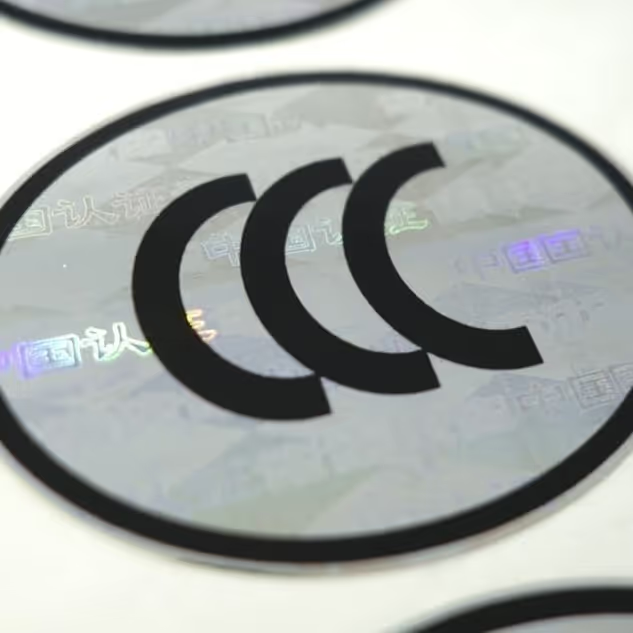
Once you have secured a valid CCC certificate, you may start to apply the CCC logo. It is critical to verify that all compliance requirements are met before moving forward with the logo application.
The producer is permitted to create and affix the CCC mark label as long as it conforms to all relevant standards for that particular category of products.
If the planned CCC marking requires review, it is essential to have the Chinese certification organization assess the marking on a document basis prior to issuance.This ensures compliance with the certification standards.
If a CCC certificate is not valid, the product must not carry the CCC mark, and Chinese customs may reject any products that bear markings from an expired certificate.
Thus, it is essential to maintain an up-to-date CCC certification for your products in order to comply with regulations and gain entry into the market.