
Published on
Last updated on
CNCA Issues 11 Trial CCC Certification Rules for Fuses and Other Products
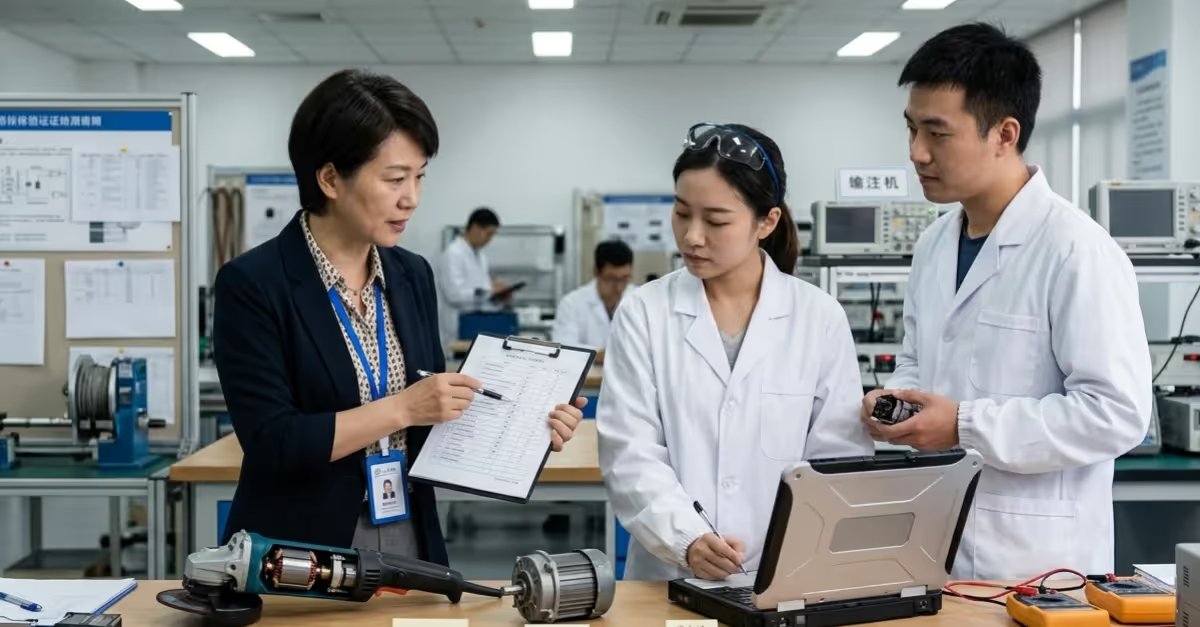
On April 11, 2026, the Certification and Accreditation Administration of China (CNCA) issued “Announcement No. 4 of 2026,” releasing 11 trial implementation rules for China Compulsory Certification (CCC). These rules will take effect on July 1, 2026.
The announcement is particularly relevant for foreign manufacturers exporting electrical products, industrial equipment, automotive components, and safety glass to China, as it signals a significant shift in market access requirements.
CNCA Issues Trial CCC Certification Rules for 11 Product Categories
The new rules establish the operational framework for products transitioning from enterprise self-declaration to mandatory third-party CCC certification.
Specifically, the 11 trial implementation rules apply to:
- Fuses
- Low-power motors
- Electric tools
- Welding machines
- Automotive seat belts
- External lighting and light-signaling devices for motor vehicles
- Indirect vision devices for motor vehicles
- Vehicle seats and headrests
- Retro-reflective markings
- Vehicle event data recorders
- Safety glass
These rules were issued to implement the requirements of SAMR Announcement No. 57 (2025), which reclassifies 16 high-risk product categories from self-declaration to mandatory third-party certification. As a result, the new framework standardizes certification criteria, procedures, and technical requirements while strengthening product safety supervision, reinforcing quality accountability, and promoting more orderly market conditions.
A Shift from Self-Declaration to Third-Party Certification
The new CNCA rules define how the affected products will be assessed under the mandatory CCC system. For overseas manufacturers, this creates a more formal China market access process with added testing, factory inspection, certification, and surveillance requirements.
This change will affect compliance budgets, launch timelines, and internal resource planning. Companies with broad product portfolios should expect more complex certification management in China.
Key Implementation Dates for China CCC Certification
The transition timeline is relatively short, making early preparation essential. Foreign manufacturers should use the period before July 1, 2026, to confirm product scope, review existing declarations, and begin preparing documentation.
- July 1, 2026: The 11 implementation rules take effect on a trial basis. Certification bodies will begin accepting CCC applications, and the self-declaration system will stop accepting new declarations for the affected products.
- December 31, 2026: Companies with valid self-declarations must complete conversion to CCC certificates and cancel the corresponding declarations. Products already manufactured within the validity period of a self-declaration and no longer in production may continue to be sold, in line with SAMR transition provisions.
- January 1, 2027: Products without CCC certification will no longer be eligible for manufacture, sale, import, or commercial use in China.
Although the legal enforcement date is January 1, 2027, the practical deadline is earlier. Certification activities (such as testing, factory inspections, and document reviews) require significant lead time.
Impact on Foreign Companies
The CNCA announcement creates a direct compliance obligation for overseas companies whose products fall within the affected CCC catalogue categories. Importers and distributors in China will also need to verify that suppliers complete the certificate conversion on time.
Higher Certification Costs and Longer Timelines
Third-party CCC certification normally requires more resources than self-declaration. Companies should prepare for testing, initial factory inspections, certification review, and post-certification surveillance.
For manufacturers outside China, factory inspection may be one of the most important planning items. Overseas production sites must be ready to demonstrate consistent production controls, quality management, and conformity with the applicable CCC implementation rules.
Transition Pressure for Existing Self-Declarations
Existing self-declarations cannot simply remain in place after the transition period. Companies must review all affected SKUs, determine whether current declarations remain valid, and submit applications to designated certification bodies.
CNCA and SAMR allow certification bodies to consider valid self-declaration assessment results when converting certificates, provided certification quality and risk control are maintained. This may help reduce duplication, but companies should not assume that all previous test data will automatically be accepted.
How Foreign Companies Should Prepare
Although the transition period provides several months, certification timelines can quickly expand due to testing gaps, documentation issues, or audit findings. To stay on track, companies should:
- Identify all products covered by the 11 implementation rules
- Map existing declarations, test reports, specifications, labeling, and quality records against CCC requirements
- Engage designated certification bodies before July 1, 2026
Early engagement is particularly valuable, as it helps clarify product classification, applicable standards, key components, factory inspection expectations, and whether existing data can be reused.
Final Thoughts: Why Early CCC Certification Planning Matters
CNCA’s 11 trial implementation rules mark a significant compliance shift for affected electrical, industrial, automotive, and safety glass products. The move to third-party CCC certification creates a clearer and more standardized framework, but it also increases the work required to maintain China market access.
The main challenge is timing. Companies must complete product assessment, documentation preparation, testing coordination, factory audit preparation, and certificate conversion before the end of 2026. Any delay may affect imports, sales, or commercial use of affected products in China.
Cisema supports foreign manufacturers with China CCC certification. For the affected product categories, Cisema can assist with portfolio screening, gap analysis, documentation preparation, testing coordination, factory audit preparation, and certificate conversion planning. To discuss your CCC certification requirements, contact Cisema today.
Further Information
Explore Cisema’s services for China Compulsory Certification (CCC).
References
Certification and Accreditation Administration of China (CNCA), Announcement No. 4 of 2026
Connect with Cisema
With more than 20 years of experience and a team of over 100 specialists, Cisema helps global companies achieve compliance across Asia Pacific with confidence and accelerate market entry.
Stay Informed with Monthly News and Analysis
Stay informed with the latest regulatory changes, expert insights, and market opportunities across APAC, delivered straight to your inbox.
Related News

China Establishes Official Testing Methods for Diclofenac Sodium & Urotropine in Cosmetics
China's NMPA has established two supplementary testing methods to detect prohibited substances in cosmetics with high-sensitivity liquid chromatography.

China Issues First Ethical Guidelines for Artificial Intelligence Medical Imaging Research
China’s Science Ministry issued ethical guidelines establishing strict standards for AI medical imaging data, algorithm validation, and ethics reviews.

China Approves NMN, Bakuchiol, & Two Other Ingredients for Existing Cosmetic Use
China’s latest regulatory change removes the NCI registration hurdle for these ingredients, with new limits and compliance requirements now applying to finished cosmetic products.