On July 31, 2020, the Beijing MPA (Medical Products Administration) made an announcement to implement stricter supervision on medical cosmetology products.

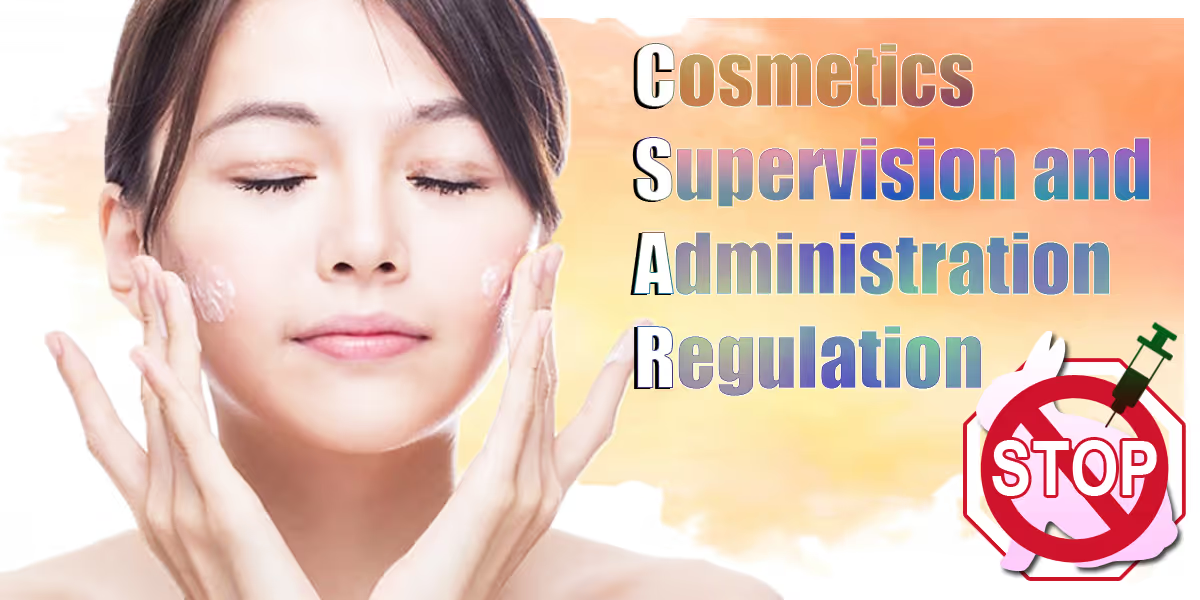
On June 29, 2020, China’s State Council announced the implementation of the new regulation for CSAR (Cosmetics Supervision and Administration), which will become effective on January 1, 2021.
Major changes
Background

The definition of cosmetics

Classification of Cosmetics

Note: Registered products with functions for hair growing, depilatories, breast enhancement, body slimming, and deodorants will no longer be classified as special cosmetics after a 5-year transition period.
Classification of Cosmetic Ingredients

Note: After the registration / filing of new ingredients, the registrant / filer should report the current status of consumer use and safety to the NMPA annually for 3 consecutive years. If any safety issues should occur during these three years, the registration / filing will be cancelled, otherwise, the new ingredient will be included in the list of used ingredients (IECIC, also known as Inventory of Existing Cosmetic Ingredients in China).
Toothpaste management

Note: According to the China Oral Care Industry Association’s announcement on July 2, 2020, toothpaste products are not considered as cosmetics. Further information will be disclosed by the NMPA.
Soap management

Requirements for registrants and filers

Penalties for violations

By Jacky Li. Contact Cisema if you would like to learn more.

Advantage Austria together with Ms. Anna King from CISEMA inform about the recent regulatory and institutional developments in China.

The Israel Export Institute co-hosted a webinar together with Cisema to introduce the China administration bodies, regulations and standards for cosmetics.

On 06.11.2019, the China NDRC (National Development and Reform Commission) announced (No.20-2019) the prohibition of daily chemical articles containing plastic microbeads for production after December 31, 2020, and for sale after December 31, 2022.Microbeads are small plastic particles, mostly included in cosmetic and cleaning products, and are known to cause water pollution to the marine and freshwater environments. Currently, 14 states have already taken action towards the ban on microbeads. Although the details of the ban for production and sales in China is still subject to further refinement, brands and manufacturers are expected to reformulate their products containing microbeads, while some have already replaced microbeads with natural abrasives as an alternative in daily chemical articles.The announcement (No.20-2019) is based on the Industrial Structure Adjustment Guidance Catalogue (2019 Edition) that was approved at the 2nd committee meeting on 27.08.2019, and has replaced the 2011 version since 01.01.2020.

On 22.11.2019, China's NMPA (National Medical Products Administration) announced a draft regulation concerning overseas inspection for cosmetic products, and launched the public consultation to receive feedback.According to the proposed regulation, it aims to introduce, standardize and optimize the inspection process. Once adopted, inspections on foreign manufacturers are required to be conducted by Chinese authorities from NMPA, which includes on-site inspections for any overseas facilities involved with the manufacturing process of cosmetic products that are intended to be sold in the China market.China NMPA will continue to solicit public opinions until 22.12.2019.

On 10.09.2019, the NMPA (National Medical Products Administration) announced changes to the procedures regarding cosmetics sample tests in China (No. 72-2019), followed by an interpretation of their announcement on 12.09.2019. Laboratories - that perform sample tests for cosmetics NMPA approval - need to re-apply for their qualification as a testing institutions because the relevant qualification will be automatically suspended on 01.11.2019. Until then - during the transitional period - there are two possible methods for managing tests. Cosmetics enterprises can follow the original procedures offline, as well as apply for sample tests online. Starting on 01.11.2019, however, laboratories have to be newly accredited. Furthermore, cosmetics enterprises and their NMPA Legal Agents will only be able to apply for and manage tests, which are related to cosmetics registration/filing, online.1) The goal is to improve the testing workflow, to standardize the test project requirements, to improve the efficiency of tests, and to provide strong technical support for cosmetics safety supervision.2) The prerequisite for testing institutions is to submit relevant information and obtain a new certification from the CMA (China Inspection Body and Laboratory Mandatory Approval).3) New guidelines for testing institutions include that testing must not be subcontracted, quality management system has to be ensured, testing work procedures for cosmetics registration and documentations have to be standardized, the facilities and equipment have to meet requirements.4) In order to improve work efficiency, an “Inspection Information System” was introduced to optimize the workflow of testing institutions. Via the online system, cosmetics manufacturers select a testing institution, submit relevant product information and apply for testing. The testing institution can then accept the test application and issues the test report online after testing.5) Changes in managing test samples include:Firstly, rather than regulatory authorities performing the on-site test sample sealing, the testing insitution seals the test samples. This change only applies to domestic “special” cosmetics.Secondly, laboratories accept samples produced for the purpose of testing if the product is not sold yet. (Please note, however, that the NMPA requires a product to be already sold in the country of origin.)6) The test requirements are changed to emphasize the safety of products during evaluation and some test items will be adjusted to better reflect the safety situation of products; for instance, by measuring dioxane.7) During the transition period – until 31.10.2019:Firstly, testing institutions should apply for their qualification because on 1 November, the old ones will be terminated.Secondly, already approved cosmetics, whose tests do not comply with the new specifications anymore, have to undergo supplementary testing a year of the announcement.Third, cosmetics manufacturers can follow the old (offline) way of applying for and managing tests, as well as the new “online” way.

On 01.08.2019, the NMPA released a notice changing the consultation service of the “National Institute for Food and Drug Control” regarding cosmetics approval applications (No. 245-2019).1) Questions regarding the technical review of cosmetics, on-site consultation is available every Tuesday afternoon.2) Questions regarding the administrative/format review of cosmetics, telephone consultation is available all day on Tuesdays and Thursdays.

On 10 July 2019, the Italian association for cosmetics industry (Cosmetica Italia) hosted a seminar on the regulatory environment of cosmetics in China. The seminar was held in collaboration with Cisema, which is specialised in the registration and certification of cosmetics in China.Following the seminar, Miriam Bandinelli, a Cisema business consultant, shared her knowledge in 2B2 interviews with individual member companies. The response was very positive: 50 Italian companies attended the event in person and via webinar. This shows the great interest of Italian companies in China, one of the main markets of the cosmetics industry.

The NMPA released 9 cosmetics test methods for cosmetics registration, filing, and supervision and inspection starting January 1, 2020.

Before November 2018, foreign manufacturers had to the choose between NMPA Registration in Beijing or Filing in the 11 Pilot New Trade Zones

On 05.02.2018, the NIFDC (National Institutes for Food and Drug Control) – a unit under the NMPA (China Food and Drug Administration) – published a draft on two alternatives to animal testing: One for skin and one for eye irritation. The draft was open for public comment until 15.02.2018 and clearly indicates a major step towards the improvement of China’s technical cosmetics regulations and the replacement of animal testing in the future.
And discover how we can support you in getting your products certified for China.