
Published on
Last updated on
China’s CDE Releases 2025 Drug Evaluation Report

China’s Center for Drug Evaluation (CDE) has issued the “2025 Drug Evaluation Report,” providing an overview of drug registration, technical review, and approval activities during 2025.
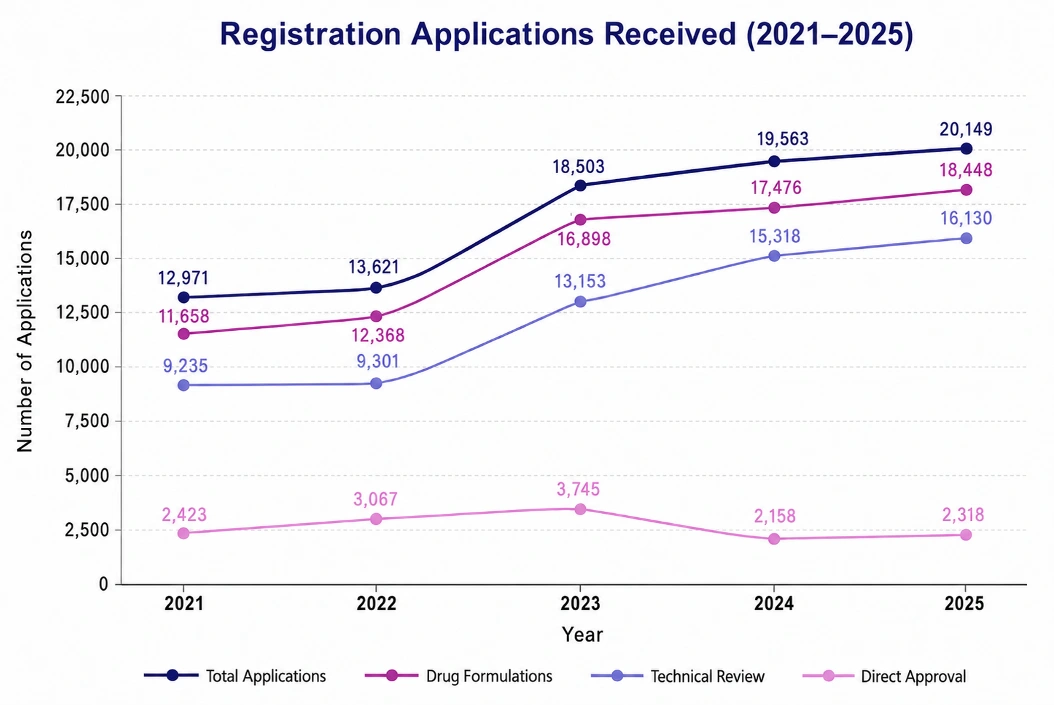
In 2025, the CDE accepted 20,149 registration applications - the highest volume in the five-year period covered by the report and a 3.0% increase year-on-year. The headline growth figure, however, understates what the data shows: the composition of applications is shifting. Clinical trial and NDA volumes are rising faster than generics; biologics are accelerating, and post-approval supplementary activity remains high. For companies planning China submissions, the picture matters more than the total.
More importantly, the data suggests that China’s regulatory workload is increasingly being driven by innovation and lifecycle management rather than by the generic quality-upgrading initiatives that dominated much of the previous decade. For companies evaluating China development and commercialization strategies, this shift may have implications for review competition, regulatory planning, and resource allocation.
Continued Growth in Drug Registration Applications
In 2025, the CDE accepted 20,149 registration applications, representing 3.0% year-on-year growth and the highest level recorded during the five-year period covered by the report.
This included:
- 18,448 drug formulation registration applications
- 1,701 chemical raw material drug registration applications
Of the total applications:
- 16,130 cases required technical review
- 2,318 were direct administrative approval applications
Although growth was more moderate than in 2023, the continued increase suggests that China’s pharmaceutical development pipeline remains active, with sustained demand for regulatory review across different product types.
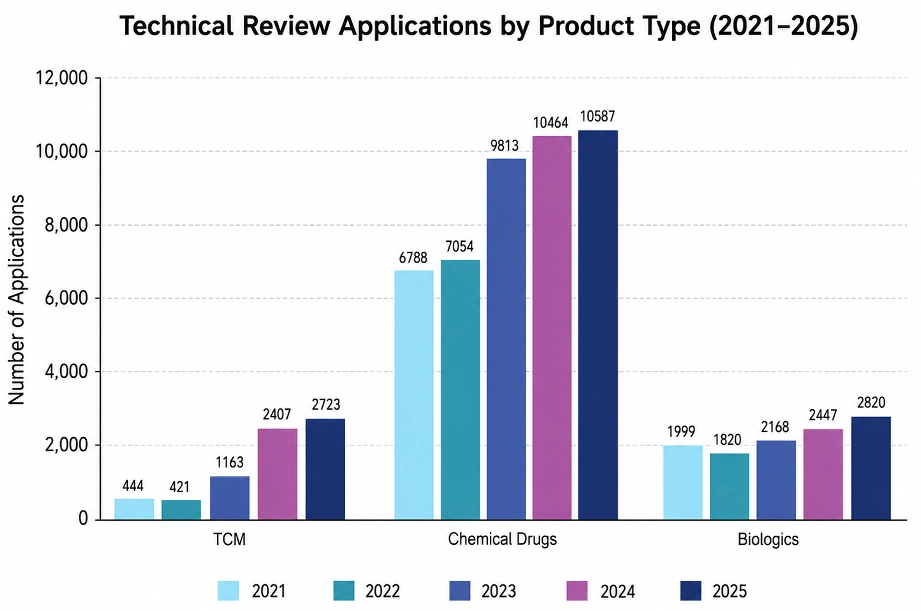
Technical Review Applications by Product Type
Technical review applications increased across major product categories in 2025, with chemical drugs remaining the dominant modality:
- Chemical drugs: 10,587 applications, up slightly from 10,464 in 2024
- Biological products: 2,820 applications, up from 2,447 in 2024
- Traditional Chinese medicine: 2,723 applications, up from 2,407 in 2024
While chemical drugs continue to dominate the review workload, biologics showed the strongest relative growth. This trend is consistent with broader industry investment patterns and reflects continued expansion of biologics development activity within China’s pharmaceutical sector.
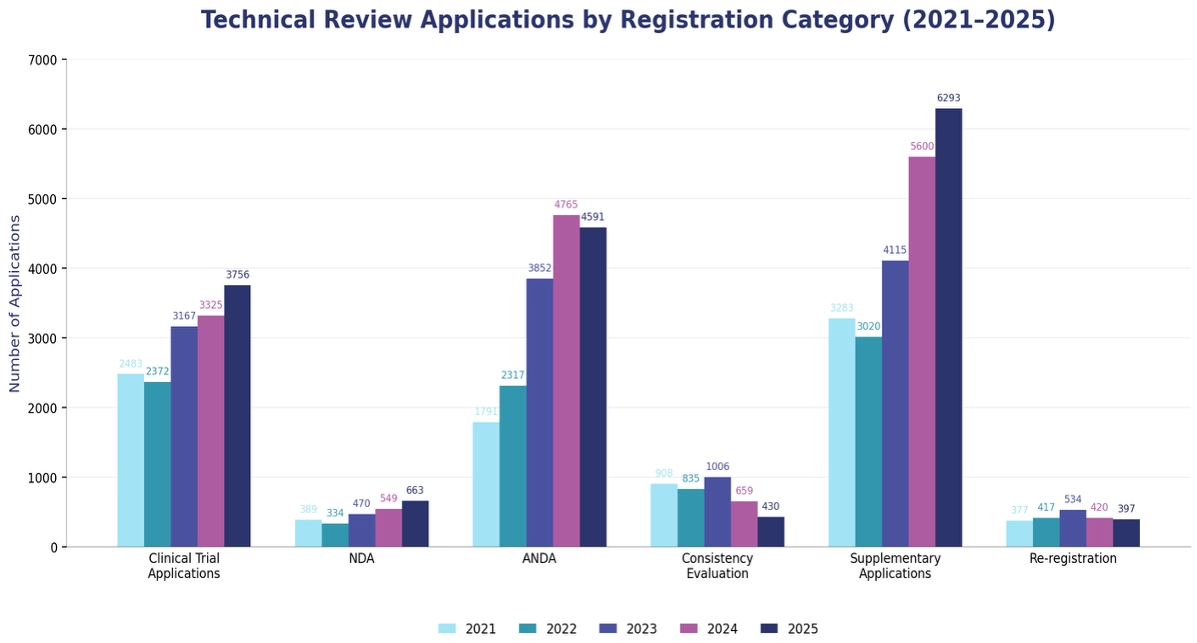
Technical Review Applications by Registration Category
The report also breaks down technical review applications by registration category, showing where development activity was concentrated in 2025.
Key increases included:
- Supplementary applications: increased to 6,293, remaining the largest technical review category
- Clinical trial applications: increased to 3,756, up from 3,325 in 2024
- New Drug Applications (NDA): increased to 663, up from 549 in 2024
By contrast:
- Abbreviated New Drug Applications (ANDA) decreased slightly from 4,765 in 2024 to 4,591 in 2025
- Consistency evaluation applications also declined from 659 to 430, continuing a downward trend from earlier years
This mix suggests that China’s drug registration activity is becoming increasingly diversified. While generic and supplementary applications still form a large part of the review workload, the rise in clinical trial and NDA applications points to continued interest in new product development and market authorization.
Importantly, supplementary applications remained in the largest technical review category. This highlights the growing importance of lifecycle management within China’s regulatory system and reinforces that market access increasingly extends beyond initial approval activities.
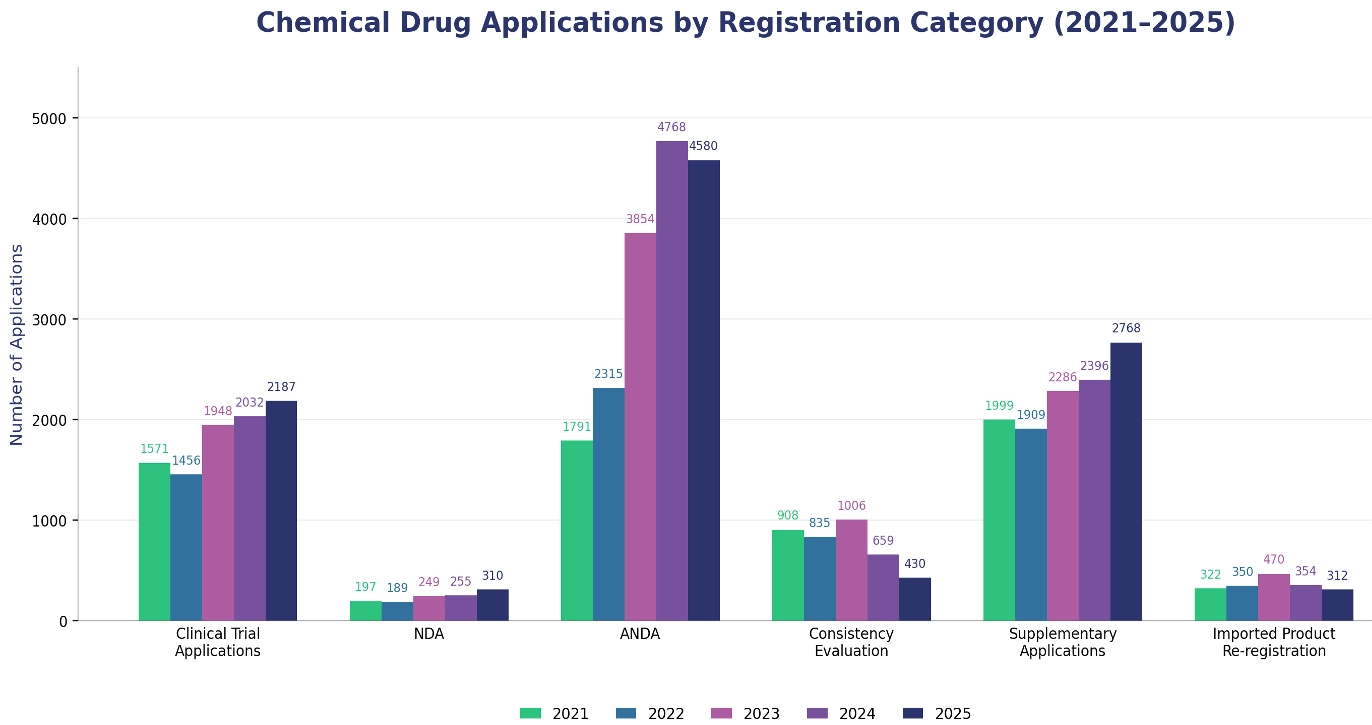
Chemical Drug Registration Trends
Chemical drugs remained the largest product category in China’s technical review system in 2025.
- Clinical trial applications increased from 2,032 in 2024 to 2,187 in 2025
- NDA applications rose from 255 to 310
- Supplementary applications increased from 2,396 to 2,768
ANDA applications remained high at 4,580 in 2025, although slightly below the 4,768 cases recorded in 2024. Consistency evaluation applications decreased to 430, continuing the downward trend observed in recent years.
Overall, chemical drugs continue to form the core of China’s drug registration activity. However, the strongest areas of growth in 2025 were not limited to generic applications. Clinical trial applications, NDA activity, and supplementary applications all increased, demonstrating continued movement across both development and post-approval stages.
Biological Product Registration Trends
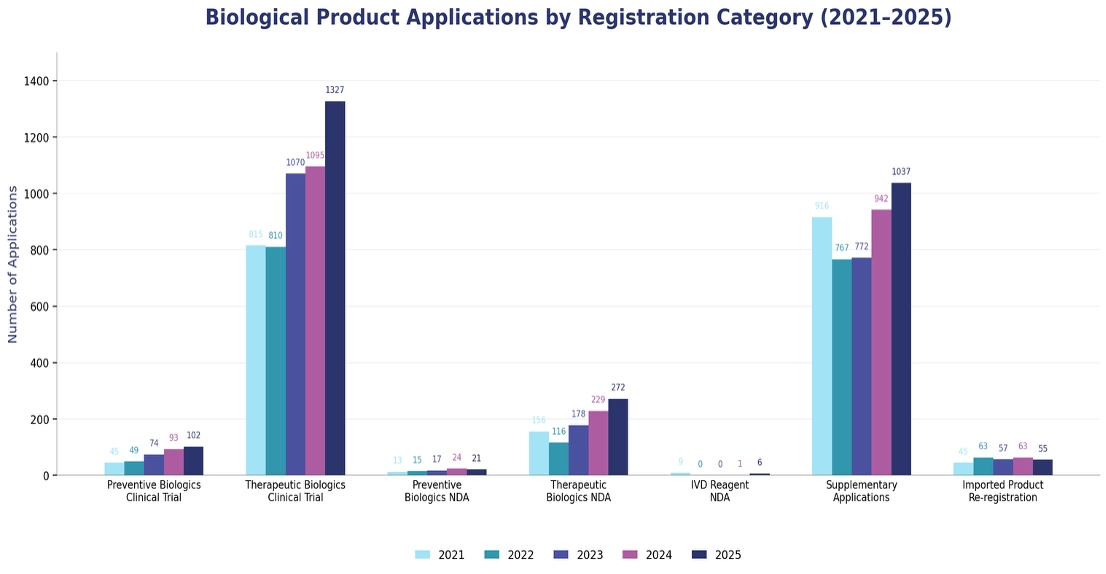
Biological products also showed strong development activity in 2025, particularly in therapeutic biological products.
Clinical trial activity increased across key biologics categories:
- Therapeutic biological products: increased from 1,095 in 2024 to 1,327 in 2025
- Preventive biological products: increased from 93 in 2024 to 102 in 2025
Post-approval activity also remained significant, with supplementary applications reaching 1,037.
NDA activity remained active, although performance varied by categories:
- Therapeutic biological products: increased from 229 in 2024 to 272 in 2025
- Preventive biological products: decreased slightly from 24 to 21
- In-vitro diagnostic reagents: increased from 1 to 6
The biologics data points to continued expansion, particularly in therapeutic products where both IND and NDA volumes grew. For overseas pharmaceutical and biotechnology companies, the continued growth in biologics submissions underscores the importance of robust clinical, quality, and regulatory strategies as development activity within the sector continues to expand.
Direct Administrative Approval Applications
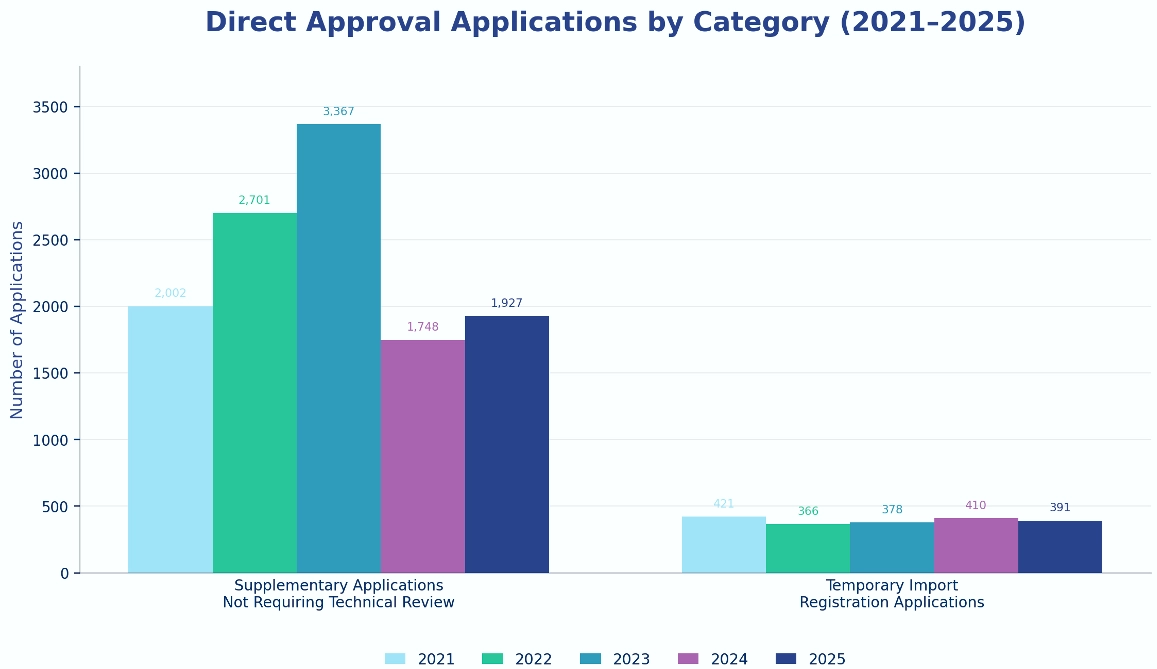
In 2025, the CDE accepted 2,318 direct administrative approval applications, including:
- 1,927 supplementary applications that did not require technical review, up from 1,748 in 2024
- 391 temporary import registration applications, down from 410 in 2024
Although the total number remained below the 2023 peak, the increase in non-technical supplementary applications shows that administrative approval procedures continue to play an important role within China’s broader registration system.
This category is often overlooked but can have significant implications for lifecycle management planning. Understanding whether a proposed change requires technical review or qualifies for direct administrative approval can materially affect submission timelines, resource requirements, and implementation planning.
What the Data Suggests About China’s Regulatory Environment
The report suggests that China’s regulatory system is entering a different phase of maturity.
While application volumes continue to grow, the composition of those applications increasingly reflects innovative development programs, biologics expansion, and post-approval lifecycle management activities rather than the large-scale generic quality initiatives that characterized earlier years.
Several themes emerge from the data:
- China’s drug registration system continues to handle a high and growing volume of applications across both development and post-approval stages
- Technical review activity remains concentrated in chemical drugs, but biological products continue to expand, particularly in therapeutic biologics
- Clinical trial applications and NDA submissions continue to increase, reflecting sustained investment in innovative product development and commercialization
- Supplementary applications remain a major component of the review workload, highlighting the growing importance of lifecycle management strategies
- The decline in consistency evaluation applications suggests that the earlier phase of generic quality upgrading is largely complete
Taken together, these trends indicate that China’s regulatory environment is becoming increasingly focused on innovation, portfolio expansion, and lifecycle management rather than solely on generic quality alignment.
Final Thoughts: China’s Regulatory System is Evolving Beyond Generic Catch-Up
The 2025 Drug Evaluation Report highlights more than continued growth in application volumes. It reflects a broader evolution in China’s pharmaceutical regulatory environment.
Clinical trial applications, NDA submissions, biologics development, and lifecycle management activities all increased during 2025, while consistency evaluation applications continued to decline. Together, these trends suggest that regulatory activity is increasingly being driven by innovation, product development, and post-approval management rather than by the generic quality-upgrading initiatives that defined much of the previous decade.
For pharmaceutical and biotechnology companies, the implications extend beyond submission statistics. Development strategy, regulatory sequencing, lifecycle planning, and resource allocation are becoming increasingly important as the volume and complexity of applications entering the review system continue to expand.
While China remains one of the world’s most active pharmaceutical regulatory markets, success increasingly depends not only on obtaining approval, but on effectively navigating the full product lifecycle within an evolving and increasingly sophisticated regulatory environment.
For additional guidance on China regulatory strategy, product development pathways, and lifecycle management planning, contact Cisema today.
Further Information
Explore Cisema’s Pharmaceutical Consulting services
Reference
Read the original report in full: Center for Drug Evaluation (CDE), National Medical Products Administration (NMPA)
Connect with Cisema
With more than 20 years of experience and a team of over 100 specialists, Cisema helps global companies achieve compliance across Asia Pacific with confidence and accelerate market entry.
Stay Informed with Monthly News and Analysis
Stay informed with the latest regulatory changes, expert insights, and market opportunities across APAC, delivered straight to your inbox.
Related News

Vietnam Expands CSDT Appraisal Capacity for Medical Devices
Vietnam’s Decision No. 3046/QĐ-BYT expands CSDT appraisal capacity for medical devices.

New Apostille Decree Takes Effect: Implications for Medical Device and Cosmetic Regulatory Dossiers
Learn how Vietnam’s Apostille Decree may affect medical device registration and cosmetic product notification, including CFS, LOA, and document legalization requirements.

China Releases 50 New and Revised Food Safety Standards
Discover key changes in China’s 50 new national food safety standards and learn how foreign food manufacturers can prepare for upcoming compliance deadlines.