
Published on
Last updated on
India’s Biopharma & Biosimilar Boom: Current Landscape, Trends & Approval Requirements

Long known as the "pharmacy of the world" for generic medicines, India is now building a formidable presence in biologics and biosimilars. Global manufacturers are actively seeking entry routes into this expanding sector, spurred on by substantial government investment and sweeping regulatory reforms.
Yet, entering the Indian market involves far more than identifying commercial demand. Due to the complexity of biological medicines, obtaining marketing authorizations in India requires a comprehensive regulatory dossier addressing quality, safety and efficacy, supported by an appropriate comparability exercise where applicable, and in compliance with the requirements of the Central Drugs Standard Control Organization (CDSCO).
Continue reading to explore the sector's current standing, key market trends, and vital regulatory updates. For tailored guidance, contact Cisema today to identify your applicable regulatory pathway, benchmark your dossier against Indian requirements, and streamline your approval process.
What’s Driving India’s Biosimilar Demand
To understand why international interest is surging, it helps to look at the underlying clinical momentum. According to market estimates cited by the India Brand Equity Foundation (IBEF), India's biosimilar market was valued at approximately US$51 million in 2024 and is projected to reach around US$192.5 million by 2034, representing a compound annual growth rate (CAGR) of approximately 14.2%.
This rapid expansion is propelled by three primary forces:
- Rising Chronic and Autoimmune Disease Burden: Increasing rates of cancer, diabetes, rheumatoid arthritis, cardiovascular disease, and chronic kidney disease are creating urgent demand for affordable, scalable biosimilar alternatives to long-term biologic therapies.
- Growing Healthcare Spending and Patient Awareness: Rising disposable incomes, greater health insurance coverage, and increased healthcare awareness are improving access to biosimilars.
- Growing Global Export Demand and International Approvals: Rising demand for cost-effective biologics in regulated markets-evidenced by recent US FDA approvals and growing exports to the EU, UK, and US-is fueling commercial expansion alongside domestic consumption.
How the Industry Is Responding to Surging Demand
Recognizing that existing capacity cannot support future needs, policymakers, regulators, and manufacturers are actively reshaping how biologics are developed, approved, and commercialized across three key fronts:
1. Government Investment in Biopharma Infrastructure
India continues to expand the use of digital regulatory submission and application management platforms, including CDSCO’s SUGAM portal. However, submission procedures and approval requirements continue to vary according to application type and the competent regulatory authority.
A major milestone arrived with the Union Budget 2026–27 on February 1, 2026, when the finance minister introduced Biopharma SHAKTI (Strategy for Healthcare Advancement through Knowledge, Technology and Innovation). Backed by an outlay of approximately US$1.064 billion over five years, the initiative aims to bolster India's biologics and biosimilars ecosystem through:
- Dedicated support for domestic R&D and manufacturing capabilities.
- The establishment of a network of 1,000 accredited clinical trial sites.
- Plans to strengthen CDSCO through a dedicated scientific review cadre.
While these investments enhance India's appeal as a hub for research collaborations, manufacturing partnerships, and commercial expansion, applicants should not assume that increased funding will immediately accelerate review timelines.
2. The Shift Toward Analytical-First Development
To bring affordable biosimilars to market faster without compromising safety, drug developers and regulators are shifting away from costly, large-scale clinical trials toward rigorous, upfront molecular proof. By placing heavier weight on advanced analytical and functional characterization, developers can establish robust similarity earlier in the lifecycle.
3. Growing Participation from International Manufacturers
Responding to India's expanding patient base and cost-efficient production environment, overseas manufacturers are increasing their direct and partnered presence. Rather than building greenfield facilities, many international entrants leverage strategic licensing agreements, contract manufacturing organizations (CMOs), and commercial joint ventures to fast-track market entry.
Regulatory Evolution: The 2025 Draft Similar Biologics Guidelines
These evolving industry practices are now being codified at the regulatory level. The single most consequential development for biosimilar manufacturers is the proposed overhaul of India's Similar Biologics Guidelines.
On May 6, 2025, CDSCO published draft revised Guidelines on Similar Biologics to replace the 2016 edition, opening stakeholder consultations until June 5, 2025. Drafted by a specialized committee comprising the National Institute of Biologicals, the Department of Biotechnology, and industry technical experts, the proposal modernizes the evidentiary standards for similarity.
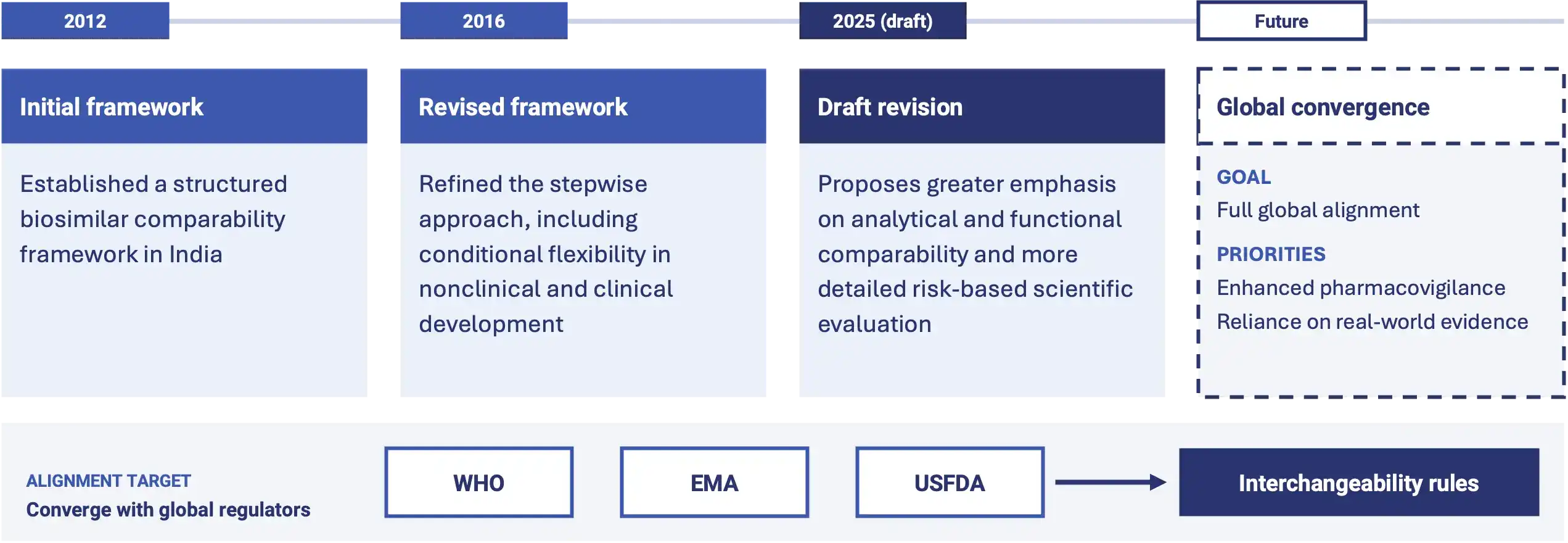
While the proposed 2025 revision retains Indias’ established stepwise approach to biosimilar development which replacing greater emphasis on advanced analytical and functional characterization. It further refines the scientific criteria for determining when additional animal studies or confirmatory clinical efficacy studies may be reduced or waived, subject to adequate scientific justification and regulatory acceptance. These provisions build on the flexibility already recognized under the 2016 guidelines.
Until the revised guidelines are formally finalized and implemented, the 2016 Guidelines remain the applicable CDSCO guidance for similar biologics, alongside the relevant statutory requirements under Indian law. Even so, manufacturers preparing dossiers today should pay close attention to three major shifts proposed in the draft:
- Stronger Analytical Rigor: The 2025 draft provides more detailed scientific guidance by calling for advanced orthogonal methods, in-house reference standards, predefined statistical similarity ranges, and multiple reference batches spanning product shelf life.
- Reduced Reliance on Animal Studies & Greater Clinical Flexibility: The draft places uncreased emphasis on in vitro evidence and further clarifies the conditions under which animal studies or confirmatory clinical efficacy trials may be waived. Comparative PK studies generally remain important, and any proposed waiver requires robust scientific justification and acceptance by the regulatory authority.
- Closer Global Alignment: The draft brings India closer to EMA, FDA, and MHRA expectations by clarifying rules on reference-product selection and immunogenicity testing, emphasizing neutralizing antibody assays for higher-risk products.
For a more detailed breakdown of the 2016 and draft 2025 requirements, see Appendix 1.
Bridging Current Law with Emerging Standards
While the May 2025 draft guidelines indicate the direction of India’s evolving scientific expectations , applicants must distinguish between binding statutory requirements and regulatory guidance. The applicable framework comprises the Drugs and Cosmetics Act, 1940, the Drugs Rules, 1945, and the New Drugs and Clinical Trials Rules, 2019, as amended, supplemented by CDSCO’s Similar Biologics Guidelines.
This regulatory architecture rests on an established triad of statutory instruments that govern every legal, clinical, and administrative aspect of the application:
- Drugs and Cosmetics Act, 1940 and Drugs Rules, 1945: The underlying legislation for importation, manufacture, sale, and licensing.
- New Drugs and Clinical Trials Rules, 2019: Govern new-drug approval, clinical trials, timelines, and Subject Expert Committee review.
- Guidelines on Similar Biologics, 2016: Provide the currently applicable CDSCO scientific and regulatory guidance for stepwise development and evaluation of similari biologics, pending finalization of the proposed 2025 revision.
Beyond the primary approval pathway, manufacturers must also navigate broader operational rules covering quality, post-market safety, and commercial pricing:
- Quality and manufacturing requirements: Encompass India's revised Schedule M for Good Manufacturing Practices (GMP) alongside applicable international standards.
- Pharmacovigilance requirements: Cover safety reporting, risk management, and periodic safety update reports.
- Drug price control framework: Certain medicines may be subject to the drug-price control framework administered by the National Pharmaceutical Pricing Authority.
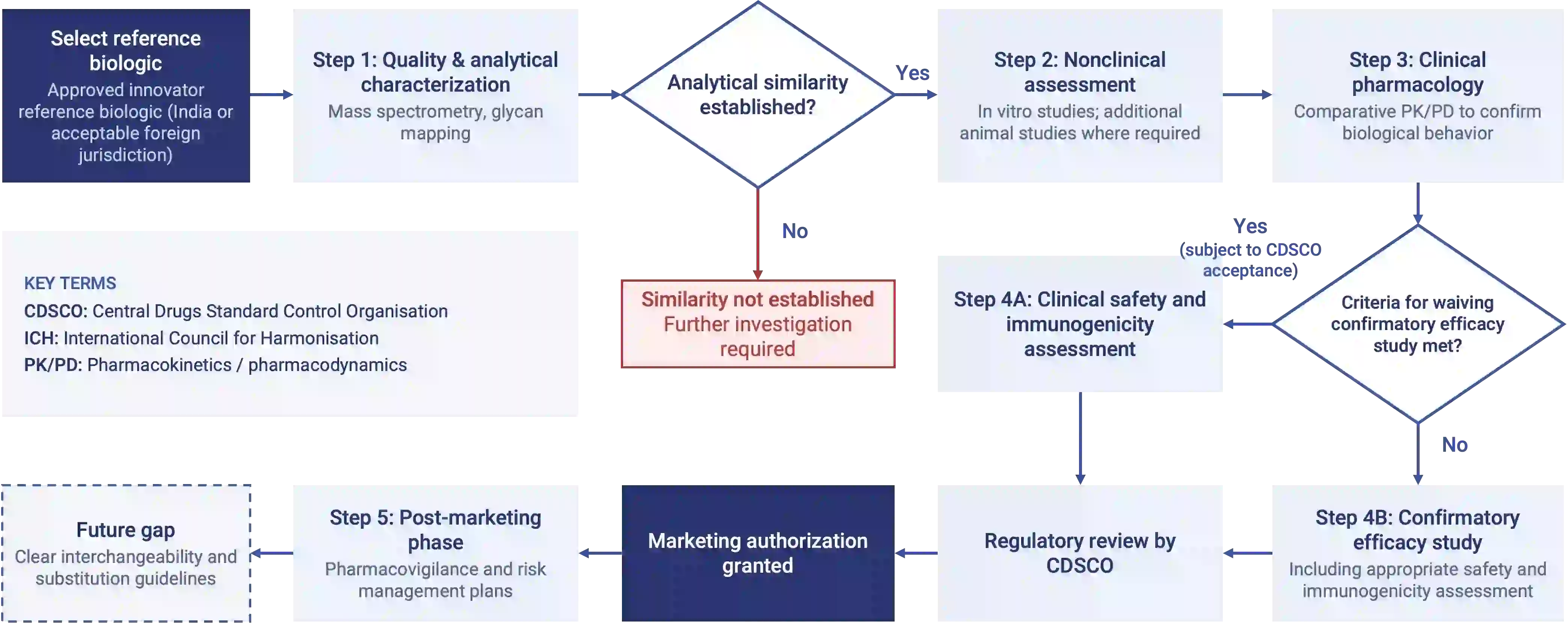
Note: Clinical development requirements and any waiver of confirmatory efficacy studies depend on the totality of evidence and CDSCO acceptance. Safety and immunogenicity assessment remain relevant in both pathways.
Strategic Considerations for Applicants
Because these overlapping legal and operational mandates govern every step of commercialization, managing regulatory execution requires careful foresight. As India transitions toward a more globally harmonized system, regulatory interpretation remains critical; a dossier built strictly for the US FDA or EMA can still trigger avoidable delays if it is not tailored to CDSCO and SEC expectations.
To support efficient regulatory development and approval, international applicants should anticipate six practical challenges:
- Preparing submissions in accordance with currently applicable regulatory requirements and guidance, while considering the scientific direction reflected in the proposed 2025 revisions.
- Appropriately sourcing and rigorously justifying an approved innovator comparator as part of a clear reference-product strategy
- Assessing the need for Indian clinical data, the acceptability of foreign clinical evidence and the scientific justification for any proposed reduction or waiver of clinical studies, subject to CDSCO requirements.
- Anticipating regulatory query cycles, as deficiency letters and Subject Expert Committee meetings can extend approval timelines if dossiers contain gaps
- Preparing both Indian and overseas manufacturing sites for applicable GMP assessments and inspections
- Managing ongoing post-approval obligations (including variations, pharmacovigilance, and periodic reporting) throughout the product's commercial lifecycle
Auditing these potential gaps well before submission positions applicants to anticipate committee questions, avoid redundant studies, and keep approval timelines on track.
Final Thoughts: Turning India's Biosimilar Opportunity into Market Access
India's biologics and biosimilar sector combines significant market potential with a modernizing regulatory framework. While the scientific direction is clear, evolving rules mean that precise execution and foresight dictate commercial success. Companies that plan early, map out the right regulatory pathway, and submit a cohesive, localized dossier will be best placed to avoid delays and reach patients efficiently.
Navigating CDSCO requirements requires a thorough understanding of India’s regulatory framework and its application in practice. Engaging experienced regulatory advisors early can help manufacturers identify dossier gaps, address India-specific requirements and reduce avoidable delays:
- Selecting the right approval pathway, mapping timelines, and auditing CMC, nonclinical, and clinical documentation against CDSCO expectations
- Developing scientifically sound waiver arguments or designing local bridging strategies and preparing for Subject Expert Committee meetings
- Managing SUGAM portal filings and drafting responses to regulatory deficiency queries.
- Handling lifecycle variations, pharmacovigilance, renewals, labeling, and NPPA price-control assessments
For manufacturers preparing an Indian application, contact Cisema today for support with building a compliant, localized regulatory strategy and streamlining your path to CDSCO approval.
Further Information
Appendix 1: Comparison of the 2016 Guidelines and the 2025 Draft Revised Guidelines
1. Scope and Regulatory Reach
- 2016 Guidelines: Covered well-characterized recombinant proteins, whether domestic or imported.
- Draft 2025 Guidelines: Maintains the same scope while introducing explicit new sections on underlying scientific principles, a dedicated import pathway (Annexure IA), critical quality attributes, and advanced statistical tools.
- Applicant Impact: The core scope remains broadly consistent, while the proposed revisions provide more detailed guidance on analytical characterization, quality attributes and scientific evaluation.
2. Reference Product Standards
- 2016 Guidelines: Required an innovator reference biological product approved on the basis of a complete quality, safety and efficacy data package. Another biosimilar could not serve as the reference product, and the same reference product was to be used throughout the comparability program.
- Draft 2025 Guidelines: Retains the established reference-product principles and provides further clarification regarding comparator selection, sourcing and use, including reference products not authorized in India.
- Applicant Impact: Comparator selection, sourcing, documentation and consistency remain fundamental considerations throughout development. The acceptability of the proposed comparator should be established early.
3. Quality and Analytical Characterization
- 2016 Guidelines: Required mandatory comparison of molecular structure alongside a stepwise comparability exercise.
- Draft 2025 Guidelines: Provides more detailed guidance on orthogonal analytical characterization, reference standards, batch-based comparability, and statistical approaches to evaluating similarity. Methods and acceptance criteria should be scientifically justified according to the criticality and characteristics of the quality attributes concerned.
- Applicant Impact: Applicants should establish a scientifically justified analytical comparability strategy, including appropriate reference batches, validated methods and statistical approaches where relevant.
4. Non-Clinical Evaluation
- 2016 Guidelines: Required a stepwise nonclinical assessment, including comparative in vitro studies and, where appropriate, in vivo pharmacodynamic and toxicity studies. Certain animal studies could already be omitted where sufficient scientific justification was available.
- Draft 2025 Guidelines: Places greater emphasis on comparative in vitro evidence and risk-based determination of the need for additional animal studies. Toxicity studies may be waived where justified and accepted by the Licensing Authority, while product differences or unresolved safety concerns may require further nonclinical investigation.
- Applicant Impact: Applicants should develop a robust in vitro comparability package and scientifically justify the need for, or omission of, additional animal studies.
5. Clinical Development Strategy
- 2016 Guidelines: Required comparative clinical evaluation, including PK/PD, safety and immunogenicity assessment, and, generally, a confirmatory efficacy study. The guidelines already provided for waiving confirmatory efficacy studies under specified conditions, subject to regulatory acceptance.
- Draft 2025 Guidelines: Further refines the criteria for tailoring the clinical development program based on the totality of analytical, functional, nonclinical, and PK/PD evidence. Waiver of confirmatory efficacy studies may be considered under defined conditions, including the availability of appropriate validated PD markers, while comparative safety and immunogenicity assessment remain important.
- Applicant Impact: The possibility of reducing confirmatory clinical studies is product-specific and requires robust scientific justification. Applicants should assess the feasibility of a waiver early, particularly for molecules without suitable validated PD markers.
6. Immunogenicity Assessment
- 2016 Guidelines: Required comparative pre-approval immunogenicity assessment and continued post-marketing monitoring, including for products where confirmatory efficacy studies were waived.
- Draft 2025 Guidelines: Provides more detailed guidance on risk-based immunogenicity assessment, including anti-drug antibody testing, neutralizing antibodies, assay selection and potential clinical consequences. The extent of testing should be justified based on the immunogenicity risk associated with the product.
- Applicant Impact: Requires an early, documented immunogenicity risk assessment integrated directly into the clinical dossier.
References
- Biotechnology Industry Research Assistance Council (BIRAC). Indian Bioeconomy Report 2026. 2026.
- Central Drugs Standard Control Organization (CDSCO) and Department of Biotechnology (DBT). Guidelines on Similar Biologics: Regulatory Requirements for Marketing Authorization in India (Draf…. New Delhi: CDSCO; 2025.
- Central Drugs Standard Control Organization (CDSCO) and Department of Biotechnology (DBT). Guidelines on Similar Biologics (Revised 2016). New Delhi: CDSCO; 2016.
- Choudhari KV, Pise AG, Nakade DS. The Biosimilar Market in India: Regulatory Landscape, Challenges, Opportunities, and Interchangeabi…. Journal of Advanced Applied Research and Finance (JAAFR). 2026;4(5).
- India Brand Equity Foundation (IBEF). Biotechnology Industry in India. August 2026.
- Ministry of Finance. Union Budget 2026–27: Budget Speech. New Delhi: Government of India; 2026.
- Ministry of Health and Family Welfare. New Drugs and Clinical Trials Rules, 2019. G.S.R. 227(E), March 19, 2019. New Delhi: Government of India; 2019.
- Raj A, Dabral K. Regulatory Framework for Approval of Biosimilars in India: Gaps and Future Perspectives. International Journal of Pharmaceutical Sciences. 2026;4(5):7469–7489.
Connect with Cisema
With more than 20 years of experience and a team of over 100 specialists, Cisema helps global companies achieve compliance across Asia Pacific with confidence and accelerate market entry.
Stay Informed with Monthly News and Analysis
Stay informed with the latest regulatory changes, expert insights, and market opportunities across APAC, delivered straight to your inbox.
Related Articles
Understand what’s driving India’s growing biopharma and biosimilar market, covering the regulatory framework, draft guideline changes and applicant challenges.

Learn how the BPJPH process works for foreign certificates (SHLN) and regular SIHALAL applications.

Discover how overseas medical companies can access China early via the GBA Connect Pathway, with a 5-step process and hospital coordination tips.