
Published on
Last updated on
What Is a Malaysia Conformity Assessment Body (CAB)?
.webp)
Expanding into Malaysia’s growing medical device market offers tremendous opportunities. However, depending on your device’s classification, success can hinge on the Conformity Assessment Body (CAB) — a key part of Malaysia’s medical device framework.
Read on to learn how the process is structured, what determines your route to approval, and how strategic preparation can accelerate your market entry. Or get in touch with Cisema today for expert support through each stage.
Understanding the Conformity Assessment Process
What exactly does conformity assessment involve, and how does it fit into the broader medical device registration process in Malaysia? In this section, we’ll break down the key components to give you a clear understanding.
What Is a Conformity Assessment?
A conformity assessment is an independent evaluation that confirms a medical device meets Malaysia’s essential principles for safety and performance (EPSP) as defined by the Medical Device Act 2012 (Act 737). Simply put, it proves your device is safe, effective and compliant.
How this proof is evaluated depends on several factors:
- The nature of your device
- Its risk classification
- The organisation performing the assessment.
To demonstrate compliance, applicants must provide evidence that the medical device meets the relevant Essential Principles and justify any principles deemed not applicable.
Before any review can begin, one critical step must be completed: determining your device’s classification within Malaysia’s risk-based system.
How Risk Classification Determines Your Path
In Malaysia, devices are categorised by risk level, which dictates not only the depth of review, but also whether you’ll need to engage a Conformity Assessment Body (CAB).
The table below summarises the different medical device risk categories in Malaysia, along with whether they are exempt from Conformity Assessment.
Accurately determining your device’s class is crucial as it shapes:
- Your documentation strategy
- Your review timeline
- The type of regulatory partners you’ll need (e.g., a CAB)
Once you know your classification, you’re ready to engage the right CAB and select the most appropriate assessment route.
What Is a Conformity Assessment Body (CAB)?
A CAB is an independent organisation approved by the Malaysia Medical Device Authority (MDA) and responsible for reviewing and certifying Class B, C, and D medical devices. Once your device’s classification is confirmed, the CAB becomes your primary regulatory partner, tasked with:
- Reviewing your technical documentation.
- Confirming that safety and performance claims are properly supported.
- Issuing a certificate and detailed report confirming compliance.
These documents are essential components of your final registration dossier submitted to the MDA.
But how the CAB assesses your documentation depends on which evaluation route your device qualifies for.
The Two Conformity Assessment Routes in Malaysia
Once your device classification is confirmed and your documentation is ready, the next step is selecting the right conformity assessment pathway. Malaysia offers two main routes, determined largely by whether your device has prior approval from recognised reference authorities and the level of supporting evidence available.
Both routes culminate in CAB certification and subsequent registration with the MDA. However, they differ in evaluation depth and documentation requirements.
Route 1: Verification Process for Reference-Market-Approved Devices
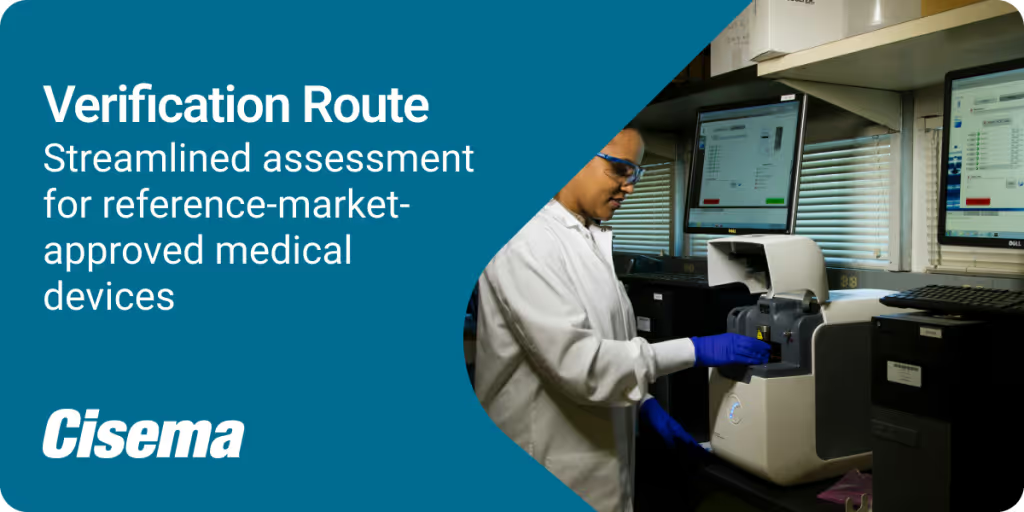
The Verification Process provides a streamlined pathway for medical devices currently approved by trusted reference authorities. These include:
- US FDA
- EU Notified Bodies
- Japan MHLW
- Australia TGA
- Devices bearing a CE mark
To qualify, medical devices must also:
- have been marketed for at least one year in the respective authority’s jurisdiction
- have the same design and intended purpose as the version approved by the recognised competent authority
- have no global safety issues reported in the past year when used as intended by the manufacturer, such as death or serious deterioration in a person’s health.
As these devices have already undergone rigorous assessments by recognised regulators, the CAB focuses on verifying that the existing technical documentation and test data comply with Malaysia’s regulatory requirements. This avoids repeating previous evaluations, making it a simpler, faster, and more cost-effective route for applicants.
Key details:
- Timeline: Around 1 month
- Outcome: Verification certificate and report for MDA submission
- Advantage: Faster route to market with minimal re-evaluation
This route offers an efficient path to market for manufacturers with established documentation. However, Malaysia may require specific formatting or documentation structures. Partners like Cisema help manufacturers in adapting their dossiers to MDA requirements, ensuring a smooth verification process.
Route 2: Full Evaluation for Non-Reference-Market Devices
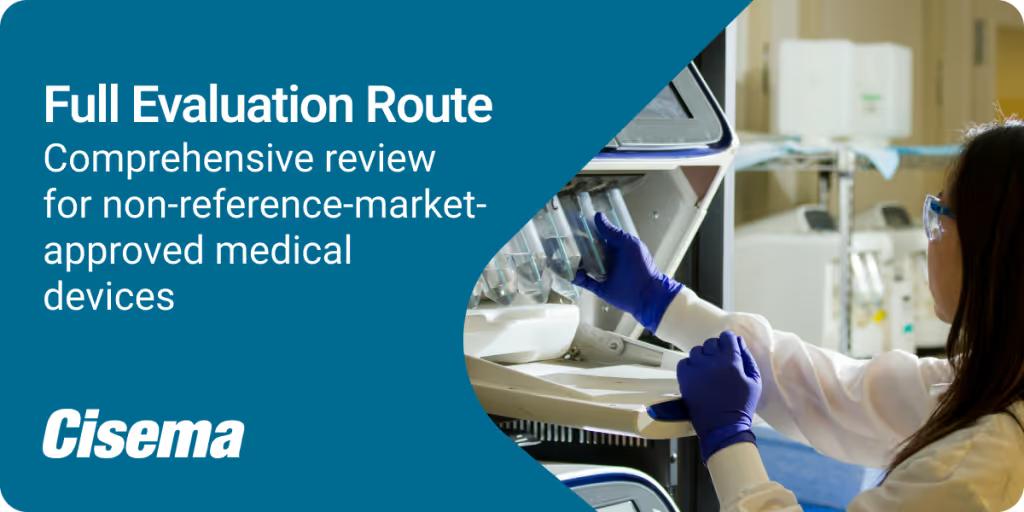
The Full Evaluation route applies to devices that have not been approved by the defined reference authorities, such as those only registered with agencies like:
- Brazil National Health Surveillance Agency (Anvisa)
- Russia Federal Service for Surveillance in Healthcare (Roszdravnadzor)
Here, the CAB conducts a thorough, start-to-finish review of your device’s design, risk management, clinical or performance data, and overall compliance with Malaysia’s Essential Principles of Safety and Performance.
Key details:
- Timeline: Typically 2 to 3 months after evaluation begins
- Outcome: Full conformity assessment certificate and report for MDA submission
Though more detailed and time-intensive, this process enables manufacturers without prior approvals to fully prove compliance and establish credibility in Malaysia. Meticulous preparation and proactive coordination help keep the process efficient and predictable.
How to Choose the Right CAB in Malaysia
With your device class and route determined, selecting the right CAB becomes your next critical decision. The right CAB will set clear expectations, establish predictable timelines, and reduce unnecessary back-and-forth during the approval process.
Malaysia currently has around 24 MDA approved CABs (full list here), each accredited for specific product categories and technical codes with differing registration fees and processing timelines.
To select the best CAB for your product, consider these steps:
- Identify CABs accredited for your device’s category and technical code.
- Confirm documentation and testing requirements early.
- Obtain quotations and agree on assessment timelines.
- Initiate the Verification or Full Evaluation process.
- Maintain close coordination with your CAB through your local license holder.
Many manufacturers choose to work with experienced local representatives like Cisema, who specialise in matching products with suitable CABs, aligning documentation with MDA standards, and ensuring a smooth, efficient approval process.
Step-by-Step: How to Register a Medical Device in Malaysia
Once your CAB assessment is complete, the next phase is registration with the MDA. The certificates and reports issued by the CAB form the foundation of your registration dossier, and MDA approval is what ultimately grants you market access.
Here’s how to move through the registration process efficiently:
- Prepare all technical documentation according to MDA requirements.
- Appoint a registered CAB to perform the conformity assessment (Verification or Full Evaluation pathway).
- Receive the CAB certificate and report after successful evaluation.
- Submit the full dossier via the MeDC@St online system through your appointed local license holder.
- Obtain final approval from the MDA and begin marketing your device.
Partnering with a knowledgeable local representative can help you navigate these steps with confidence and avoid unnecessary delays.
Learn more about the step-by-step process and compliance essentials in our full guide to Medical Device Registration in Malaysia.
Common Pitfalls and How to Avoid Them
Even with a solid plan, small oversights can cause major delays in the CAB and MDA process. Below are some common challenges and how to avoid them:
By anticipating these challenges and following best practices, manufacturers can streamline both CAB assessment and MDA registration, reducing costly back-and-forth and achieving faster market access.
Final Thoughts: Getting Your Medical Device Approved in Malaysia
The conformity assessment process is central to registering Class B, C, and D medical devices in Malaysia. As outlined in this guide, understanding your device classification, identifying whether the Verification or Full Evaluation route applies, and choosing the right Conformity Assessment Body are key steps toward approval. With these elements in place—and the support of an experienced local license holder — you can navigate the process smoothly and achieve compliant market access in Malaysia.
As an independent license holder with a local office in Penang, Cisema acts and long-term partner for manufacturers seeking efficient, compliant market entry. From coordinating with accredited CABs and preparing technical documentation to managing license holding and post-market responsibilities, our team ensures your path to approval is clear and predictable.
Get in touch with Cisema today to discuss your how we can help your medical device enter the Malaysian market.
Further Information
- Explore our Malaysia Medical Device Registration Services and discover how Cisema supports manufacturers enter the Malaysian market.
- Read our Malaysia Medical Device Registration Tips to better understand the process and requirements under the Medical Device Authority.

References and Resources
- “Conformity Assessment for Medical Device” Guidance Document – Medical Device Authority (MDA), Malaysia
- “Conformity Assessment Body (CAB)” Definition – Medical Device Authority (MDA), Malaysia
- “Conformity Assessment Body (CAB) Guide for Conducting Conformity Assessment by Way of Verification” – Medical Device Authority (MDA), Malaysia
- “The Essential Principles of Safety and Performance of Medical Devices” – Medical Device Authority (MDA), Malaysia
- Medical Device Act 2012 (Act 737) – English Version – Medical Device Authority (MDA), Malaysia
- Medical Device Act 2012 (Act 737) – Bahasa Melayu Version – Medical Device Authority (MDA), Malaysia
- Registered Conformity Assessment Body Search – Medical Device Authority (MDA), Malaysia
- Official Portal of the Medical Device Authority (MDA) Malaysia – Medical Device Authority (MDA), Malaysia
FAQ: Conformity Assessment and CAB Certification in Malaysia
What’s the difference between CAB certification and MDA registration?
A Conformity Assessment Body (CAB) certifies that a medical device meets Malaysia’s essential principles for safety and performance, whereas the Medical Device Authority (MDA) reviews the CAB’s certification and documentation to grant final product registration approval.
Which medical devices require CAB assessment in Malaysia?
All Class B, C, and D medical devices must undergo conformity assessment with a registered CAB. Class A devices, which pose the lowest risk, are exempt from this requirement.
How long does the CAB assessment process take?
The timeline depends on your assessment route. The Verification process usually takes around one month, while the Full Evaluation typically takes two to three months after submission to the CAB.
Where can I find a list of registered CABs in Malaysia?
The official list of MDA-approved CABs is available on the Medical Device Authority Register. Each CAB is accredited for specific product categories and technical codes.
What happens after I receive the CAB certificate and report?
Once your CAB assessment is complete, your local license holder will submit the CAB certificate and report to the MDA as part of your registration dossier. The MDA will then conduct its final review and issue your product registration approval, allowing you to market your medical device in Malaysia.
Connect with Cisema
With more than 20 years of experience and a team of over 100 specialists, Cisema helps global companies achieve compliance across Asia Pacific with confidence and accelerate market entry.
Stay Informed with Monthly News and Analysis
Stay informed with the latest regulatory changes, expert insights, and market opportunities across APAC, delivered straight to your inbox.
Related Articles

Understand the key differences between China Medical Device GMP and ISO 13485, including requirements for quality management, suppliers, facilities and documentation.

Learn when medical device and IVD changes in Indonesia require a notification, variation, or new registration, and how to maintain ongoing regulatory compliance.

Discover how leveraging Real World Data generated in the Greater Bay Area can accelerate market entry for medical products in China.