
Published on
Last updated on
5-Step Guide to Taiwan Medical Device Classification (TFDA)

Misjudging your medical device classification in Taiwan can derail your launch timeline before registration even begins. Because Taiwan does not simply adopt foreign approvals from the U.S. or EU, manufacturers must navigate the Taiwan Food and Drug Administration's (TFDA) distinct system from scratch. Misstep here, and you risk costly approval delays, unexpected clinical requirements, or outright rejections.
The core test comes down to one central question: Does your product match the exact scope of an existing TFDA classification entry?
This guide walks through five steps to answer that question and explains what to do when the classification is not clear-cut. Need tailored support? To navigate the registration process and register your medical device in Taiwan, contact Cisema today.
Taiwan Medical Device Definition: Is Your Product Regulated as a Medical Device?
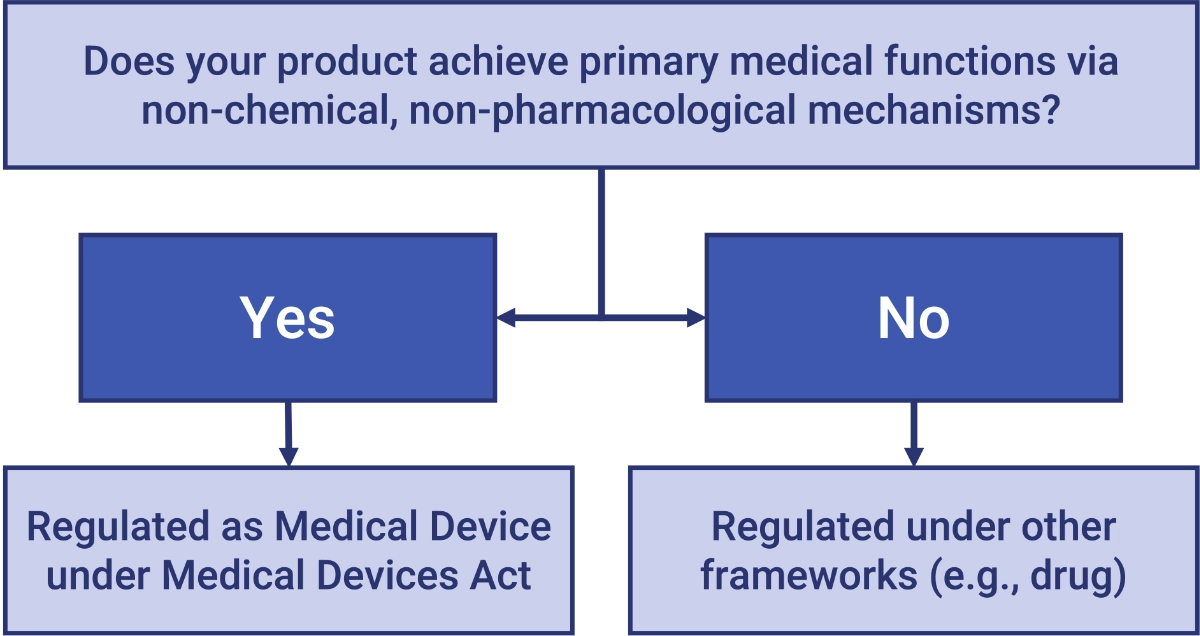
Before asking which risk class applies, resolve the most fundamental question: Does Taiwan consider the product a medical device?
Foreign manufacturers can easily get this wrong by assuming a U.S. FDA or EU CE designation automatically carries over to Taiwan. It does not.
Under Article 3 of Taiwan’s Medical Devices Act, a medical device is an instrument, machine, apparatus, substance, software, or in vitro diagnostic reagent designed to achieve a primary medical function in or on the human body through non-pharmacological, non-immunological, non-metabolic, and non-chemical means.
The definition covers products intended to:
- Diagnose, treat, alleviate, or directly prevent disease
- Regulate or improve the structure or function of the human body
- Regulate conception
Two points deserve particular attention.
- Look at how the product works. If its primary action is metabolic or chemical, it may fall under pharmaceutical regulation rather than the medical device framework.
- Do not assume a medical device must be hardware. Liquids, gels, and other substances can fall within the definition when their primary action is physical or mechanical.
Once the product is confirmed as a medical device in Taiwan, the next step is to determine its risk classification.
Taiwan Medical Device Classification System: Class I, Class II, and Class III
Under the Regulations Governing Categorization and Classification of Medical Devices, Taiwan divides medical devices into 16 categories, A through P, based on factors such as function, intended use, operating method, and technology.
These categories help identify where to look in the Taiwan medical device classification system, but they do not determine the device’s risk class.
Medical devices are assigned to one of three risk classes:
- Class I (Low Risk): Typically subject to streamlined administrative listing procedures.
- Class II (Medium Risk): Requires detailed technical documentation and quality management system evidence.
- Class III (High Risk): Demands comprehensive safety and performance files, clinical evaluation reports, or local clinical trial data.
Note: Taiwan’s three-tier model does not map 1:1 onto the other jurisdictions’ medical device risk classification systems, such as the EU’s four-tier structure (Class I, IIa, IIb, III). Foreign classifications can provide useful background, but the product must be assessed under Taiwan’s own classification rules.
Taiwan Medical Device Classification Catalog
To connect a physical device to one of these three risk classes, the TFDA relies on an official Classification Catalog containing over 1,800 active entries.
Every entry in this catalog contains five specific data points:
- Item code
- Chinese name
- English name
- Assigned risk class
- Identification Scope (鑑別範圍) — The definitive legal text defining the entry's boundaries
That final element is critical. Finding a similar product name is only the beginning; the Identification Scope determines whether the entry actually applies to your medical device.
5 Steps to Determine Medical Device Classification in Taiwan
With the framework established, the classification assessment can be approached as a straightforward product-matching exercise.
Step 1: Define the Product’s Intended Use and Characteristics
Start with the product itself, not a classification code.
Document the characteristics that will determine where the product may fit within Taiwan’s system, including:
- Intended use
- Primary function
- Method of use
- Working principle
- How the product acts on the body
- Physical characteristics
- Whether it is an accessory or part of a combination product
- Whether it contains or incorporates a drug
This gives you the technical profile needed to identify potential catalog entries.
Step 2: Search the TFDA Medical Device Classification Database
Use that profile to search the TFDA Medical Device Classification Catalog and identify potential entries.
The A–P categories can help narrow the search, but treat the results as candidates, not confirmed classifications.
A product may appear to fit several entries. Equally, an apparently obvious match may prove unsuitable once its Identification Scope is examined.
Step 3: Compare the Product with the TFDA Identification Scope
This is the most important part of determining medical device classification in Taiwan. For each potential TFDA classification entry, compare the product directly against the full Identification Scope (鑑別範圍).
Check:
- Intended use: Does the product perform the function described?
- Technology: Does its operating principle or method match?
- Configuration: Do its relevant physical and technical characteristics fit?
- Exclusions: Does the entry exclude the product, its materials, configuration, or intended use?
- Conditions: Does the entry specify characteristics that affect its classification?
This is often where an apparently obvious classification falls apart.
A product with the same commercial name may not qualify if its characteristics fall outside the Identification Scope. Likewise, a product with a completely different brand or commercial name may fit an existing entry if its characteristics meet the scope.
Step 4: Apply the Correct Taiwan Medical Device Risk Class
Once the product meets the Identification Scope, apply the risk class assigned to that entry.
However, do not assume every entry has one fixed class. Some have split classifications, where the risk class changes depending on how the product operates or is configured.
Take L.5900 Therapeutic Vaginal Douche as an example:
- Gravity-Fed Mechanisms: Classified as Class I.
- Motorized / Pressure-Driven Systems: Elevates the device to Class II.
- Scope Exclusion: The irrigation liquid itself is explicitly excluded from L.5900 and requires an independent pharmaceutical or device assessment.
The takeaway is simple: medical device classification can depend on how a product works, not just what it is called. This is why reading only the catalog title, or even the assigned class, can therefore lead to the wrong conclusion.
Step 5: Document the Classification Rationale
Once the applicable entry has been identified, document why it applies.
The classification rationale should link the product’s technical characteristics to the selected TFDA entry and its Identification Scope. Keep this assessment in the regulatory file as the basis for the medical device classification decision.
If the classification is clear, proceed with the relevant Taiwan medical device listing or registration pathway. If uncertainty remains, use Taiwan’s additional classification rules and formal inquiry process rather than forcing the product into an unsuitable category.
What If No Taiwan Medical Device Classification Entry Applies?
Some products will not fit neatly into one catalog entry. This can be particularly challenging for novel technologies, multifunctional devices, accessories, and combination products.
When the five-step assessment does not produce a clear Taiwan medical device classification, the regulations provide additional ways to resolve the issue.
Article 4: What Happens When Multiple Rules Apply?
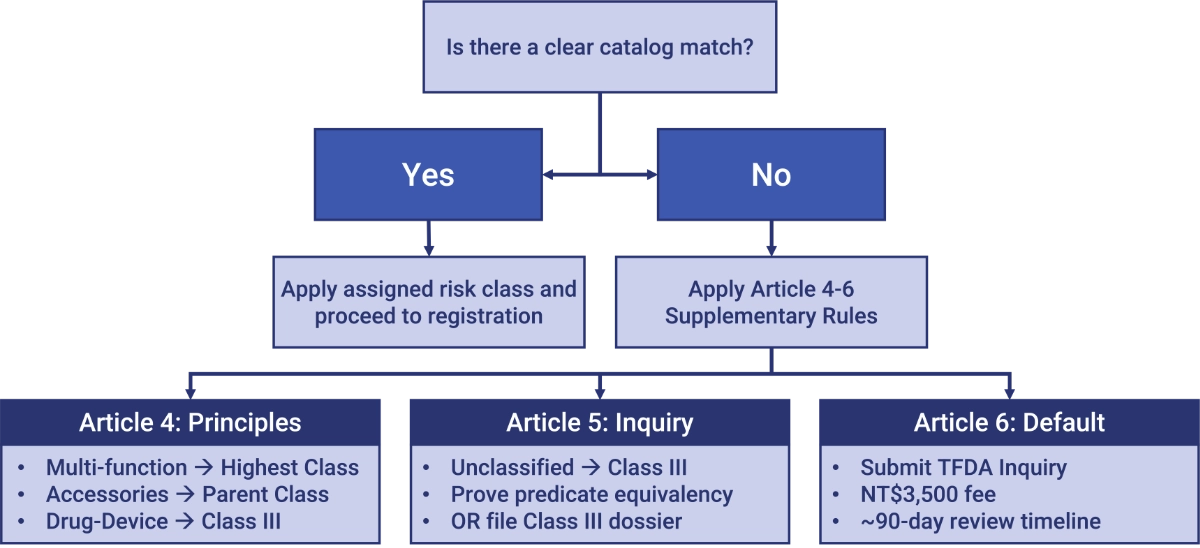
When a product has complex characteristics, Article 4 of the Regulations supplies clear rules of hierarchy:
- Multiple Functions / Classifications: The highest applicable risk class governs the entire device
- Dedicated Accessories: Accessories explicitly intended for a parent device inherit that device’s classification, unless the catalog specifies otherwise
- Combination Products: Systems combining multiple devices default to the highest individual component class
- Drug-Device Combination Products: Devices incorporating an ancillary medicinal substance default to Class III if the principal action is device-based
These rules help prevent manufacturers from selecting a lower-risk classification simply because one component of a product would qualify for it.
Article 6: What If There Is No Applicable Catalog Entry?
If a novel technology falls completely outside the existing Taiwan medical device classification catalog, Article 6 provides a Class III default.
Where a similar product has already been approved in Taiwan, however, the manufacturer may be able to use evidence relating to that product as part of the applicable regulatory pathway.
Article 5: Still Unsure? Ask the TFDA
If the classification cannot be resolved through the catalog and applicable rules, manufacturers can submit a formal TFDA Medical Device Classification Inquiry.
Fee & Timeline
Requires an official fee of NT$3,500 per application and has a statutory review timeframe of up to 90 calendar days.
Required Documentation
- The completed inquiry form
- The manufacturer’s product instructions covering method of use, function and working principle (with a Chinese or English translation if the original is in neither)
- Any existing US, EU or other classification data, which may be omitted if none exist.
Foreign approvals can be included as supporting information, but they do not determine the outcome.
Avoiding Common Taiwan Medical Device Classification Pitfalls
Understanding the most common classification mistakes can help manufacturers avoid unnecessary delays during medical device registration in Taiwan:
Final Thoughts: Don't Classify by Name Alone
Taiwan’s medical device classification system is easier to navigate once you stop looking for the closest product name and start looking at the regulatory scope.
The key is evaluating precisely what your product does, how it operates, and how it interacts with the body against the official Identification Scope of the catalog entry. Getting this assessment right from day one eliminates guesswork, clarifies your registration pathway, and keeps your commercial launch on track. Even when novel technologies create uncertainty, formal TFDA inquiry channels exist to give you clear, definitive answers.
Navigating these regulatory nuances is much easier with local expertise on your side. Through our local office in Taiwan, Cisema acts as your direct bridge to the TFDA, helping you evaluate catalog entries, manage formal classification inquiries, and execute seamless medical device registrations.
For support with Taiwan medical device classification, TFDA classification inquiries, or medical device registration in Taiwan, contact Cisema today.
Further Information
Explore Cisema’s services for medical device registration in Taiwan.
References
- Taiwan Medical Devices Act, Article 3
- Medical Devices Act – Official English Translation
- Regulations Governing Categorization and Classification of Medical Devices
- TFDA – Classification Catalog / Appended Table
- TFDA – Amendment History of the Regulations
- TFDA – Application for Medical Device Classification Inquiry
- TFDA Medical Device Classification Database
Connect with Cisema
With more than 20 years of experience and a team of over 100 specialists, Cisema helps global companies achieve compliance across Asia Pacific with confidence and accelerate market entry.
Stay Informed with Monthly News and Analysis
Stay informed with the latest regulatory changes, expert insights, and market opportunities across APAC, delivered straight to your inbox.
Related Articles

This guide explains Singapore’s HSA regulatory system and why it is a strategic first step for entering Southeast Asian markets with medical devices, pharmaceuticals, and cosmetics.
.avif)
Learn 5 key steps for China dental medical device registration, covering classification, biocompatibility testing, and legal agent selection.

Learn how a smart clinical trial strategy for medical devices in China can speed up NMPA approval and bring your product to market faster.