
Published on
Last updated on
China CEL Update: 2025 Energy Efficiency Label Catalogue & Implementation Rules
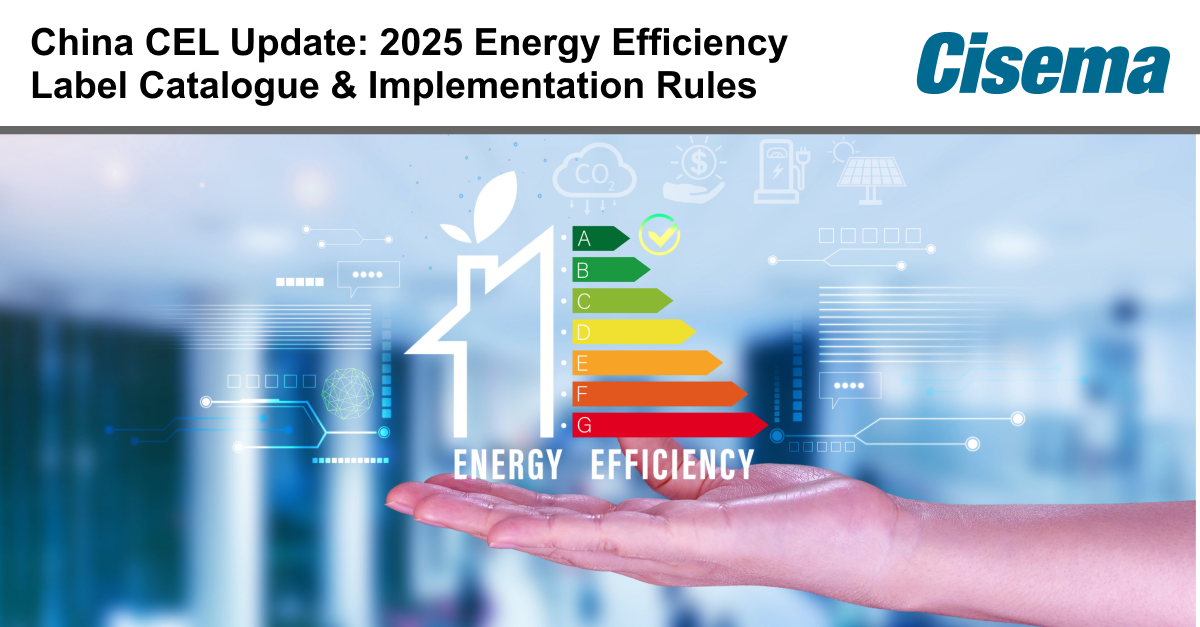
On 17th September 2025, the National Development and Reform Commission (NDRC) and the State Administration for Market Regulation (SAMR) jointly issued a notice regarding the "Product Catalogue for Energy Efficiency Labels of the People’s Republic of China (2025 Edition)" and the relevant implementation rules (Document No. [2025] 1218).
The revised catalogue now covers 38 product categories, with the first implementation deadline set for 1st November 2025 for household and similar-use kitchen appliances. Products manufactured or imported before the respective category’s deadline will have a grace period for compliance, with the final grace period expiring on 1st April 2028.
China Energy Efficiency Label: Policy Background
Since the introduction of the Energy Efficiency Labelling Management Measures in 2005, the China Energy Label has been key in improving the energy efficiency of both consumer and industrial products. However, with rapid technological advances and changing market demands, the original framework no longer fully meets current needs.
To address this, the NDRC and SAMR have updated the labelling system to better align with modern technologies and the evolving market landscape.
Key Changes in China’s 2025 Energy Efficiency Labelling Update
The 2025 Edition brings two core sets of updates: an expanded product catalogue and revised implementation rules. Together, they reshape how energy efficiency will be measured, verified, and communicated to consumers and regulators.
The principal areas of change are outlined below:
Expansion of the Product Catalogue
The new catalogue significantly broadens the scope of products required to display energy efficiency labels. In addition to refining the classification and definitions of existing categories, it now covers a series of high-energy-consuming products.
The revised catalogue includes, among others:
- Household and similar-use kitchen appliances
- Permanent magnet synchronous motors
- Air purifiers
- Microcomputers
- Gas cookers
- High-voltage three-phase squirrel-cage asynchronous motors
- Commercial refrigeration equipment
Key Revisions in the Energy Efficiency Labelling Implementation Rules
The updated implementation rules introduce several key optimisations:
- Standardisation of Labelling Content: Clearer requirements for the information displayed on energy efficiency labels—including product details, energy efficiency grades, and performance indicators—ensure greater transparency and comparability across products.
- Updated Testing Methodologies: The introduction of more advanced and precise testing procedures for certain products improves the reliability and reproducibility of test results.
- Stricter Supervision and Management: Enhanced oversight mechanisms strengthen the inspection and enforcement of energy efficiency labels. The updated rules also clarify the responsibilities of manufacturers, retailers, and testing organisations to ensure the effective enforcement of the labelling system.
Implementation Timeline
The policy will roll out in stages between late 2025 and early 2026, allowing manufacturers and importers a two-year grace period for stock adjustment and technical compliance:
Product CategoryImplementation DateGrace Period for Pre-existing ProductsHousehold and similar-use kitchen appliances1st November 2025Until 1st November 2027Permanent magnet synchronous motors, air purifiers1st January 2026Until 1st January 2028Microcomputers1st February 2026Until 1st February 2028Gas cookers1st March 2026Until 1st March 2028High-voltage three-phase squirrel-cage asynchronous motors, commercial refrigeration equipment1st April 2026Until 1st April 2028
This phased approach allows businesses to adapt their production, testing, and labelling processes to meet the new standards.
Impact of the China Energy Efficiency Label Update on Manufacturers
Manufacturers will need to ensure their products meet the new energy efficiency standards and are properly labelled to continue selling in the Chinese market. Products that don’t comply with these updated requirements may be phased out as high-energy-consuming models lose market access. This shift will drive investment in research and development, with energy-efficient products gaining a competitive edge.
As energy-efficient products gain momentum, the policy is expected to stimulate growth in related industries and contribute to the development of a greener economy.
Next Steps for Foreign Manufacturers
Foreign companies planning to sell products in China should start preparations promptly to ensure full compliance with the updated energy efficiency requirements. To facilitate a smooth transition, the following steps are recommended:
Confirm if Products Require Energy Efficiency Labelling
Begin by reviewing your product catalogue to identify which items fall under the 38 categories subject to energy efficiency labelling as per the 2025 update. This step helps ensure that you target only the products requiring compliance, enabling you to focus efforts efficiently and align your actions with the applicable timelines and grace periods.
Conduct Energy Efficiency Testing for Compliance
For products that fall under the scope, conduct testing—either in-house or through an accredited third-party laboratory—to verify that your products meet the required energy efficiency grades and performance criteria.
Update Product Design & Packaging As Needed
Once testing is complete and results are in, you can proceed with the following adjustments to ensure compliance.
- Design Updates: Adjust product designs as needed based on the test results to meet the new energy efficiency standards.
- Packaging and Labelling: Update the product packaging to accommodate the new energy efficiency label, ensuring all required details are clearly displayed.
After making these adjustments, gather the necessary documentation—such as the business license, energy efficiency test report, and a sample of the energy efficiency label—for energy label registration before products are imported or manufactured.
Final Thoughts
The 2025 revision of China’s energy efficiency labelling framework demonstrates the government’s commitment to sustainability and market transparency. For both domestic and international manufacturers, timely compliance is crucial for market access and competitiveness in an energy efficiency-driven market.
For companies seeking support, Cisema—a regulatory consultancy with over 20 years of on-the-ground expertise in China—can assist with CEL registration for electronic devices. Get in touch today to ensure a smooth and compliant transition under the updated regulations.
Further Information
Discover Cisema’s certification services in China: Cisema Certification Services
References
Read the NDRC and SAMR joint notice in Simplified Chinese:
Download the Energy Efficiency Labelling Catalogue in Simplified Chinese:
Connect with Cisema
With more than 20 years of experience and a team of over 100 specialists, Cisema helps global companies achieve compliance across Asia Pacific with confidence and accelerate market entry.
Stay Informed with Monthly News and Analysis
Stay informed with the latest regulatory changes, expert insights, and market opportunities across APAC, delivered straight to your inbox.
Related News

Hong Kong Requires MDACS Listing for Injectable Dermal Fillers by March 1, 2027
New requirements could affect how injectable devices, including dermal fillers, are supplied in Hong Kong’s private healthcare sector.

China Enacts First Healthcare Security Law: Impact on Global Medtech
China’s new Healthcare Security Law affects medical device reimbursement, health economic evidence, payment models, and digital traceability from 2027.

Indonesia Mandates Pre-Shipment Halal Verification for Imported Products
BPJPH Regulation No. 4 of 2026 introduces pre-shipment halal verification and LPPH reports for imported goods starting September 2026.