
News

NMPA published a notice addressing the work items for medical device sampling inspection, reinspection, objections and appeals, etc.
The NMPA drafted a guidance document to include human factors/usability engineering (HFE) for the registration of medical devices.

The Standardization Administration of China released the GB 9706.1-2020 addressing new safety and performance requirements for medical electrical equipment.

Once a medical device is approved for use within the Pilot Zone, hospitals can use a special pathway to apply for NMPA registration in China.

NMPA solicites public opinions on the draft proposal to reclassify IVD reagents in the 6840 Classified Subdirectory (2013 Version).
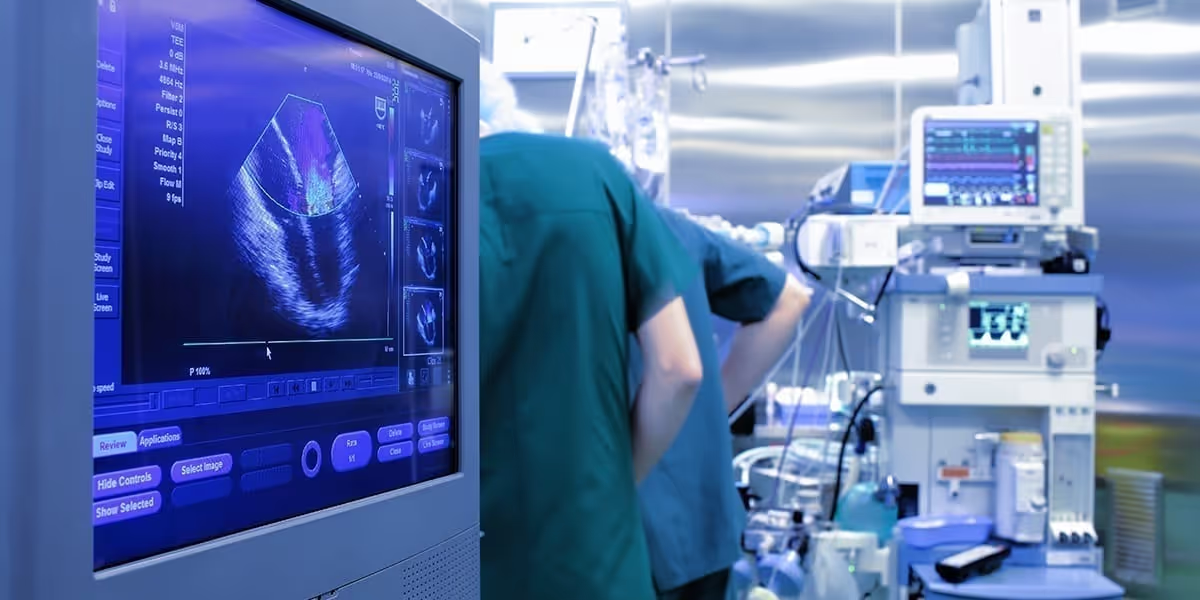
The UDID was officially released to the public, allowing users to use the search tool, download, and data sharing features.

Hainan MPA utilizes real-world data application and other measures to enhance the healthcare industry development in the Hainan Free Trade Zone.
The NMPA made temporary rearrangements for the submission of notarized documents for medical device registration applications due to the COVID-19 outbreak.
Exporting coronavirus protection supplies in China requires the declaration of conformity and the overseas product registration certificate.
In response to the coronavirus epidemic, NMPA guides the suitable pathway for the registration application of different types of medical supplies in China.

The NMPA announced the fast-track approval for Edwards Lifesciences’ transcatheter valve repair clip device, utilizing the special review procedure.
On 29.04.2020, the National Center for Adverse Drug Reaction (ADR) Monitoring of NMPA (National Medical Products Administration) released its 2019 Annual Report, providing an overview of China’s progress for medical device adverse event monitoring and reporting. Key highlights are:
The total number of adverse event reports reduced by 2.61%
In 2019, there were 396,345 adverse events reported in China, a decrease of 2.61% as compared to 2018.
Severe injury reporting cases decreased sharply by 10.17%
In 2019, 0.05% (213 reports) of the total adverse events reported death cases, an increase of 70.6% as compared to 2018.
In 2019, 6.74% (26,723 reports) of the total adverse events reported severe injury cases, a significant decrease of 10.17% as compared to 2018.
Mainly medical institutions and consumers
In 2019, 357,799 adverse events were reported by users (medical institutions and consumers), 8,600 adverse events were reported by NMPA Legal Agents and 29,833 adverse events were reported by manufacturers.
42.07% of the total adverse events reported related to infusion, care and protective equipment
Medical Devices
(According to the NMPA Classification Catalogue for Medical Devices [2017])Number of
Adverse Events Reports% of Total01 Active Surgical Instruments3,5980.91%02 Passive Surgical Instruments10,1542.56%03 Nerve and Cardiovascular Surgical Instruments2,3490.59%04 Orthopaedic Surgical Instruments7170.18%05 Radiation Therapy Equipment6060.15%06 Medical Imaging Equipment8,7872.22%07 Medical Examination and Monitoring Equipment35,1698.87%08 Respiratory, Anaesthesia and First Aid Equipment18,2264.60%09 Physical Therapy Equipment23,1815.85%10 Blood Transfusion, Dialysis and Extracorporeal Circulation Devices10,8892.75%11 Medical Device Disinfection and Sterilization Equipment1,9120.48%12 Active Implant Instruments5830.15%13 Passive Implant Instruments3,3130.84%14 Infusion, Care and Protective Equipment166,73442.07%15 Patient Carrying Devices1,4680.37%16 Ophthalmic Instruments5,7431.45%17 Stomatology Instruments4,3941.11%18 Obstetrics and Gynaecology, Assisted Reproductive and Contraceptive Devices12,9713.27%19 Medical Rehabilitation Equipment8160.21%20 TCM Equipment4,1791.05%21 Medical Software720.02%22 Clinical Testing Devices19,7254.98%IVDs2,9350.74%Pending for categorization57,82414.59%Total396,345100%
By Jacky Li. Contact Cisema to learn more.
On 10.04.2020, the NMPA (National Medical Products Administration) made the announcement No.25-2020 to provide guidance to NMPA Legal Agents on the timescales for monitoring and reporting medical device adverse events.
A summary of the NMPA Legal Agent responsibilities for monitoring medical device adverse events:
- A well-established monitoring system for medical device adverse events
- Based on the business structure, an appropriate percentage of staffs should be assigned to monitor medical device adverse events
- Collect, report, investigate, analyse and evaluate medical device adverse events in a proactive manner
- Take effective measures for risk control and inform the public in a timely manner
- Continue to conduct research on the safety of already registered medical devices
- Carry out risk assessments and key monitoring work as required and submit relevant reports
- Cooperate with the MPAs in carrying out medical device adverse event monitoring related work
- The NMPA Legal Agent shall establish an information transmission mechanism with overseas manufacturers to promptly exchange information on the adverse event monitoring and re-evaluation of medical devices
- The NMPA Legal Agent shall be registered as an account user of the National Medical Device Adverse Event Monitoring Information System to directly report any adverse events when required
- Responsible for the maintenance of account user and product registration information in a timely manner
- For any changes made to the product registration information, it should be immediately updated in the system
Timescale for adverse events reporting
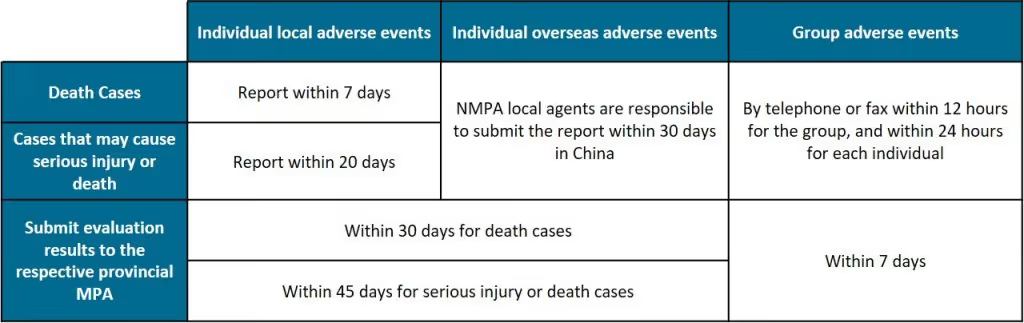
We note that this announcement should be read together with the NMPA’s new requirements for periodic risk assessment released on 6 May, and further illustrates the NMPA’s increasing emphasis on post-market surveillance.
By Jacky Li. Contact Cisema to learn more.

On 06.05.2020, the NMPA (National Medical Products Administration) provided important details on the ongoing reporting requirements for NMPA-registered medical devices (including IVDs). The NMPA’s medical device supervision department, the National Center for Adverse Drug Reaction (ADR) Monitoring, has explained the timescale and data collection scope for preparing and submitting the initial periodic evaluation report for medical devices according to the Administrative Measures on the Monitoring and Re-evaluation of Medical Device Adverse Events (Order No. 1 of the General Administration of Market Supervision and Administration) (abbr. as “the Measures”):
- Class II and Class III medical device registrants should submit periodic risk evaluation reports for 2020 following the requirements of the Measures. If the due date is earlier than 30/09/2020, the registrants should submit the report before 30/09/2020.
- For class II and class III medical devices that are in the first registration cycle on 01/01/2019, the registrant should also submit the 2019 annual risk evaluation report before 30/09/2020.
- For medical devices in their first registration cycle, the registrant should submit a periodic risk evaluation report annually. The data collection start date should be consistent with the date on the registration certificate.
- Class I medical device registrants should submit a periodic risk evaluation report annually in the first five years after obtaining the filing certificate. But there is no need to write the reports afterward.
- For medical devices whose specifications were registered in different certificates (e.g. different specifications of disposable sterile syringes) or medical devices that must be used together with other devices under a different registration certificate (e.g. hip systems which include acetabular cups, femoral stems, etc.) can incorporate the risk assessments in one report and submit it before the earliest deadline. The registrant should indicate the information of related medical devices upon report submission or archiving. For medical devices of the same kind, the registrant intended to incorporate the risk assessments in one report, they should conduct a subgroup analysis based on the registration certificate number.
The English version is for reference only. In case of any discrepancy or ambiguity of meaning between this English translation and the Chinese version, the latter shall prevail.
This new reporting requirement is consistent with the NMPA’s push for continuous post-market surveillance. Since 2018, post market compliance, adverse event and annual reporting regulations are increasingly strict. It is important for companies with registered devices to be vigilant with their ongoing requirements and not take a “set-and-forget” approach. The role of NMPA Legal Agent is therefore increasingly important.
Cisema has 11 offices worldwide, five of which are in China. We can represent manufacturers as their NMPA Legal Agent for the complete product life cycle without their need to create a local entity in China. Contact us to talk through your particular requirements.
Read the Chinese version here.
By Jacky Li. Contact Cisema to learn more.
On 05.05.2020, a webinar was held in cooperation with the trade association of industrial enterprises in Baden (German: Wirtschaftsverband Industrieller Unternehmen in Baden or WIVB).
Experiences were exchanged and Cisema presented news about the current situation in China and important changes in the rules for medical devices. One focus was the introduction of the UDI system in China on 01.10.2020 (link to UDI news) and the intention of market access to the Greater Bay Area via listing in Hong Kong (link to Greater Bay Area news). Over 20 WVIB members from the German MedTech industry, followed the webinar and were able to ask detailed questions afterwards.
Link to WVIB website here.

Due to shortages of qualified medical staff and consistent with the Chinese government’s emphasis on AI technology, the NMPA has made a number of announcements providing guidance on the registration process for AI software in the healthcare sector. The most recent was in March 2020 to provide an assessment framework for product registration of Corona-related diagnostic software.
Large Chinese companies such as Tencent have also been heavily investing in AI software in the fight against Corona virus, as reported here in Chinese newspapers recently.
Software that assists with curative or diagnostic processes in China generally must be registered as a medical device with the NMPA. China has two kinds of license for AI medical devices: (1) assistive products, being those which aid healthcare professionals in their provision of care to patients; and (2) diagnostic products, being those that assist with determining the cause of an ailment.
On 05.03.2020, the Center for Medical Device Evaluation of NMPA (National Medical Products Administration) released (No.8-2020) the assessment framework for the product registration of pneumonia diagnostic software in China. The assessment applies to SaMDs (software as a medical device) adopting deep learning technology to evaluate chest CT scans, to assist triage and to diagnose clinical cases affected by the Covid-19 pandemic.
According to the NMPA, this type of software product is classified as a Class III medical device, and the software security level is B. The assessment framework advises manufacturers to focus on, but not limited to, the following requirements for the preparation of research data and supplementary materials:
Basic functions
The software should at least cover one of the following functions:
- Anomaly detection
- Quantitative analysis (For example: Lesion volume ratio, CT value distribution, etc.)
- Data comparison (Manual or automatic)
- Report output
Anomaly detection is used for the triage of suspected cases, whilst quantitative analysis and data comparison are used for the diagnosis of confirmed cases.
Data for Machine Learning
- The chest CT scan images of a minimum of 2000 Covid-19 patients
- Must be sourced from three medical institutions, and one of the medical institutions must be located in a Covid-19 heavily-affected area
- Must include the chest CT scan images of the initial and advanced stage of confirmed Covid-19 cases
Data Distribution
The data distribution of Covid-19 information based on the following factors:
- Demographics (For example: Gender and Age)
- Stages (Initial, advanced, and severe) of the chest CT scan images
- Data sourcing companies
- CT scan equipment (For example: Manufacturer and Layer thickness)
For SaMDs adopting traditional machine learning technology, the manufacturers are advised to refer to another assessment framework (No.7-2019) released by the CDME on 03.07.2019. This assessment framework applies to the product registration of SaMDs using deep learning and traditional machine learning technologies to assist medical staffs in making clinical decisions.
Both traditional machine learning and deep learning technologies are a subset of AI, however, the former normally requires human intervention for the feature extraction process, whilst the latter automatically completes the feature extraction process itself. The assessment framework addresses the basic principles of evaluating the risks, benefits, safety and effectiveness of the SaMD throughout its product lifecycle to ensure the pre-market and post-market regulatory requirements have been met.
the emergency channel relating to COVID-19 response is no longer open due to the virus situation in China coming under control.

The State Administration of Market Regulation announced that from 01.06.2020 the certification obligation will be introduced in China.

The GB standard about “Strength requirement and test of automobile seats, their anchorages and any head restraints” will be implemented on 01.07.2020.
The China Quality Certification Center (CQC) published further support measures to contain the Covid-19 pandemic. It is also a step to improve efficiency.
Get in Touch with Our Consultants
And discover how we can support you.