
Published on
Last updated on
China Tightens Recall Rules for Cross-Border Food Imports
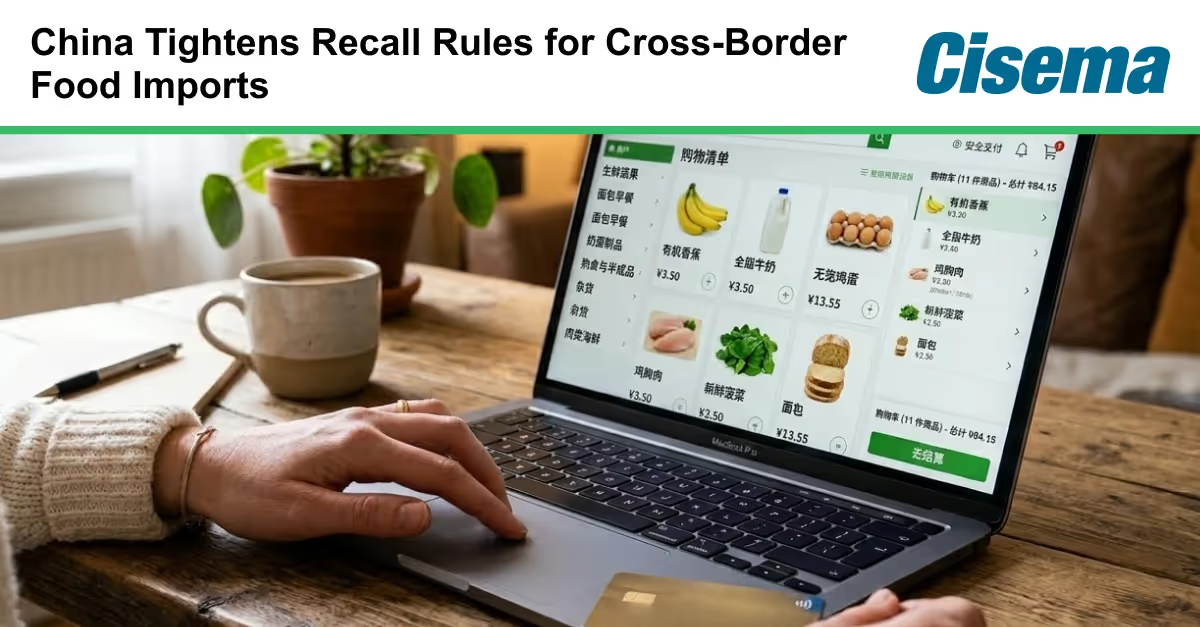
On February 13, 2026, China’s State Administration for Market Regulation (SAMR) and Ministry of Commerce jointly issued the “Announcement on Further Strengthening the Supervision of Recall of Cross-Border E-Commerce Retail Imported Food.” The measure is intended to further clarify recall responsibilities for cross-border e-commerce retail imported food, prevent food safety risks, and strengthen consumer protection.
To achieve this, the announcement places greater emphasis on clearly assigning responsibilities among:
- Cross-border e-commerce enterprises
- Entrusted domestic enterprises
- Cross-border e-commerce platforms
Clearer Recall Obligations for Cross-Border E-Commerce Food Sellers
Under the new requirements, cross-border e-commerce enterprises are subject to clearer and more immediate recall responsibilities.
Mandatory Use of Entrusted Domestic Enterprises for Recall Execution
Under the new framework, the cross-border e-commerce enterprise bears the principal food safety responsibility and must entrust one domestic food production or business enterprise to carry out recall work.
Where a product presents a quality or safety risk, or where an issue has already occurred, the cross-border e-commerce enterprise is required to take coordinated action. Specifically, it must:
- Immediately stop sales
- Notify the entrusted domestic enterprise to recall sold products and properly handle them
- Timely report the recall and handling situation to market regulation and other relevant authorities
This structure ensures that recall execution can be carried out locally while accountability remains with the cross-border e-commerce enterprise.
Expanded Platform Responsibilities and Regulatory Enforcement Mechanisms
In parallel with enterprise-level obligations, the announcement strengthens the role of cross-border e-commerce platforms in supervising compliance.
Platforms are required to urge cross-border e-commerce enterprises to strengthen quality and safety risk prevention and control, and press both enterprises and entrusted domestic entities to carry out recall-related work. Where cross-border e-commerce enterprises fail to take active recall measures, platforms are required to suspend their services.
Strengthened Regulatory Oversight and Credit Management Measures
The announcement further states that regulators will intensify recall supervision. Where cross-border e-commerce enterprises, entrusted domestic enterprises, or platforms fail to fulfil their obligations, they will be handled in accordance with applicable laws and regulations, and relevant information will be reported to other authorities for inclusion in credit management systems.
Key Implications for Overseas Companies
For overseas companies selling food into China via cross-border e-commerce channels, the announcement underscores the need for clearly defined recall structures and reliable local execution capabilities.
To meet these requirements, businesses will need to ensure that:
- An appropriate domestic food production or business enterprise is designated to carry out recall work
- Internal procedures support immediate sales suspension when risks are identified
- Recall execution and regulatory reporting can be carried out promptly and effectively
These heightened requirements are likely to have a differentiated impact across the market. Smaller or less-prepared foreign sellers may face increased compliance pressure, potentially raising market entry barriers. At the same time, non-compliant operators may exit the market, contributing to accelerated industry consolidation.
In parallel, the evolving regulatory environment is expected to drive demand for specialized compliance infrastructure, including recall advisory services, entrusted enterprise coordination, and digital tracking and reporting tools.
Operational Steps to Meet China’s New Recall Requirements
In light of the announcement, companies involved in cross-border e-commerce retail imported food should assess whether their current operating model aligns with the new recall requirements.
This includes reviewing both organizational arrangements and operational readiness to ensure compliance under risk scenarios.
Key actions include:
- Evaluating whether to establish or leverage an in-China entity to serve as an entrusted enterprise
- Identifying and engaging multiple qualified entrusted enterprise partners to ensure continuity
- Developing or outsourcing Chinese-language customer service and recall response capabilities
- Implementing or upgrading recall management systems to meet regulatory timelines and reporting requirements
Early preparation will be critical to maintaining uninterrupted access to China’s cross-border e-commerce market.
Final Thoughts: Outlook for Cross-Border Food Compliance in China
Overall, the announcement reflects a broader move toward tighter regulatory control over cross-border e-commerce food imports, with clearer accountability and stronger enforcement mechanisms.
For overseas businesses, these developments create practical compliance challenges — particularly for those without an established presence in China or experience managing local regulatory interactions. Companies will need to act quickly to build compliant structures while maintaining business continuity.
To address these demands, Cisema supports international food manufacturers and distributors with:
- Compliance diagnostics and gap analysis
- Matching and management of entrusted enterprises
- Platform communication and regulatory filing support
For tailored support in adapting to China’s evolving food safety requirements, contact Cisema today.
Further Information
- Explore Cisema’s services for food and supplement registration in China
References
- “Announcement on Further Strengthening the Supervision of Recall of Cross-Border E-Commerce Retail Imported Food”
- “Announcement on Adjusting the Cross-Border E-Commerce Retail Import Product List (2022 Version)”
- “Announcement on Expanding the Cross-Border E-Commerce Retail Import Product List (2019 Version)”
Connect with Cisema
With more than 20 years of experience and a team of over 100 specialists, Cisema helps global companies achieve compliance across Asia Pacific with confidence and accelerate market entry.
Stay Informed with Monthly News and Analysis
Stay informed with the latest regulatory changes, expert insights, and market opportunities across APAC, delivered straight to your inbox.
Related News

Hong Kong Requires MDACS Listing for Injectable Dermal Fillers by March 1, 2027
New requirements could affect how injectable devices, including dermal fillers, are supplied in Hong Kong’s private healthcare sector.

China Enacts First Healthcare Security Law: Impact on Global Medtech
China’s new Healthcare Security Law affects medical device reimbursement, health economic evidence, payment models, and digital traceability from 2027.
Indonesia Mandates Pre-Shipment Halal Verification for Imported Products
BPJPH Regulation No. 4 of 2026 introduces pre-shipment halal verification and LPPH reports for imported goods starting September 2026.