
Published on
Last updated on
New NMPA Guideline Defines Registration Requirements for IVUS Systems and Catheters
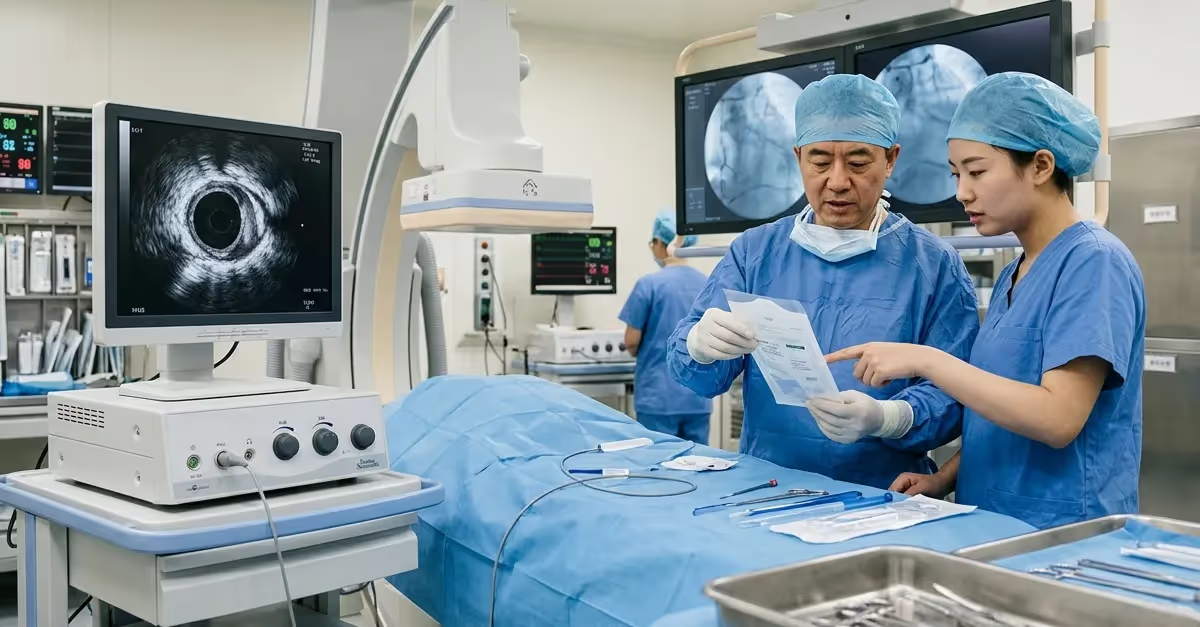
On April 13, 2026, theChina’s Center for Medical Device Evaluation (CMDE) published the firstdedicated regulatory framework for reviewing intravascular ultrasound (IVUS)diagnostic systems and catheters in China — “Guideline for Registration Review of Intravascular Ultrasound Diagnostic Devices.”
For manufacturers pursuing China medical device registration, the guideline clarifies the technical standards, registration unit classification rules, and clinical evaluation pathways applicable to IVUS products entering the Chinese market.
A New Regulatory Framework for IVUS Devices in China
Intravascular ultrasound plays a critical role in cardiovascular interventions by enabling high-resolution imaging inside blood vessels. Despite its clinical importance, China previously lacked a dedicated registration review guideline specifically addressing IVUS diagnostic products.
The newly released guideline addresses this regulatory gap by introducing a structured framework for evaluating IVUS medical devices under China medical device regulation. It defines the core elements manufacturers must address during the NMPA review process, including:
- Technical performance indicators
- Testing expectations
- Clinical evaluation pathways
- Documentation requirements
For overseas manufacturers planning IVUS registration in China, the guideline improves regulatory clarity while also establishing more detailed compliance expectations. Companies must now carefully consider factors such as registration unit classification, coating material studies, animal testingdesign, and clinical evaluation strategies.
Scope and Registration Unit Classification
To clarify how IVUS products should be evaluated during regulatory review, the guideline first defines the scope of devices covered:
- IVUS consoles
- Patient interface units (PIU/withdrawal motors),
- Single-use IVUS diagnostics catheters
- Related accessories, including devices that integrate additional diagnostic technologies such as optical coherence tomography (OCT) or fractional flow reserve (FFR) functions
Within this scope, manufacturers may register IVUS systems and catheters either together as an integrated system or separately. However, the guideline introduces detailed rules governing how registration units must be defined, which directly affects NMPA submission strategy.
Classification of Catheters and System Configurations
Because IVUS systems may be configured in multiple ways, the guideline establishes specific rules for grouping devices and catheters into registration units. These requirements vary depending on whether components are registered together or independently.
These classification rules are particularly important for manufacturers managing global product portfolios, as registration unit strategy directly affects submission planning, regulatory timelines, andtesting requirements for IVUS registration in China.
Medical Device Classification and Naming Rules
Beyond defining registration units, the guideline also clarifies theregulatory classification and naming conventions applicable to IVUS products.
IVUS products areclassified as Class III medical devices, reflecting their high-risk designation within China’s medical device regulatory framework.
The guideline specifies the following classification codes
- 06-07-01: IVUS systems or systems registered together with catheters
- 06-08-04: IVUS catheters registered independently
In addition, product names must comply with the “Guideline for Naming Generic Names ofMedical Devices.” The naming rules require clear differentiation between coronary-specific catheters, peripheral-specific catheters, and general-purpose catheters.
Technical Performance Requirements and Supporting Studies
The guideline establishes detailed technical performance indicators for both IVUS devices and catheters.
Both IVUS consoles and catheters must meet defined ultrasound imaging performance indicators based on YY/T 1659 and related Chinese medical device standards.
Key performance parameters include:
- Acoustic operating frequency
- Imaging radius
- Axial resolution
- Lateral resolution
- Geometric position accuracy
- Image geometric distortion
All adjustable catheter pullback speeds must also meet these imaging performance requirements to ensure consistent diagnostic performance.
Device Safety, Software, and Structural Requirements
In addition to imaging performance, the guideline specifies broader technical requirements covering device structure, system stability, and software functionality.
Catheters must comply with standards such as YY 0285.1, covering radiopacity, peak tensile force, leak resistance, chemical properties, sterility, and bacterial endotoxin limits. Device requirements include indicators for:
- Appearance and structure
- Connection stability
- Software functionality
- Usage restrictions
- Access control
For acoustic energy safety, in addition to compliance with GB 9706.237, limits must be specified for:
- Mechanical index (MI)
- Thermal index (TI)
- Spatial-peak temporal-average intensity
- Spatial-peak pulse-average intensity
These requirements ensure IVUS systems meet established safety standards for ultrasound energy exposure.
Lubricious Coating Study Requirements
For IVUS catheters with lubricious coatings, the guideline introduces additional documentation requirements.
Manufacturers must submit coating study data in accordance with the “Guideline for RegistrationReview of Vascular Interventional Devices with Lubricious Coatings.”
Required evidence includes:
- Coating integrity testing
- Lubricity performance evaluation
- Particle quantification following simulated clinical use
These studies are intended to demonstrate that catheter coatings maintain performance and do not release harmful particulate matter during clinical use.
Biological Safety Evaluation
Alongside coating validation and technical testing, the guideline requires comprehensive biological safety evaluation for IVUS catheters.
Required testing includes
- Cytotoxicity
- Sensitization
- Irritation or intracutaneous reactivity
- Pyrogenicity
- Acute systemic toxicity
- Hemocompatibility, including hemolysis, coagulation, and thrombogenicity
Together, these tests confirm the biocompatibility of materials used in catheter construction and ensure compliance with China medical device safety standards.
Clinical Evaluation Pathways for IVUS Products
Beyond non-clinical testing, manufacturers must also determine the appropriate clinical evaluation pathway for IVUS product registration.
The guideline allows standard coronary or peripheral IVUS systems and catheters to rely on predicate device comparison when safety and effectiveness can be adequately demonstrated through non-clinical data.
However, this pathway does not apply to all product configurations.
When Clinical Trials Are Required
Clinical trials should be conducted when a product incorporates:
- A completely new design
- Significantly different technical parameters
- Features that cannot be sufficiently validated through non-clinical testing
In addition, the guideline explicitly requires clinical data for certain advanced functions, including:
- Plaque characterization algorithms
- IVUS-based fractional flow reserve (FFR) calculations
Manufacturers developing these advanced features should anticipate clinical study requirements during early product development.
Animal Testing and Product Stability Requirements
Animal testing should evaluate:
- Device maneuverability
- Image quality
- Measurement accuracy
- Overall procedural safety
For coronary IVUS systems, testing must cover the three primary coronary arteries:
- Right coronary artery
- Left anterior descending artery
- Left circumflex artery
Peripheral IVUS studies should focus on the most challenging representative vessel associated with the intended clinical use.
Service Life and Shelf-Life Verification
Active IVUS devices must undergo service life verification according tothe “Guideline for Registration Review of Service Life of Active MedicalDevices.”
- Cathetersand dedicated accessories must provide shelf-life validation data
- Coating performance testing is recommended for coated products after accelerated or real-time aging studies
- All components must additionally undergo transport stability testing to confirm product integrity during distribution
These studies ensure IVUS devices maintain safety and performance throughout storage and distribution.
Instructions for Use Requirements
The guideline also specifies labeling and documentation requirements forIVUS devices entering the Chinese market.
Instructions for usemust clearly indicate:
- Intended vessel locations
- Applicable vessel diameter ranges
For catheters with lubricious coatings, manufacturers must disclose the primary coating components, coating type, and coating location. The instructions must alsoinclude coating-related warnings and precautions to ensure safe clinical use.
Opportunities and Compliance Challenges for Overseas Manufacturers
The introduction of a dedicated IVUS registration guideline improvesregulatory predictability for companies pursuing China medical device registration for cardiovascular imaging technologies.Defined review standards and clinical evaluation pathways may helpmanufacturers plan regulatory strategies more effectively.
At the same time, the guideline introduces stricter technicaldocumentation and testing requirements that may increase submission complexity.
Key challenges include:
- Expanded documentation requirements for coating materials
- Strict registration unit classification rules
- Animal testing expectations covering specific coronary vessels
- Clinical data requirements for advanced IVUS functions
Manufacturers that fail to address these requirements early mayencounter supplementary data requests or longer NMPA review timelines.
Recommended Actions for IVUS Manufacturers
Foreign manufacturers planning IVUS registration in China should beginevaluating how the guideline affects existing product portfolios and regulatorystrategies.
Recommended steps include:
Conduct a Compliance Gap Analysis Immediately
Evaluate existingproducts against the guideline requirements, particularly regarding registration unit classification (coronary vs. peripheral, mechanical rotational vs. phased array), coating study documentation, and animal study design. Identify gaps and define corrective measures.
Strengthen Coating Material Studies
For catheters withlubricious coatings, prepare coating integrity data, lubricity performancetesting, and particle shedding quantification according to the dedicatedcoating guideline. Ensure coating composition and warnings are clearly stated in the instructions for use.
Standardize Animal Study Protocols
Coronary IVUS studiesmust cover the right coronary artery, left anterior descending artery, and left circumflex artery. Peripheral studies should select the most challenging representative vessels (e.g., aorta or lower-limb vessels). Use a five-point Likert scale and independent blinded evaluation by two reviewers.
Select the Clinical Evaluation PathwayCarefully
Predicate devicecomparison may be used for standard products, but plaque characterizationfunctions and IVUS-based FFR functions require clinical data. Products with newdesigns or significantly different parameters should plan for clinical trials.
Use Pre-submission Consultation and OverseasTesting Policies
Engage with NMPAthrough pre-submission consultations to clarify technical questions andevaluate the use of overseas testing self-inspection policies to ensure testrepresentativeness and reduce the risk of supplementary requests or repeatedtesting.
Implications for IVUS Manufacturers Entering the China Market
While the guideline improves regulatory transparency, it also introduces more granular technical and testing expectations for IVUS products. Requirements related to registration unit classification, coating validation, animal studies, and clinical evaluation may require manufacturers to reassess existing development and registration strategies.
For companies preparing IVUS submissions in China, these changes place greater emphasis on early regulatory planning and technical alignment. Addressing potential gaps in testing documentation, clinical evidence, or product configuration before submission can significantly reduce the risk of supplementary requests or extended review timelines.
Navigating these evolving requirements often requires specialized regulatory expertise. Through regulatory strategy development, compliance gap analysis, clinical evaluation planning, and full NMPA registration support, Cisema helps international medical device companies interpret new guidance documents and align their submission strategies with China’s regulatory expectations.
Contact Cisema today to evaluate how thenew IVUS registration review guideline may impact your product registration strategy in China.
Further Information
Explore Cisema’s services for China medical device registration, including regulatory strategy development, compliance gap analysis, clinical evaluation planning, and full NMPA submission support for overseas manufacturers entering the Chinese market.
References
“Announcement on the Release of Five Registration ReviewGuidelines Including the Guideline for Registration Review of IntravascularUltrasound Diagnostic Devices (CMDE Announcement No. 12 of 2026)”— Center for Medical Device Evaluation (CMDE).
Connect with Cisema
With more than 20 years of experience and a team of over 100 specialists, Cisema helps global companies achieve compliance across Asia Pacific with confidence and accelerate market entry.
Stay Informed with Monthly News and Analysis
Stay informed with the latest regulatory changes, expert insights, and market opportunities across APAC, delivered straight to your inbox.
Related News

Hong Kong Requires MDACS Listing for Injectable Dermal Fillers by March 1, 2027
New requirements could affect how injectable devices, including dermal fillers, are supplied in Hong Kong’s private healthcare sector.

China Enacts First Healthcare Security Law: Impact on Global Medtech
China’s new Healthcare Security Law affects medical device reimbursement, health economic evidence, payment models, and digital traceability from 2027.

Indonesia Mandates Pre-Shipment Halal Verification for Imported Products
BPJPH Regulation No. 4 of 2026 introduces pre-shipment halal verification and LPPH reports for imported goods starting September 2026.