
Published on
Last updated on
Metal Bone Needle Registration and CMDE Guidance for China Market Entry
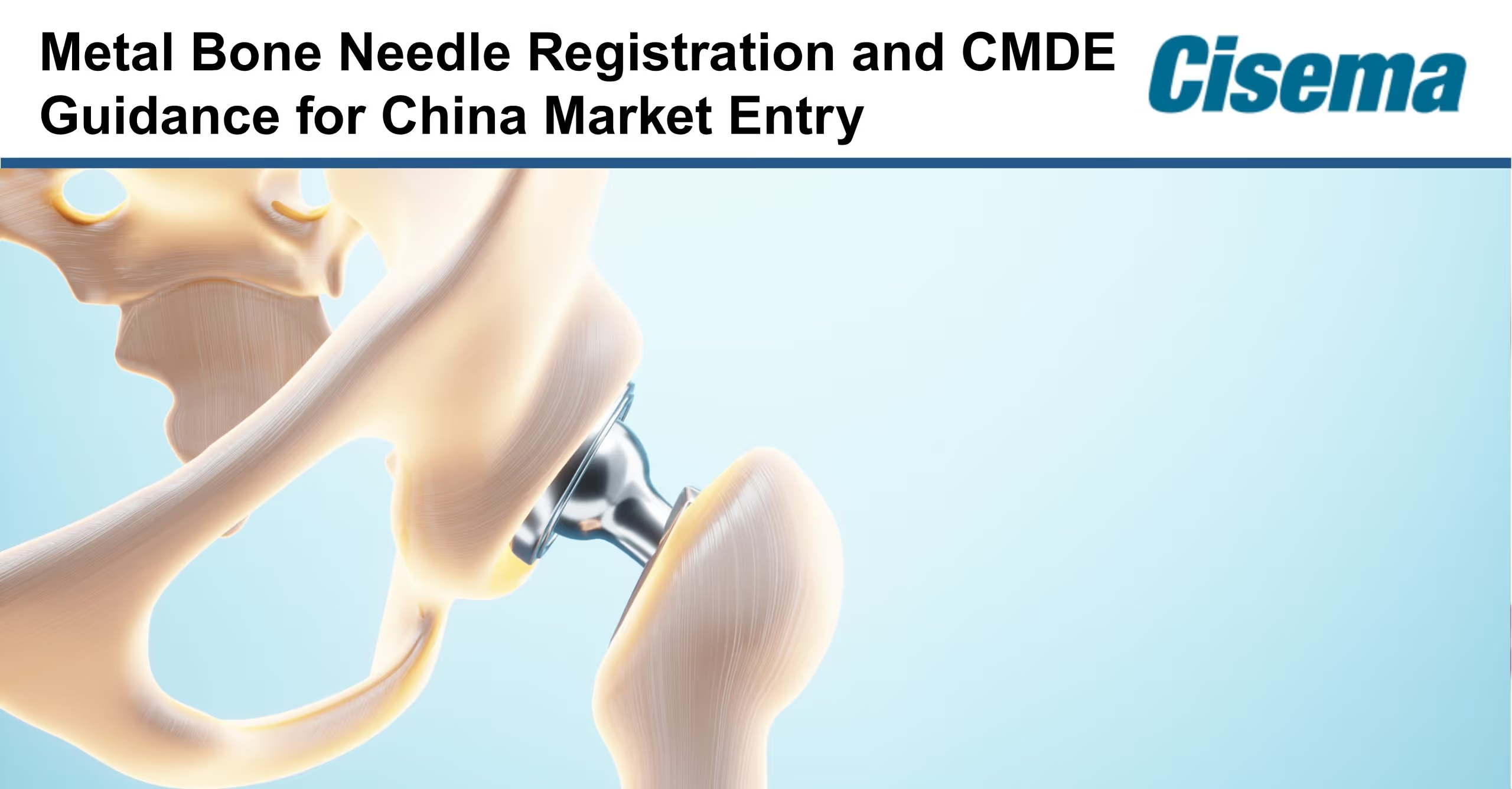
Metal Bone Needle Registration and CMDE Guidance for China Market Entry was outlined in a regulatory article released on April 24, 2025, by the China Center for Medical Device Evaluation (CMDE). The article details key considerations for the design, development, risk management, and technical review of metal bone needle products. Manufacturers of orthopedic implants should take note.
The Necessity of Designing Metal Bone Needle Products Based on Clinical Value
- Driven by clinical needs: At present, the technology iteration of China's orthopedic medical device market is rapid, but the clinical effect has not been improved simultaneously, and 20% of orthopedic implants have unreasonable design, resulting in postoperative complications such as prosthesis loosening, infection and mechanical failure. The traditional design pays too much attention to the technical parameters and ignores the actual clinical needs, and the implant does not match the patient's anatomical structure enough, resulting in a high rate of postoperative complications. This phenomenon highlights the need for a clinical value-oriented design of orthopedic implants.
- Promotion of policies and regulations: Regulatory agencies in various countries are gradually increasing their attention to the clinical value of medical devices. The Technical Guidelines for Clinical Evaluation of Medical Devices, issued by the National Medical Products Administration of China, emphasize the importance of real-world data; The Breakthrough Medical Device Program issued by the U.S. FDA clearly requires clinical end-benefit as the core evaluation index. Medical devices serve clinical practice, and high-level design and development can better achieve high-quality development of products.
- Consideration of individual differences of patients: The design of orthopedic medical devices needs to deconstruct clinical needs from three dimensions: anatomy, biomechanics and surgical operation. Different anatomical parts have significant differences in the mechanical properties of bone needles, which need to be based on big data analysis or imaging modeling to achieve anatomical fit.
Focus on the Design and Development of Metal Bone Needle Products
- Material selection and performance optimization: Material type: There is a trade-off between mechanical properties and biological responses: such as 316L stainless steel (relatively low cost), titanium alloy (better biocompatibility), and cobalt-chromium alloy (strong wear resistance). Surface modification: e.g., hydroxyapatite (HA) coatings can improve osseointegration, but the crystallinity (60%-70%) needs to be controlled to avoid the risk of flaking.
- Structural design and manufacturing process: Geometric parameters: such as thread depth and pitch need to match the bone density distribution. Manufacturing techniques: Additive manufacturing (e.g., SLM) supports complex structures, but the internal defect rate needs to be verified (should be < 0.1%).
- Biocompatibility and mechanical verification: Biological evaluation was carried out with reference to GB/T 16886.1, and corresponding biological tests were carried out if necessary, such as cytotoxicity, sensitization and local reactions after implantation. Mechanical test: You can refer to the requirements of the corresponding standard to carry out dynamic and static mechanical properties test on bone needles, see Table 1 below.
Classify Research Projects Recommended Method Metal bone needles are used alone Static flexural performance YY/T 0342 Tensile properties GB/T 228.1 Metal needles with external fixation brackets Static flexural performance YY/T 0342 Tensile properties GB/T 228.1 Fit performance / Threaded metal bone needle Breaking torque, torsion angle at break YY/T 0018 Rotational torque Axial pull-out force Self-attacking performance Coated metal bone needle In addition to the above-mentioned physical and mechanical properties, it is also necessary to evaluate the strong bond between the coating and the substrate and the risk of coating peeling, such as static tensile, static shear, shear fatigue and wear resistance. Hydroxyapatite coating products can refer to YY/T 1640 "Test Methods for the Solubility of Calcium Phosphate Granules, Products and Coatings for Surgical Implants" to evaluate the solubility of the coating and the influence of the coating preparation process on the matrix material. YY/T 1640
Concerns of Technical Review of Metal Bone Needle Products
- Product risk management information: product technical requirements and performance indicators, such as tensile strength, elongation at break, corrosion resistance of stainless steel products, surface defects, surface roughness, appearance, key dimensions and tolerances, sterility, ethylene oxide residue; For coated bone needles, it is also necessary to determine the roughness of the coating surface and the strength of the bond between the coating and the substrate.
- Research data: product physical properties (see Table 1), chemical/material characterization, biological characteristics, stability.
- Clinical evaluation: For the traditional metal bone needles that have been included in the "Catalogue of Medical Devices Exempt from Clinical Evaluation", the evaluation should be carried out in accordance with the "Technical Guidelines for the Comparison and Description of Products Included in the Catalogue of Medical Devices Exempt from Clinical Evaluation", but more detailed clinical evaluation needs to be carried out for metal bone needle products outside the catalogue of medical devices exempt from clinical evaluation, such as adding clinical evaluation data of products that are out of scope, and it is recommended to pay attention to real-world evidence, collect as much corresponding real-world clinical use data as possible, and pay attention to the reporting of adverse reaction events.
Recommendations for International Manufacturers
- To enter the Chinese market, international manufacturers need to be familiar with relevant laws, regulations and guidance documents related to the production, operation and registration of medical devices in China.
- Pay attention to the pain points of metal bone needle products in clinical use, adhere to the clinical value as the core, attach importance to risk management, ensure reliable product quality and stable system, and improve post-marketing follow-up feedback.
- With the integration of precision medicine and smart manufacturing, value-oriented bone needle products based on clinical needs will be more favored.
Further Information
To read the original announcement about the key points on the design and technical review of metal bone needle products (2025) released by the China Center for Medical Device Evaluation (CMDE), please click here.
If you are a pharmaceutical or medical device manufacturer with questions about how long it takes or how much it costs to register your product for the China market, please contact Cisema.
GET IN TOUCH
Connect with Cisema
With more than 20 years of experience and a team of over 100 specialists, Cisema helps global companies achieve compliance across Asia Pacific with confidence and accelerate market entry.
Stay Informed with Monthly News and Analysis
Stay informed with the latest regulatory changes, expert insights, and market opportunities across APAC, delivered straight to your inbox.
Related News

Hong Kong Requires MDACS Listing for Injectable Dermal Fillers by March 1, 2027
New requirements could affect how injectable devices, including dermal fillers, are supplied in Hong Kong’s private healthcare sector.

China Enacts First Healthcare Security Law: Impact on Global Medtech
China’s new Healthcare Security Law affects medical device reimbursement, health economic evidence, payment models, and digital traceability from 2027.

Indonesia Mandates Pre-Shipment Halal Verification for Imported Products
BPJPH Regulation No. 4 of 2026 introduces pre-shipment halal verification and LPPH reports for imported goods starting September 2026.