
Published on
Last updated on
Is a Foreign Halal Certificate Valid in Indonesia? Requirements Explained

Overseas manufacturers aiming for the Indonesian market often face a critical question: Can an existing foreign halal certificate be registered with Indonesia’s Halal Product Assurance Agency (BPJPH), or must the product undergo full local recertification?
The answer dictates your compliance timeline, documentation workload, local representative duties, and whether you'll need to host an overseas site audit. These factors all take on urgent operational weight under Indonesia's mandatory halal rules effective October 18, 2026.
Read on to evaluate which compliance route applies to your product line, or contact Cisema today to align your regulatory strategy with local BPJPH standards.
What Are Indonesia's Halal Requirements for Foreign Products?
Established under Law No. 33 of 2014 and Government Regulation No. 42 of 2024, BPJPH oversees a mandatory compliance framework governing imported products entering and circulating in Indonesia.
For overseas manufacturers, however, the process is not as simple as submitting an existing certificate. Foreign companies cannot apply directly through the SIHALAL system; applications must be handled through an Indonesian entity, such as an importer or authorized representative, with the necessary local credentials.
The regulation also includes a clear distinction for non-halal items: products containing prohibited (non-halal) materials do not require halal certification, but they must carry clear, prominent non-halal labeling on their packaging.
Key Halal Certificate Categories Enforced Under the October 18, 2026 Mandate
- Food and beverages
- Slaughtered products and slaughtering services
- Cosmetics
- Chemical and genetically engineered products
- Natural medicines, quasi-drugs and health supplements
- Raw materials, food additives and processing aids for food and beverages
- Selected consumer goods, including household health supplies and Class A medical devices
Is a Foreign Halal Certificate Valid in Indonesia?
Not automatically. Indonesia accepts foreign halal certificates strictly on a bilateral and reciprocal basis.
Under Article 47 of Law No. 33/2014, Article 143 of GR No. 42/2024, and Minister of Religious Affairs Regulation No. 2/2022, a foreign Halal Certification Body (HCB) must meet three strict criteria:
- Established or endorsed by the government or recognized Islamic authority in its country of origin
- Legally recognized and licensed by competent local authorities
- Accredited by the local accreditation body or approved by BPJPH
As of late 2025, Indonesia has signed Mutual Recognition Agreements (MRAs) with 94 foreign Halal Certification Bodies across 33 countries.
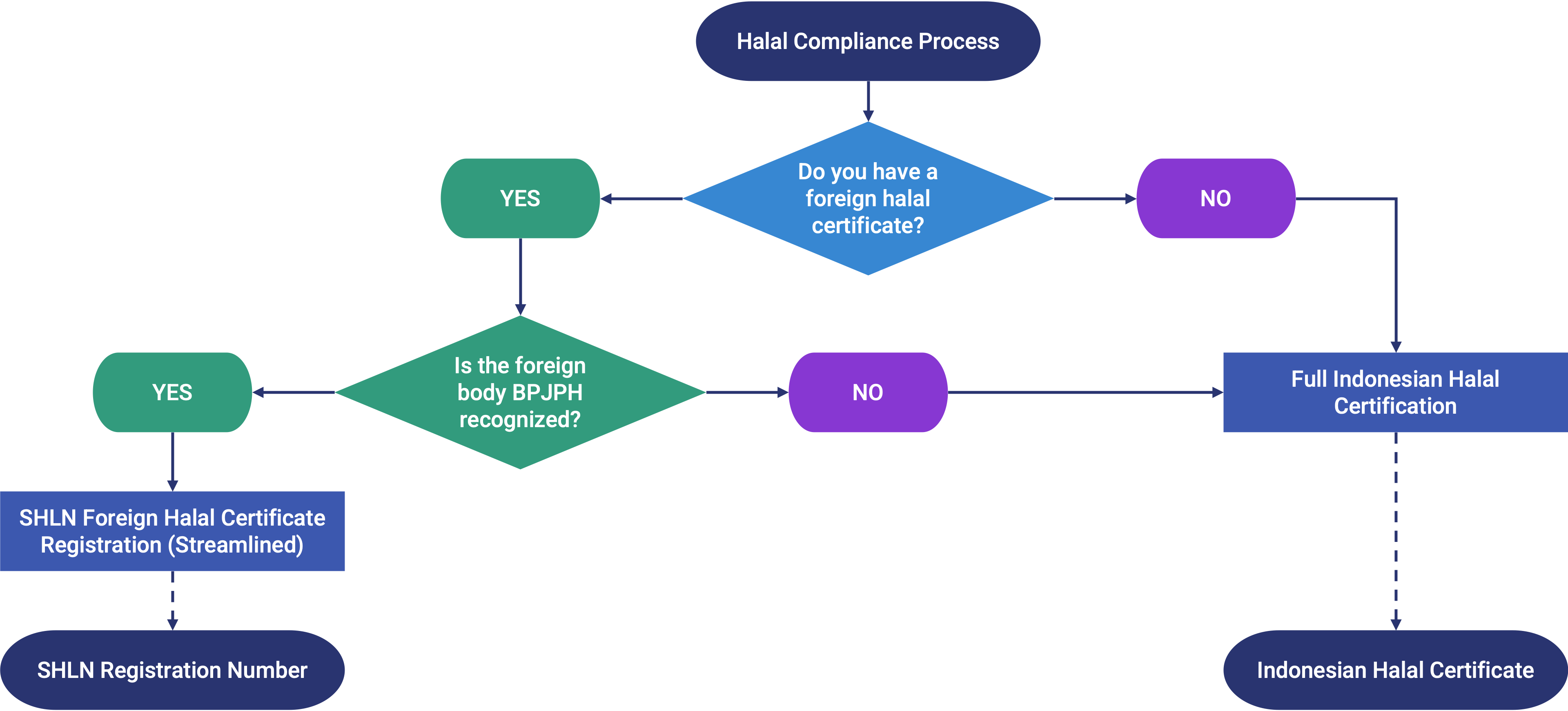
This creates two distinct compliance routes:
- Recognized foreign certificate: The certificate may be registered through the Foreign Halal Certificate Registration (SHLN) pathway, avoiding full Indonesian recertification.
- Unrecognized foreign certificate: The product generally needs to proceed through Indonesia’s full halal certification process.
The distinction is significant because the two routes differ substantially in terms of assessment, audit requirements, and time and cost implications.
Pathway 1: Registering a Recognized Foreign Halal Certificate (SHLN)
If your foreign halal certificate originates from an overseas body holding active recognition or a Mutual Recognition Agreement (MRA) with BPJPH, you can register through the SHLN portal without repeating the entire local certification process.
Step-by-Step SHLN Process
- Verify certifier status: Confirm BPJPH active recognition for your issuing halal body.
- Compile paperwork: Gather your valid foreign halal certificate (must have sufficient remaining validity), ingredient lists, product HS codes, storage warehouse details, and supporting technical documents.
- Submit via local rep: File the SHLN application through your appointed Indonesian importer or local license holder via the SIHALAL portal.
- Complete verification: Undergo BPJPH administrative and document checks (taking up to 30 working days) managed by your local regulatory partner.
- Update product packaging: Obtain your official electronic SHLN registration number and display it on product packaging alongside local labeling requirements.
Because leveraging a recognized foreign halal certificate can bypasses full local recertification, verifying the foreign certifier’s recognition status one of the most important steps to take before beginning the application.
Pathway 2: Full Halal Certification in Indonesia
If your product does not have a qualifying foreign halal certificate, or the existing certificate falls outside the relevant BPJPH recognition scope, the streamlined SHLN route is unavailable.
In that situation, the product must proceed through the standard Indonesian halal certification process. Unlike SHLN registration, this route involves a substantive assessment of the product, materials, manufacturing processes, and halal assurance controls.
Standard Halal Certification Workflow
- Appointing an Indonesian importer or local authorized representative to manage local license holder duties
- Preparing information on materials, manufacturing processes and the Halal Product Assurance System (SJPH)
- Submitting the application to BPJPH
- Completing an assessment by an appointed Halal Inspection Body (LPH)
- Undergoing an audit of the overseas manufacturing facility
- Receiving the halal determination and Indonesian halal certificate
What Happens During an Overseas Halal Audit?
When an audit is required, LPH inspectors travel to your manufacturing plant to verify how halal integrity is maintained across production.
During the audit, inspectors typically examine:
- Raw materials, processing aids, and ingredient sources
- Supplier qualification and procurement controls
- Production processes and line segregation
- Equipment cleaning protocols and sanitation procedures
- Product traceability and quality management records
- Internal halal management and SJPH implementation
Because the audit takes place at your production site, your team must budget for international auditor travel, accommodation, and administrative support. You should also ensure key personnel across quality, production, procurement, supply chain, and internal halal compliance are present to walk inspectors through records and processes.
Direct Comparison: SHLN Registration vs. Full Certification
The two pathways can be summarized as follows:
The practical takeaway is straightforward: a recognized foreign certificate can significantly simplify the route to Indonesian market access. However, for manufacturers with large product portfolios, there is another question to consider: can multiple products can be managed under a single submission?
Smart Halal Application Strategy: SKU Grouping
If you manage a broad product catalog, you may not need to file separate applications for every single SKU. BPJPH allows products to be grouped under a unified submission when they share core characteristics, such as:
- Raw material compositions and formulations
- Manufacturing plant locations and production lines
- Shared processing methods, product category, and overall risk profiles
Leveraging expert local regulatory support to conduct a portfolio audit prior to filing helps identify grouping opportunities, preventing redundant fees and unnecessary administrative overhead. However, grouping should never be assumed, as any significant variation in raw materials, manufacturing sites, or processing steps may require separate filings.
Common Failure Points & How to Avoid Them
When entering the Indonesian halal system, overseas brands frequently encounter preventable delays:
Failure Point 1: Scope Mismatches
- What Goes Wrong: Assuming a foreign certifier's MRA covers all your products. An MRA might cover raw food ingredients, but not cosmetics or medical devices.
- How to Avoid It: Check the certification body’s current BPJPH recognition status and applicable product scope before filing. If your product falls outside the recognized scope, determine whether full Indonesian certification or another recognized certification body is required.
Failure Point 2: Inconsistent Product Naming
- What Goes Wrong: Character-level discrepancies between product names on your foreign certificate, commercial invoices, and BPOM/MoH registration dossiers cause SIHALAL rejections.
- How to Avoid It: Ensure 100% exact naming alignment across all regulatory documents. Where trade names differ, obtain the appropriate declaration of equivalence from the issuing foreign certification body using the applicable BPJPH template.
Failure Point 3: Unregistered Processing Aids
- What Goes Wrong: Overlooking secondary processing aids, equipment lubricants, or packaging films that come into contact with animal-derived materials.
- How to Avoid It: Conduct a thorough line audit to ensure all indirect contact materials (e.g., equipment lubricants, anti-foaming agents, and primary packaging) hold valid halal statements or non-animal declarations.
For category-specific guidance, explore our guides to halal compliance for health supplements, cosmetics, and medical devices in Indonesia.
Final Thoughts
The difference between a quick foreign halal certificate registration and a costly, months-long factory audit comes down to whether your certifier has BPJPH recognition. Pinning down your pathway early saves you from unexpected expenses, border hold-ups, and missed launch dates.
By embedding halal compliance into your broader market-entry roadmap — whether you are launching cosmetics, health foods and supplements, or medical devices — you safeguard your investment and clear a smooth path to commercial rollout. Leveraging local regulatory support to take stock of your product portfolio today protects your bottom line tomorrow, keeping your pipeline open to Southeast Asia’s largest consumer market.
Whether you need to verify your foreign certificate or map out full market entry for your cosmetics, health supplements, or medical devices, contact Cisema today to align your regulatory strategy with local BPJPH standards.
Further Information
Explore Cisema’s services for:
- Medical device registration and compliance in Indonesia
- Cosmetics registration and compliance in Indonesia
Further reading from Cisema on Halal Certification:
- What Is Indonesia Halal Certification for Health Supplements?
- Understanding Indonesia Halal Cosmetic Certification Requirements
- Key Requirements for Indonesia Halal Medical Devices
References
- Law No. 33 of 2014 on Halal Product Assurance
- Government Regulation of the Republic of Indonesia Number 42 of 2024 concerning the Implementation of the Halal Product Assurance Sector
- BPJPH Decree No. 221 of 2025 on Foreign Halal Certificate Registration
- November 2025 TBT Committee Meeting, World Trade Organization Trade Concerns Database
Connect with Cisema
With more than 20 years of experience and a team of over 100 specialists, Cisema helps global companies achieve compliance across Asia Pacific with confidence and accelerate market entry.
Stay Informed with Monthly News and Analysis
Stay informed with the latest regulatory changes, expert insights, and market opportunities across APAC, delivered straight to your inbox.
Related Articles

Understand the key differences between China Medical Device GMP and ISO 13485, including requirements for quality management, suppliers, facilities and documentation.

Learn when medical device and IVD changes in Indonesia require a notification, variation, or new registration, and how to maintain ongoing regulatory compliance.

Discover how leveraging Real World Data generated in the Greater Bay Area can accelerate market entry for medical products in China.