
Published on
Last updated on
When Is a Clinical Trial Required for China NMPA Medical Device Registration?

For medical device manufacturers entering the Chinese market, a key question looms over the regulatory roadmap: Does NMPA registration require a medical device clinical trial in China?
The short answer: Not necessarily.
While Class II and Class III devices generally require clinical evidence for National Medical Products Administration (NMPA) registration, that does not automatically mean a new clinical trial in China. Depending on the device and the evidence already available, there may be other ways to meet NMPA requirements.
With registration timelines estimated at around 18 months for Class II devices and 21 months for Class III devices without a clinical trial, a local study is no small commitment. Before committing to the time and cost of a clinical trial, it’s worth taking a closer look at what the NMPA requires, and whether the clinical evidence you already have could get you there.
Read on to explore how NMPA reviewers assess clinical data, what alternatives may be available. If you're ready to discuss your strategy, learn more about Cisema’s services for medical device clinical trials in China or contact us today.
Clinical Evaluation vs. Clinical Trial: Two Different Regulatory Concepts
Before determining whether you need a medical device clinical trial in China and committing capital to unnecessary local studies, it is important to understand the difference between clinical evaluation and clinical trial.
Foreign manufacturers often conflate these two distinct regulatory concepts, but they serve different purposes:
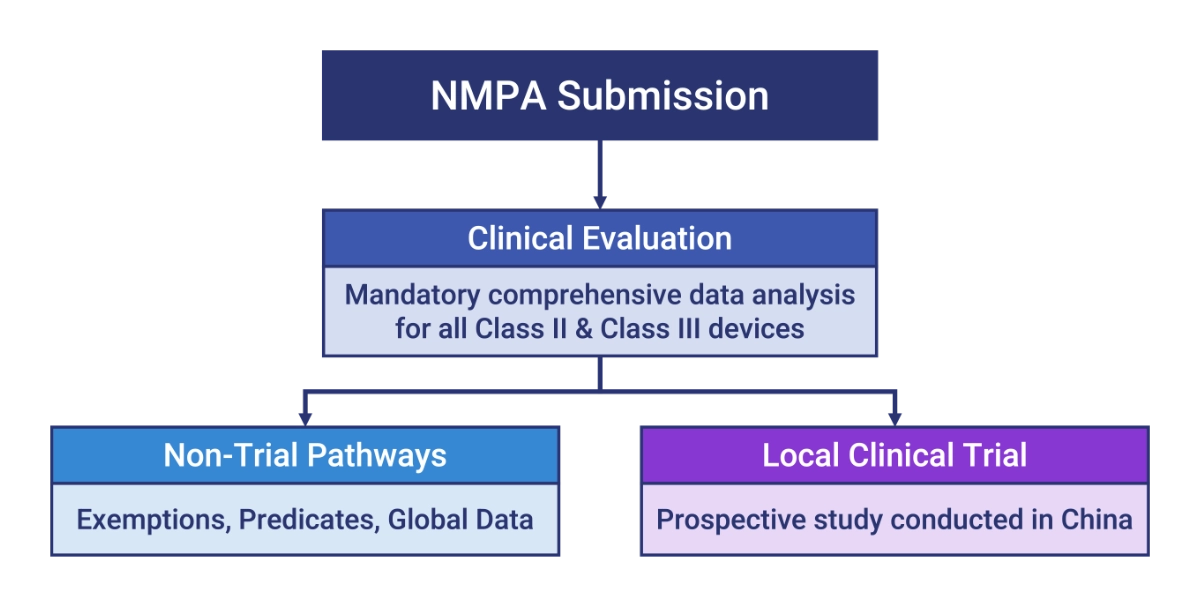
- Clinical Evaluation: The mandatory, comprehensive analysis of clinical data required for all Class II and Class III medical devices.
- Clinical Trial: A specific, prospective empirical study designed to generate new data only when existing evidence is insufficient.
Therefore, the requirement for a clinical evaluation does not automatically mean that an NMPA clinical trial is required.
The real question is: Is the available clinical evidence sufficient, relevant, and applicable to support NMPA registration?
Answering that question starts with your device's risk classification in China.
NMPA Risk Classification Sets Your Clinical Evidence Baseline
Before reviewing your existing clinical data, confirm the device's official NMPA classification.
China generally divides medical devices into three risk classes, and classification determines the applicable regulatory pathway and clinical evidence requirements.
Practical tip: Never assume your US FDA clearance or European CE Mark transfers on a 1:1 basis. The NMPA frequently categorizes risk differently. However, even a high-risk Class III designation does not automatically trigger a mandatory local trial if your existing clinical evidence is sufficiently robust and applicable.
For more information, see our guide on How Risk Classification Determines Your NMPA Pathway.
How to Determine Whether an NMPA Clinical Trial Is Required
Once you confirm that a Clinical Evaluation is required, how do you determine where your existing data package is sufficient?
Rather than defaulting to a clinical trial, manufacturers should assess their clinical evidence systematically to find the most direct path to compliance:
- Stage 1: The Exemption Check – Assess whether your device code is listed on NMPA’s official Clinical Evaluation Exemption Catalogue to qualify for a simplified exemption pathway.
- Stage 2: Non-Trial Evaluation Audit) – If non-exempt via the catalogue, audit whether safety and effectiveness can be proven without a local trial by: (1) conducting non-clinical evaluations (e.g., bench testing) where such evidence is sufficient; or (2) evaluating clinical trial and clinical use data from a predicate medical device, overseas trials, and published literature.
- Stage 3: Data Gap Bridging – If (and only if) an unresolvable evidence gap remains, regulators require you to generate fresh supplemental data, which may trigger a local clinical trial in China.
Because navigating these multiple evidence streams can be complex, many manufacturers partner with regulatory specialists like Cisema to compile a Feasibility Study Report (FSR). This structured analysis rigorously evaluates predicate data, overseas clinical results, and real-world evidence against NMPA standards to map out the most efficient route forward.
Ultimately, the decision to conduct a China clinical trial should only be made after completing this comprehensive assessment, rather than assuming every Class II or Class III device automatically requires a local study.
To help you navigate this process, let’s explore the specific non-trial pathways available during Stage 2 to clear the audit and bypass a local study entirely.
Four Ways to Build an NMPA Clinical Evidence Package Without a New China Trial
If a new local clinical trial is not required, manufacturers can explore several potential pathways for supporting their NMPA clinical evaluation.
Pathway A: NMPA Clinical Evaluation Exemption Lists
The NMPA periodically publishes official exemption catalogues. Where a device meets the applicable criteria, the exemption may eliminate the need for a full clinical evaluation.
However, never assume equivalence based solely on commercial similarities. The NMPA demands explicit structural and functional alignment with catalogue criteria.
Pathway B: Predicate or Equivalent-Device Evidence
Where an exemption does not apply, manufacturers may be able to support the clinical evaluation through comparison with a legally marketed predicate or equivalent device in China.
The NMPA evaluates equivalence across several key dimensions:
- Intended use and clinical indications
- Therapeutic mode of action
- Structural design and materials
- Technical specifications and performance parameters
The greater the differences between the subject device and the reference device, the more extensive the justification may need to be.
A common challenge for foreign manufacturers is accessing the technical and clinical information needed to establish equivalence. Competitor device dossiers may not be readily available, making an equivalence strategy difficult without sufficient proprietary or publicly available reference data.
Pathway C: Leveraging Overseas Clinical Trial Data
Under NMPA guidelines, clinical data generated outside China can directly support domestic registration, provided it satisfies strict methodological and demographic standards.
To be accepted, your foreign data package must meet four essential criteria:
- Ethical and Legal Principles: The trial must adhere to recognized ethical principles and relevant legal requirements. Specifically, overseas trials must fully comply with Chinese regulations and technical guidance.
- Endpoint Alignment: Clinical study endpoints must directly align with your Chinese registration claims.
- GCP Compliance: Studies must strictly adhere to international Good Clinical Practice (GCP) standards.
- Ethnic Considerations: You must evaluate intrinsic factors (e.g., genetics, physiology) and extrinsic factors (e.g., medical practices, environment) to prove that population differences do not alter safety or performance in Chinese patients.
Importantly, clinical data used to support an FDA clearance, PMA, or European CE Mark do not automatically become acceptable NMPA clinical evidence. What matters is the quality, relevance, and applicability of the underlying data.
Pathway D: Real-World Data (RWD) & Literature
Published clinical literature, real-world data (RWD), and observational evidence can also bridge target gaps in your evidence package.
Real-world evidence can be particularly useful when it addresses specific clinical evidence gaps that cannot be adequately resolved through existing clinical studies.
Foreign manufacturers may also consider China's Hainan Boao Lecheng International Medical Tourism Pilot Zone, which provides a specialized regulatory environment where certain imported medical products can be used under specific conditions and relevant clinical experience may potentially be generated.
The applicability of such data to an NMPA registration strategy should be assessed on a case-by-case basis.
When Is a Medical Device Clinical Trial in China Necessary?
The need for a trial should emerge from an evidence assessment. If the device does not qualify for an applicable exemption and the existing clinical evidence does not adequately demonstrate safety and effectiveness, additional clinical evidence may be required.
For some medical devices, the remaining evidence gap can be addressed through targeted supplemental analysis, testing, or additional data.
For others — particularly novel medical devices, first-of-kind technologies, high-risk devices, or products with new clinical claims — a local clinical trial in China may be necessary.
If your existing global clinical package already answers the relevant clinical questions, conducting a new medical device clinical trial in China may create unnecessary cost and delay.
What Does Executing a Medical Device Clinical Trial in China Involve?
When an evidence audit proves a trial is unavoidable, strategy shifts into execution.
A successful medical device clinical trial in China requires careful planning across several stages:
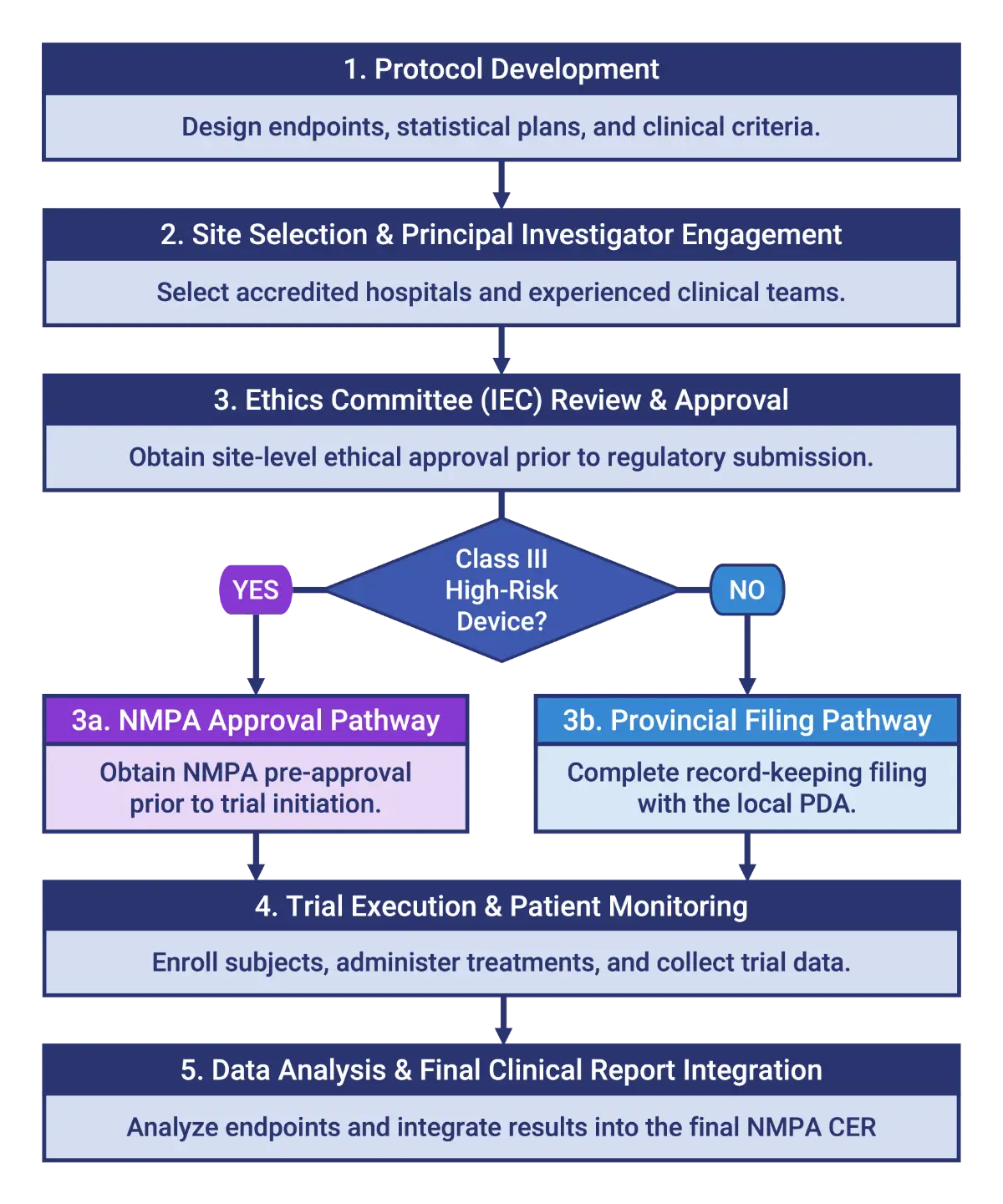
1. Clinical Trial Protocol Development
Developing a targeted protocol to directly address the evidence gaps identified during clinical evaluation. This stage involves defining the study objectives, design, endpoints, methodology, patient population, and statistical plan to generate data supporting the intended NMPA registration claims.
Because getting this right out of the gate is critical, many manufacturers engage a regulatory specialist, like Cisema, for clinical trial protocol design tailored specifically to NMPA expectations.
2. Clinical Trial Sites and Investigators
Selecting and contracting qualified Chinese trial sites and principal investigators based on factors such as:
- Device characteristics
- Study design
- Target patient population
- Clinical expertise
- Site capabilities
- Recruitment potential
- Experience with medical device clinical trials
Appropriate site selection helps ensure that the China clinical trial can be conducted efficiently while generating reliable and relevant clinical data.
3. Ethics Committee Review and Regulatory Filing / Approval
Obtaining Institutional Ethics Committee (IEC) approval and completing the required regulatory procedures prior to trial initiation:
- Provincial Regulatory Filing: Ordinary medical device clinical trials are subject to filing (record-keeping) management with the provincial drug regulatory authority where the trial site is located.
- NMPA Regulatory Approval: Clinical trials for Class III medical devices with relatively high human risk strictly require formal approval from the NMPA before the study may begin.
The precise requirements should be confirmed based on the device, its classification, intended use, and the applicable NMPA regulations.
4. Clinical Trial Execution
Conducting required preclinical or animal safety studies when applicable (particularly for implants and certain other high-risk medical devices), followed by:
- Patient recruitment and enrollment
- Device implantation, use, or treatment
- Clinical observation and follow-up
- Safety and effectiveness assessments
- Clinical data collection
- Data management and monitoring to maintain GCP compliance
Preclinical or animal studies may also be required as part of the overall safety assessment.
5. Clinical Data Analysis and Final Report
Analyzing trial data against the predefined statistical plan upon completion, compiling the outcomes into a final clinical trial report, and integrating the resulting evidence into the clinical evaluation dossier to demonstrate safety and effectiveness for NMPA registration.
Final Thoughts: Start With the Evidence, Not the Trial
Before locking in budget for a local China clinical trial, take a step back: auditing your current clinical portfolio first could reveal a faster, far more cost-effective path to NMPA approval.
Navigating NMPA review independently often brings unforeseen friction. Equivalence claims frequently stall over local predicate data, foreign trial results demand precise positioning to avoid redundant studies, and managing local testing can rapidly derail launch timelines.
This is where a specialized regulatory partner like Cisema makes the difference. With more than two decades of on-the-ground experience in China, we bridge the gap between your existing clinical data and NMPA expectations. We help you map out the fastest, most efficient route to market entry, whether through a compiling a targeted Feasibility Study Report, crafting a winning Clinical Evaluation Report (CER), managing local type testing, or acting as your official NMPA Legal Agent.
If a local trial proves truly unavoidable, Cisema manages the full study lifecycle from end to end, including clinical trial protocol design, ethics submissions, GCP monitoring, and statistical reporting.
Before committing to a medical device clinical trial in China, contact Cisema to assess your existing clinical evidence and identify the most efficient path to NMPA approval.
Further Information
- Explore Cisema’s services for China medical device clinical trials.
- Discover key tactics to avoid costly delays and streamline your registration in our article on how clinical trial strategy affects NMPA approval timelines.
- Pinpoint your clinical evidence requirements with our article on how medical device risk classification determines your NMPA registration pathway.
- Watch a step-by-step breakdown of NMPA compliance for foreign manufacturers in our free webinar on how to register medical devices in China 101.
China Local Clinical Trial FAQs
1. Does Every Class III Device Require a Clinical Trial in China?
Not necessarily. While most Class III devices are expected to undergo clinical trials, exemptions may apply if the manufacturer can demonstrate substantial equivalence to an approved Chinese predicate device or provide sufficient clinical evaluation data. The NMPA assesses exemption eligibility case by case. A detailed clinical evaluation report is always required, even when a new trial is not.
2. Can Overseas Clinical Trial Data Be Used for China Registration?
Yes, overseas clinical data may be accepted if the study complies with Good Clinical Practice standards and demonstrates relevance to the Chinese population. The manufacturer must justify demographic applicability, medical practice comparability, and product consistency. If gaps are identified, the authority may require supplemental local data or bridging studies conducted in China.
3. How Do I Know If My Device Is on the Clinical Trial Exemption Catalog?
Manufacturers must first confirm their product’s official classification code and then compare it against the published clinical trial exemption catalog. Exact alignment of intended use, technical characteristics, and risk profile is required.
4. Are IVD Products Subject to the Same Clinical Trial Requirements?
IVD devices follow a related but distinct pathway. Manufacturers must first confirm their product’s official classification code, too. Then manufacturers should confirm whether the product is within the IVD clinical trial exemption catalog. If so, non-GCP clinical testing is required to evaluate product performance; If not, GCP clinical trials are required to evaluate the product's safety and efficacy.
5. How Long Does a Clinical Trial in China Typically Take?
When required, a medical device clinical trial in China generally takes 12–24 months, depending on product complexity, patient recruitment speed, and site availability. This timeline includes Clinical Trial Application approval, ethics review, enrollment, monitoring, and data analysis. Early feasibility assessment can significantly reduce overall registration delays by identifying exemption opportunities or documentation gaps in advance.
Regulatory References
- Announcement of the National Medical Products Administration and National Health Commission on the Release of the 'Good Practice for Clinical Trials of Medical Devices' (2022 No. 28)《国家药监局 国家卫生健康委关于发布《医疗器械临床试验质量管理规范》的公告(2022年第28号)》
- Announcement of the National Medical Products Administration on Issuing the List of In Vitro Diagnostic Reagents Exempt from Clinical Trials (2025) (No. 23 of 2025) 《国家药监局关于发布免于进行临床试验体外诊断试剂目录(2025年)的通告(2025年第23号)》
- Announcement of the National Medical Products Administration on the Issuance of Five Technical Guidelines for Clinical Evaluation of Medical Devices and Five Other Guidelines (2021 No. 73) 《国家药监局关于发布医疗器械临床评价技术指导原则等5项技术指导原则的通告(2021年第73号)》
- Classification Rules for Medical Devices (Order No. 15 of the National Medical Products Administration)《医疗器械分类规则》(国家食品药品监督管理总局令第15号)
- Guideline for Registration Review on Clinical Trial Data Submission Requirements for Medical Devices《医疗器械临床试验数据递交要求注册审查指导原则(2021年第91号) 》
- Measures for the Administration of Medical Device Registration and Filing《医疗器械注册与备案管理办法》
- Regulations on the Supervision and Administration of Medical Devices《医疗器械监督管理条例》
- Technical Guideline for Accepting Overseas Clinical Trial Data of Medical Devices《接受医疗器械境外临床试验数据技术指导原则(2018年第13号)》
- Technical Guideline for Comparative Description of Products Listed in the Catalogue of Medical Devices Exempt from Clinical Evaluation《列入免于临床评价医疗器械目录产品对比说明技术指导原则(2021年第73号)》
- Technical Guideline for Decision on Whether to Conduct Clinical Trials of Medical Devices《决策是否开展医疗器械临床试验技术指导原则》(2021年第73号)
- Technical Guideline for the Use of Real-World Data in Clinical Evaluation of Medical Devices《真实世界数据用于医疗器械临床评价技术指导原则(试行)(2020年第77号)》
Connect with Cisema
With more than 20 years of experience and a team of over 100 specialists, Cisema helps global companies achieve compliance across Asia Pacific with confidence and accelerate market entry.
Stay Informed with Monthly News and Analysis
Stay informed with the latest regulatory changes, expert insights, and market opportunities across APAC, delivered straight to your inbox.
Related Articles
Find out when a clinical trial is required in China and when clinical evaluation, exemptions, overseas data, or other evidence may be sufficient.

Understand Indonesia’s foreign halal certificate requirements, including covered categories and BPJPH registration routes.

Learn how MARA imported feed registration in China works: Product eligibility, registration requirements, China-based agents, testing and more.