
News

The SAMR issued technical guidelines concerning toxicology, strains used, physicochemical properties and hygienic indicators for health food products

Since the implementation of the CSAR (Cosmetics Supervision and Administration) was officially announced in June 2020, China has been preparing for the regulation to become effective on January 1, 2021. In November 2020, the NMPA (National Medical Products Administration) released 5 regulatory updates to support the CSAR. We have summarised these below.
Draft instructions for cosmetic registration and filing dossiers
In order to implement the CSAR, this draft includes a total of 6 chapters and 57 articles to further clarify and refine the specific information requirements for cosmetics registration and filing.
The CSAR requires the manufacturers to register their special cosmetic products with hair coloring, hair perming, freckle whitening, sunscreen, anti-hair loss functions or with new efficacy claims, whilst filing would be required for general cosmetics (in the past referred to as non-special cosmetics).
The public consultation period is open until November 30, 2020.
Draft instructions for new cosmetic ingredient registration and filing
This draft includes a total of 28 articles addressing the requirements for the registration and filing for new cosmetic ingredients:
- Registrants are responsible for the safety monitoring of the new cosmetic ingredients and required to submit an annual report for three years
- Registration will be required for new cosmetic ingredients with higher risk functions such as antiseptics, sun protection, hair coloring, freckle removal, whitening, etc., while filing will be required for other cosmetic ingredients
The public consultation period is open until November 30, 2020.
Draft guidelines for cosmetic efficacy claim evaluation
This draft consists a total of 22 articles to provide technical guidance on the evaluation of efficacy claims for the cosmetics industry. Different types of efficacy claims require their own evaluation method and are identified in the draft to ensure their scientific character and accuracy.
The public consultation period is open until November 30, 2020.
Draft measures for the management of cosmetic supplementary testing methods
This draft consists of 6 chapters and 29 articles covering the scope, procedures, guidelines and rules of cosmetic supplementary testing methods. Such supplementary testing methods will be applied for sampling inspections, quality and safety investigations and adverse reaction investigation.
The public consultation period is open until December 10, 2020.
Draft administrative measures on toothpaste products
This draft consists of 23 articles addressing the requirements of ingredients, product filing and efficacy evaluation of toothpaste products:
- If the toothpaste product uses a new ingredient for the first time in the market, the registrant must ensure that a mandatory technical standard is implemented before marketing. If there is a standard already, only the safety evaluation report of the ingredient would be required for submission
- The NMPA will formulate the classification catalogue for efficacy claims and keep it updated in a timely manner
- There should be sufficient and reliable scientific evidence to support the efficacy claims
- The product labelling should not claim to have medical effects in an expressive or implicit manner
- Any violations including, but not limited to, the following will be punished:
- Not registering or filing the product as required
- Illegal use of other ingredients
- Violation of labelling requirements
- Not verifying the efficacy claims as required
The public consultation period is open until December 12, 2020.
If you are interested in making a public submission, please share your opinions with us before the consultation period ends.
By Jacky Li. Contact Cisema if you would like to learn more.
The draft guidelines cover real-time fluorescent PCR analyzers, disposable non-absorbent closure clamps, nanomaterials, and intravascular catheters

Industry requirements, evaluation methods and testing guidelines cover bone implants, medical imaging devices, SaMDs, surgical equipment, test kits, etc.
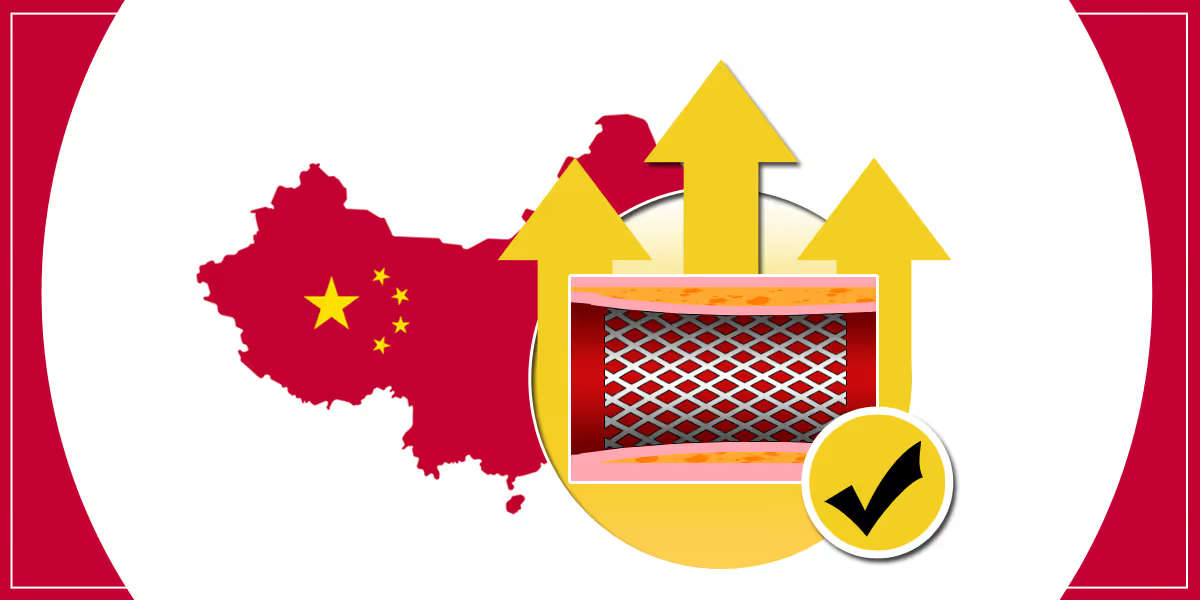
The NMPA announced 6 principles to strengthen the market surveillance of coronary stents following the centralized procurement process

The CMDE prepared a brief analysis as reference for manufacturers planning to register their drug-device combination products in China

During the past month, the NMPA and CMDE were actively involved in facilitating the fast-track approvals for medical devices in the Chinese market.

Once the sampling inspection procedures in the recent draft amendment is finalized, the NMPA Legal Agents will play a more important role.
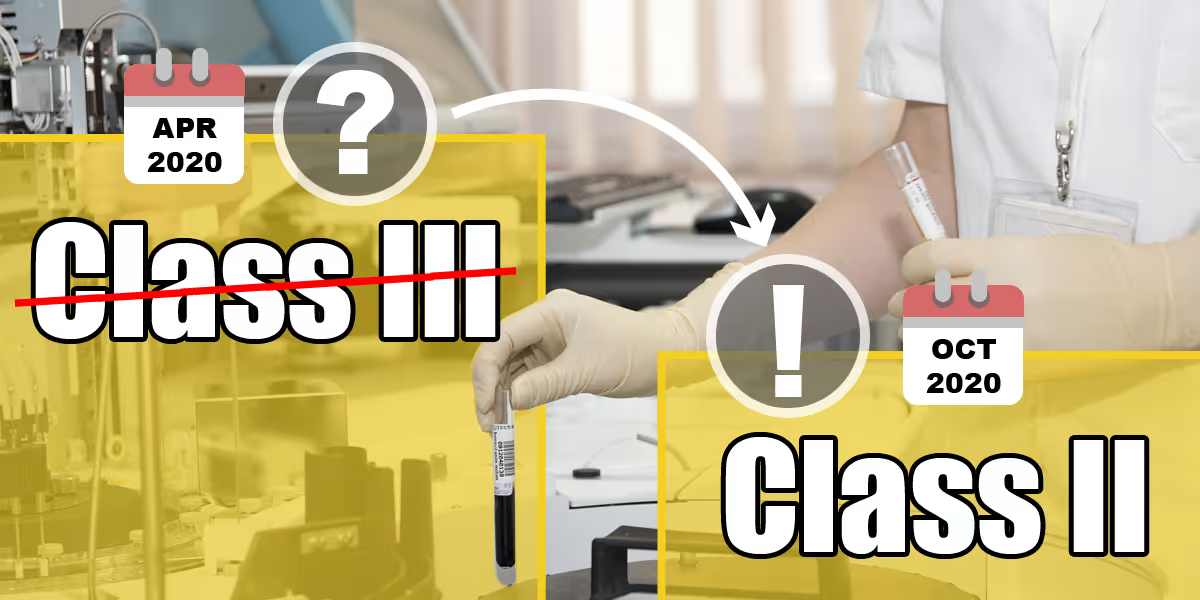
NMPA’s recent release of the updated product information of 29 IVD reagents, primarily to down-classify from class III to class II, was long overdue.

The NMPA will issue both electronic and paper certificates to successful registrants during a trial period from October 19, 2020 to August 31, 2021.
This accreditation now means that biological compatibility testing of medical devices conducted in China will more readily be recognized globally.

The CMDE is drafting pre-market evaluation guidelines for AI software in diagnostic pathology to support China’s upcoming 5-year plan
International Medical Device Regulator Forum Accepts China’s Proposal on “Post-Market Clinical Follow-Up Studies” and Seeks Industry Comment

4 draft regulations were released to support the implementation of the CSAR whilst the safety and technical standards for cosmetics will be amended.
In September 2020, the NMPA accepted 2 overseas applications from CooperVision and BIOMERIEUX for prioritized review and approval.
In September 2020, the NMPA issued technical review guidelines for medical devices including 3D-printed lower jaw prosthesis, customized bone implants, etc.

On September 14, the CMDE announced two new additions in the list of class III medical devices requiring clinical trials in China.
The NMPA updated the first batch of medical devices requiring UDI, and extended the UDID’s pilot phase to January 1, 2021

The NMPA optimizes the approval process for overseas manufacturers intending to produce their already registered class II or III medical devices in China.
The SAMR launched a public consultation on 6 draft documents covering technical requirements, manufacturing processes and excipients for health food filing.
Get in Touch with Our Consultants
And discover how we can support you.