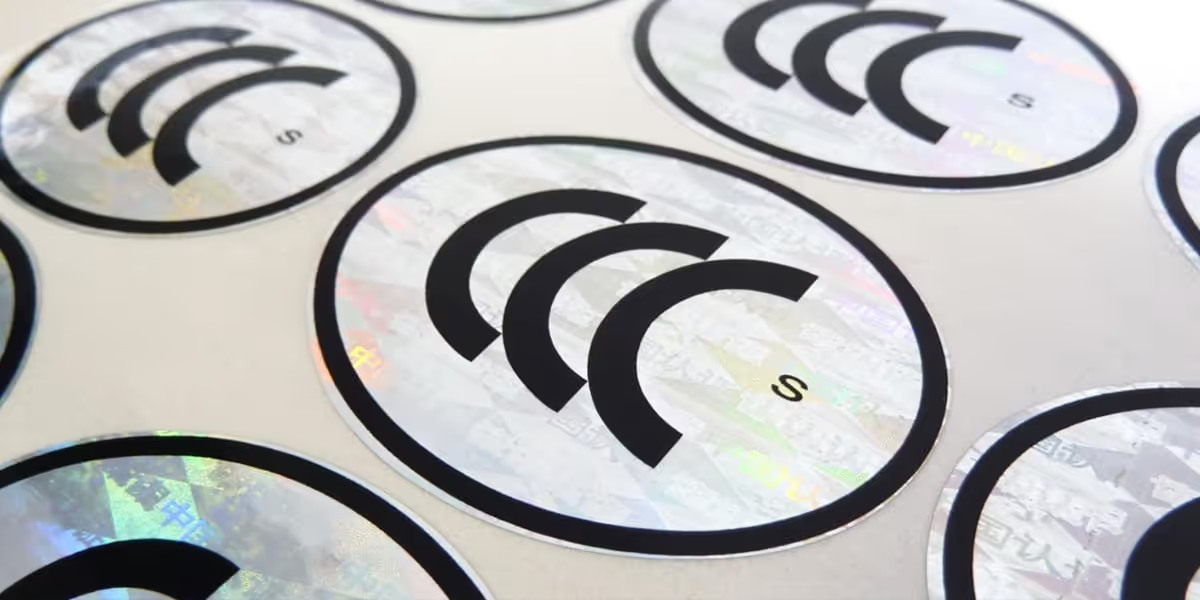
On 15.06.2018 the authorities SAMR and CNCA published in their announcement 11/2018 that for some product groups the mandatory certification according to CCC (China Compulsory Certification) is lifted and some others are going to be converted into a manufacturer's declaration.

On 15.3.2018 the certification authority CNCA (Certification and Accreditation Administration of the P.R. China) announced on short term (announcement 10/2018) that the issuance of Permissions of Printing (PoP) for marking products with the CCC-logo (China Compulsory Certification) will be stopped as of 20.03.2018. According to the announcement, the owners of CCC certificates can start the marking immediately after receipt of the CCC certificate, provided they adhere to the guidelines. This procedure is similar to other well-known certification marks like E, CE or UL.
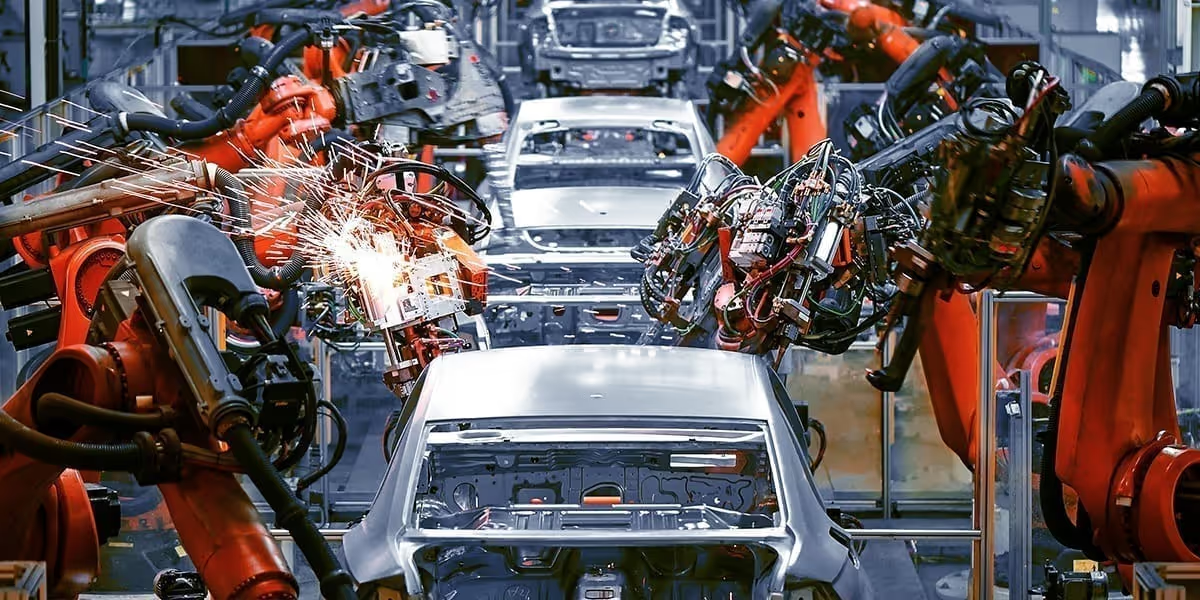
The CNCA (Certification and Accreditation Administration of the People's Republic of China) announced with its Notice No. 43-2017 that the CAQC (Cyberspace Administration of China) is allowed to process CCC (China Compulsory Certification) certification for product groups in the automotive sector.

Starting August 1st 2018 motorcycle helmets, electric blankets, heating pads and similar flexible heaters required the CCC certification of the P.R. China.
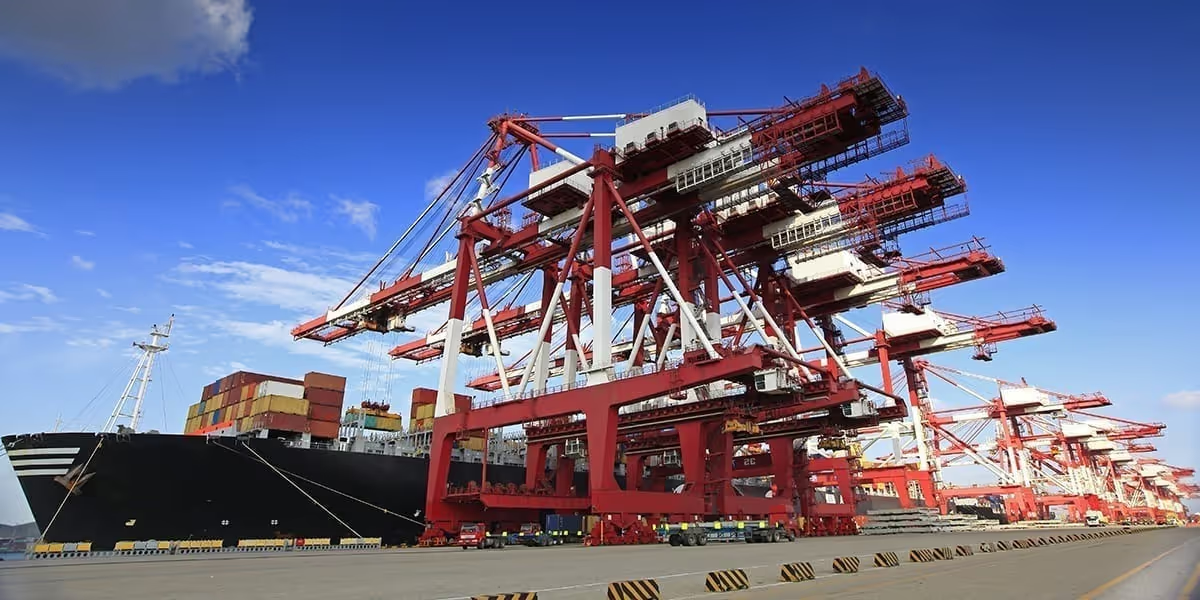
Online Trade - Deliveries Classified as Products for Personal Use.As of 1st January 2018 the Chinese customs authorities will treat all commodities traded through CBEC as articles for personal use. The reason is that commodities traded through CBEC are for private persons and usually have a low value and low quantities.Another five pilot cities for CBEC will be nominated: Besides Hangzhou, Tianjin, Shanghai, Chongqing, Zhengzhou, Guangzhou, Ningbo,Shenzhen, Fuzhou und Pingtan, there will now be added Chengdu, Dalian, Qingdao, Suzhou und Hefei.More details for the supervision will be published shortly. It can be assumed, however, that certain product groups which normally need registration or certification, can be traded and imported freely through CBEC. Among these commodities are:Ordinary cosmetics such as lotion, cream, facial mask, shampoo
It has not been decided yet if the new regulation also applies to infant formula.Further information on this topic can be obtained from:Cisema GmbHTel.: +49 89 4161 7389 – 00Fax: +49 89 7484 9956info@cisema.dewww.cisema.com

As of January 1, 2017, low volume imports will not be handled by the local CIQ any longer, but by the certification authorities.

The BJCIQ published a procedure where CCC-liable goods may be imported in small quantities without CCC certification.

CCC certification - dimensions of interior and insulation materials in the automotive sector further specified:On 01.01.2015 the new implementation guideline of the CNCA (Certification and Accreditation Administration of the People's Republic of China) for automotive interiors and insulating materials came into force (CNCA-C11-09:2014). With this regulation, a number of new components have been included in the scope of CCC certification (China Compulsory Certification). This led to an increase in the number of applications for CCC certification of products whose relevance was not clear.The competent Commission was therefore obliged to publish a further clarification of the Directive in December 2015. Based on last year's experience, especially with frame parts, components that completely cover a rectangle with the standard dimensions 356 x 100 mm are considered for certification. The final decision on compulsory certification clearly focuses on the geometry of the component. For example, a large component with several holes, one of which occupies more than 50% of the total area, may not be eligible for certification if the test sample cannot be cut in the required shape and size. In cases of doubt, the respective Chinese certification organisation makes an individual decision. Until now, smaller components were also accepted for certification if they reached the standard dimensions only in terms of length and width (e.g. in the form of a triangle). For affected components, certification can be maintained or cancelled if desired.Further information on the topics mentioned can be obtained from:Cisema China Certification GmbHTel.: +49 89 4161 7389-00Fax: +49 89 7484 9956info@cisema.dewww.cisema.de

The import of used machines to China will become much easier: AQSIQ (State Administration of Quality Supervision, Inspection and Quarantine) regulates the process anew with Communication No. 145 2014.Since the beginning of 2015, the complex and time-consuming application for the import of used machines at CIQ (China Inspection and Quarantine) has been eliminated.From now on, the Chinese customs tariff number can be used to determine whether it is possible to import a used machine or plant and which further steps are necessary for the import - for example, a pre-shipment inspection by the CCIC (China Certification & Inspection Group) or an Automatic Import License.The new regulation makes such exports easier to plan and significantly reduces the time and thus also the financial expenditure.Further information on the topics mentioned can be obtained from:Cisema GmbHTel.: +49 89 4161 7389 - 00Fax: +49 89 7484 9956info@cisema.dewww.cisema.de

China Adjusts Its Import Control for Child Safety Seats and Alloy Wheels.With announcement 147/2014 the “General Administration of Quality Supervision, Inspection & Quarantine of China” (AQSIQ) and the “General Administration of Customs of China” (GACC) the entry/exit inspection-quarantine requirements have been imposed on car seats for children as well as automotive alloy wheels/parts.As of September 1st 2015 child safety seats are also subject to the mandatory CCC-certification.For more information please contact us:Cisema China Certification GmbHTel.: +49 89 4161 7389 – 00Fax: +49 89 7484 9956info@cisema.de www.cisema.de

The Chinese certification authority CNCA (Certification and Accreditation Administration) has updated the list of product categories subject to CCC certification (China Compulsory Certification). Quite a few products have for instance been added to category 11 the “Motor vehicles and safety-relevant accessories”. It now includes insulation material in the engine compartment, floor mats, dashboards and devices for indirect vision. Category 20 “children products” now also contains child-seats.The previous 22 categories were reduced by two: Latex products and medical devices have been switched to NMPA (China Food and Drug Administration).Currently the CCC certification requirements apply to the following product groups:
If you have any more questions please contact us at:Cisema China Certification GmbHTel.: +49 89 4161 7389 - 00Fax: +49 89 7484 9956info@cisema.dewww.cisema.com

As of 01.01.2015 the new implementation rules for vehicles and their components came into force. The update has been published on CNCA’s (China National Certification Administration) homepage in Chinese. On the basis of this general regulation the two relevant certification organizations CQC (China Quality Certification Centre) and CCAP (China Certification Centre for Automotive Products) have compiled their own detailed guidelines. They apply in addition to the general set of rules and are at the moment available in Chinese only.Affected CCC certificates need to be updated before 31.12.2016. There are also a couple of products that have not been within CCC-scope but are now (for instance dashboards, floor mats, interior trimming material, rear view cameras), they have to get their certificate before the end of 2015 or else they are no longer allowed to be imported into China or distributed there.For more information please contact us:Cisema China Certification GmbHTel.: +49 89 4161 7389 – 00Fax: +49 89 7484 9956info@cisema.dewww.cisema.com
And discover how we can support you in getting your products certified for China.