
News

The Chinese authorities CNCA and SAMR announced on 03.12.2018 that several product groups will no longer be subject to CCC certification...
For products that are no longer relevant for CCC (Chinese product safety certification) since June 15, 2018, new guidelines for voluntary certification have been published. Specifically for brake hoses/pipes, fuel tanks and fanfare for motor vehicles; motorcycle engine and e-bikes.
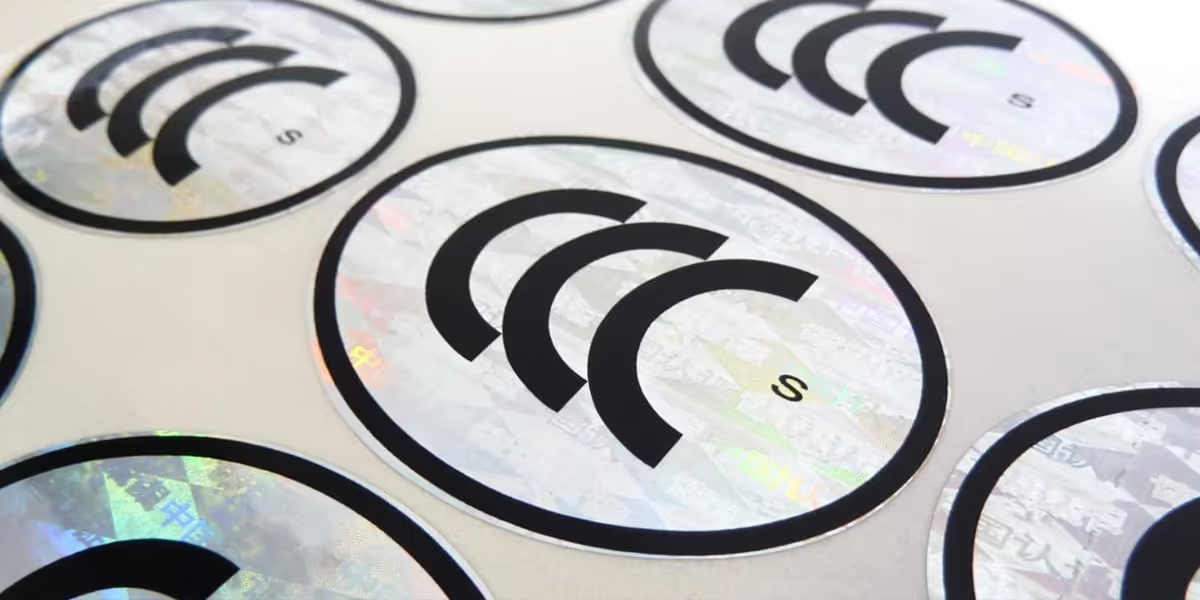
On 15.06.2018 the authorities SAMR and CNCA published in their announcement 11/2018 that for some product groups the mandatory certification according to CCC (China Compulsory Certification) is lifted and some others are going to be converted into a manufacturer's declaration.
On 15.3.2018 the certification authority CNCA (Certification and Accreditation Administration of the P.R. China) announced on short term (announcement 10/2018) that the issuance of Permissions of Printing (PoP) for marking products with the CCC-logo (China Compulsory Certification) will be stopped as of 20.03.2018. According to the announcement, the owners of CCC certificates can start the marking immediately after receipt of the CCC certificate, provided they adhere to the guidelines. This procedure is similar to other well-known certification marks like E, CE or UL.

On 05.02.2018, the NIFDC (National Institutes for Food and Drug Control) – a unit under the NMPA (China Food and Drug Administration) – published a draft on two alternatives to animal testing: One for skin and one for eye irritation. The draft was open for public comment until 15.02.2018 and clearly indicates a major step towards the improvement of China’s technical cosmetics regulations and the replacement of animal testing in the future.
The CNCA (Certification and Accreditation Administration of the People's Republic of China) announced with its Notice No. 43-2017 that the CAQC (Cyberspace Administration of China) is allowed to process CCC (China Compulsory Certification) certification for product groups in the automotive sector.
On 17.11.2017 the NMPA (China Food and Drug Administration) published a notice announcing that fee-charging tests (also referred to as sponsored tests) are accepted as part of the NMPA registration of medical devices (No. 2017-187).
Cisema gave a talk on medical device registration as part of the webinar on hosted by the U.S. Commercial Service on December 13, 2017.

Cisema celebrates its 15th annversary: Over the years Cisema has developed a range of services with the main focus on certification, registration and licensing in the People's Republic of China. Since China’s WTO accession, the Chinese government has made great efforts to adapt non-tariff trade barriers to international guidelines.
Starting August 1st 2018 motorcycle helmets, electric blankets, heating pads and similar flexible heaters required the CCC certification of the P.R. China.
Enhanced Acceptance of Foreign Clinical Trial Data. On 08.10.2017, the CPC Central Committee and State Council published “Deepening the Reform of the Examination and Approval System and Encouraging the Innovation of Pharmaceutical and Medical Devices (Draft for Comment)”. According to this, NMPA plans to accept foreign clinical trial data if it complies with Chinese requirements.NMPA comments on the following aspects of clinical trial management:
- Speeding up the review and approval of market entry
- Promoting drug innovation and generic drug development
- Strengthening the lifecycle management of pharmaceutical and MD
- Improving technical support
- Strengthening organization and implementation
NMPA Released a Note about Standardizing the Classification of Medical Devices. On 10.10.2017 the NMPA (China Food and Drug Administration) introduced in its Notice No. 2017/127 a specific work flow for the classification of medical devices, which applies to newly developed medical devices that had not yet been included in the "Medical Device Catalogue". The regulation officially comes into force on 01.08.2018 but experience has shown that it will probably be applied in practice earlier than this.

During the meeting of the Chinese State Council on 20.09.2017, it was decided to extend the CBEC Policy Grace Period for a second time. The regulation allows the introduction of unregistered cosmetics, medical devices, infant formulas and health foods into Chinese cross-border cities until 31.12.2018.
The NMPA published a new classification catalogue on August 31, 2017, with reference to more than 2,000 medical device examples.
China RoHS 2.0 „Compliance Management Catalog“ progressing to next phase.On February 3rd 2016 the responsible authorities (published an update on the regulation for hazardous substances - RoHS 2.0. The regulation is effective since July 1st 2016 (we reported).Originally a „Compliance Management Catalog“ was scheduled for publishing in October 2016. The content should provide a definition, whether a mandatory registration, and possibly an inspection of the manufacturer, will be introduced. So far there was no progress. On July 28th 2017 a consultation of the authority MIIT with business representatives ended. We expect to receive further information about the future approaches for China RoHS by end of this year.For further information please contact:Cisema China Certification GmbHTel.: +49 89 4161 7389 00Fax: +49 89 7484 9956info@cisema.dewww.cisema.de

AQSIQ is planning to introduce an official certificate of clearance for all food imports.On 1.10.2017 announcement 83 2017 issued by AQSIQ (Administration for Quality, Safety, Inspection and Quarantine of China) will come into force. From then on, all food exported to China must be accompanied by an official certificate of clearance, which is to be issued by the competent authorities in the country of origin. Up to now, AQSIQ has not communicated any details, like which authorities are accepted by AQSIQ or which information is to be contained in the certificate.Many of China's trade partners have already filed a note of protest at WTO against this regulation and the feasibility of the Chinese plans is most uncertain according to expert opinions.We shall inform you immediately, if there are any news on the certificate of clearance.For further information please contact:Cisema GmbHTel.: +49 89 4161 7389 00Fax: +49 89 7484 9956info@cisema.dewww.cisema.com
NMPA has Formulated Confidentiality Measures in Regards to Review and Approval of Drugs and Medical Devices.
In order to protect the rights and interests of the manufacturer of pharmaceuticals and medical devices, NMPA (China Food and Drug Administration) issued a code of confidentiality for all employees involved in the registration process.According to the code, all employees involved in a registration process must sign a confidentiality agreement, whose compliance is strictly monitored. Should an employee be in violation of the agreement, he will be punished. Depending on the severity of the failure, the consequence is a disciplinary punishment which can range from a written warning or dismissal up to legal action against the employee.If the applicant of the registration can prove that the information disclosed by relevant staff or expert leads to losses, he has the right to file a lawsuit.If the NMPA pays a compensation according to the judgment of people's court, they will reclaim part or all of the compensation costs from the violating employee or expert.For further information please contact:Cisema GmbHTel.: +49 89 4161 7389 00Fax: +49 89 7484 9956info@cisema.dewww.cisema.com
Simplifications of clinical studies for medical devices and pharmaceutical products in China.On 11.05.2017 NMPA (China Food and Drug Administration) issued two announcements – no. 2017-52 and -53 – handling the simplification of clinical studies in China. Medical devices and pharmaceutical products can thus be launched in China much easier.1. Policies about promoting market approval of new and innovative drugs and medical devices:This proposal refers particularly to innovative treatment methods for life-threatening diseases. If such a product turns out to be successful at an early stage of the clinical study, it can be put on the market with reservations even before the clinical study has been finished.2. Policies about administration of clinical trials on the innovation of medical devices and drugs:This is an initiative which allows all hospitals and medical institutions to carry out clinical studies in China, which, up to now, only specially accredited hospitals of the highest category, were allowed to do. In the future, a medical institute only has to register on the NMPA website, in order to be allowed to perform clinical studies.Furthermore, the draft allows clinical studies which were performed abroad to be used for product registration in China, as long as they comply with the “Requirements of the NMPA Drugs and Medical Device Registration”. The only exception are eight Class III high risk medical devices like implantable cardiac pacemakers, blood pump, infusion pump for medicines, stents, artificial organs and orthopedic components (see NMPA Notice 2014/14 ).On 17.05.2017 the draft of the third revised list for medical devices exempted from clinical studies was issued. It contains 22 class II and 6 class III products.These measures will give Chinese patients a faster access to innovative and improved treatments and reduce the launching costs.NMPA has used much effort in the past years to make the registration process more efficient and safe. The number of employees working for registration was increased by 450 in a period between mid-2015 and end of 2016, which means a fourfold increase.In April this year the Supreme People’s Court of the People’s Republic of China announced a new interpretation of the criminal code, according to which persons who forge clinical studies are facing severe punishment. If a drug, which was registered with forged clinical studies and caused injury to a patient’s health, the forger faces a 10 years’ imprisonment – if the patient dies, even a death sentence is possible. Even if the drug in question was not registered and did not cause any harm, the submission of falsified registration documents is punished with a 3 years prison sentence. Should any organizations entrusted with the performance of clinical studies be involved in any fraud, their accreditation will be cancelled.For further information on the above topics, please contact:Cisema GmbHTel.: +49 89 4161 7389 – 00info@cisema.dewww.cisema.com

The NMPA rules for infant formula registration was issued on June 8, 2016 whilst its online-platform was launched on November 22, 2016.
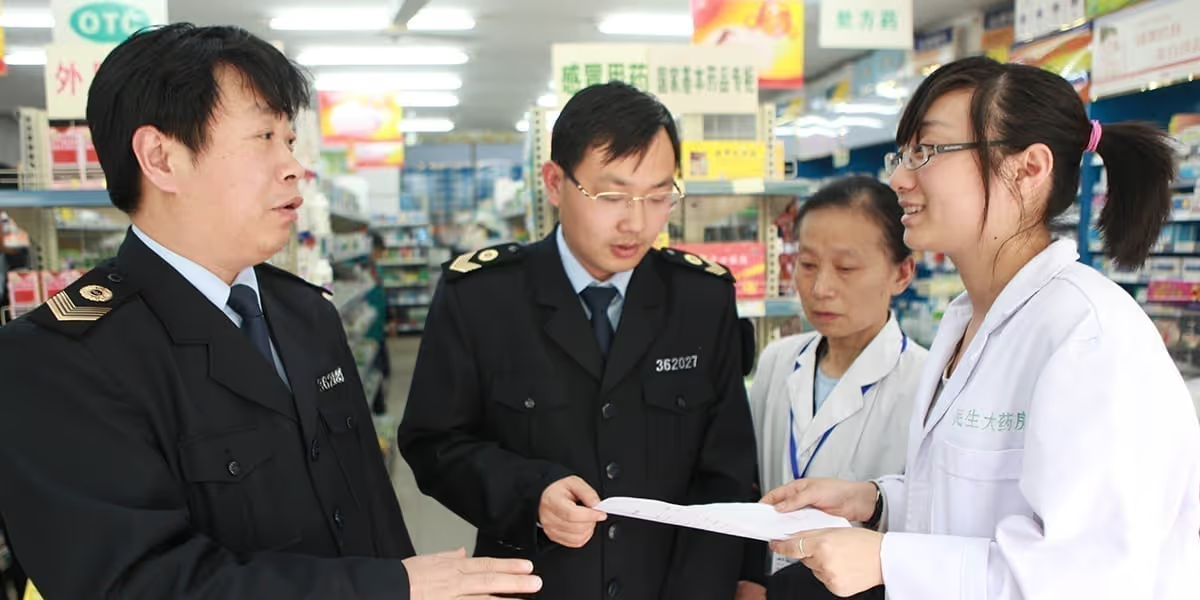
China Food and Drug Administration (NMPA) report on registration of medical devices in China.NMPA recently published its Annual Report 2016 on medical device registration. The number of registrations in Class II, III and IVD has increased to 8.653, which is a plus of 14.9 % compared to the previous year. The retracement suffered in 2015 was due to the various regulatory changes dating back to 2014 as well as the increase of application fees in 2015, but the current figures have reached the 2014 level again.A large percentage of applications for the registration of medical devices and IVD comes from abroad. Class II had 3.095 applications from abroad, which is an increase of 2% compared to 2015 and in Class III there were 2.818 applications, an increase of even 15%.The P.R. China continues to promote the import of high-end and high-cost medical devices from abroad. The top five class II and III product groups of foreign origin to be registered in 2016 were:
- Implanted material and artificial organs (509) – was on place 2 in 2015
- Medical optical instruments, devices, and endoscopes (406)
- Medical electronic instruments and devices (285)
- Medical polymer material and products (249)
- Devices and instruments for OR, IR, and Doctor’s consulting room (141) – superseded dental care equipment.
According to the NMPA report 2016, top of the list of registrations of foreign class II and III products (including IVD) were the USA followed by Germany, places 3, 4 and 5 were held by Japan, United Kingdom and Korea.Further information concerning this topic can be obtained from:Cisema GmbHTel.: +49 89 4161 7389–00Fax: +49 89 7484 9956info@cisema.dewww.cisema.com
Get in Touch with Our Consultants
And discover how we can support you.